

Spotlight On: Merodie Hancock, President, Thomas Edison State University
Key points:
- • New student enrollment shows double-digit growth as the digital campus is rebuilt.
- • Accelerated nursing graduates rose about 88% at the latest graduation.
- • The state budget removed aid for part-time students; TESU seeks reinstatement.
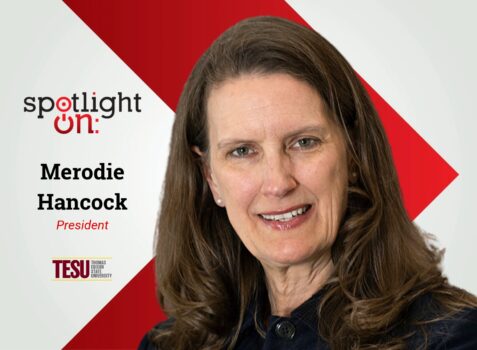 November 2026 — In an interview with Invest:, Merodie Hancock, president of Thomas Edison State University, discussed adult learning, healthcare workforce pathways, and the university’s response to changing technology and financial pressures. “Finishing a degree is a long, demanding commitment. We need a permanent solution for state aid so students don’t face sudden changes in their funding,” Hancock said.
Join us at caa’s upcoming leadership summits! These premier events bring together hundreds of public and private sector leaders to discuss the challenges and opportunities for businesses and investors. Find the next summit in a city near you!
Which changes have had the greatest impact on Thomas Edison State University over the past year?
One of the largest changes has been the change in the administration. The Sherrill administration has come in focused on job growth at all levels. That matters to us because our students are older and already in their careers, and our work is closely connected to job growth.
Her leadership team has been interested in working with Thomas Edison to make sure people get the training and credentials they need. We don’t try to be all things. Rather, we focus on adults in applied professions and the trades. We’re working on the coordination between training, certification, and job growth to help strengthen New Jersey’s workforce.
What progress have you made in rebuilding enrollment and your digital campus?
We lost 2,000 students during COVID, so rebuilding has required a purposeful focus on students’ needs. In the past few years, we’ve seen those efforts paying off. We had double-digit growth in new students last year, and four months into the new academic year, we’re again well into double-digit growth in new students.
Nursing is a particular area of growth. The number of new nurses we prepare has grown by 300 hundred percent over the past couple of years.
We’re also entirely rebuilding our digital campus. Our accelerated nursing program is in-person, but everything else is online, so our campus is largely digital. We’re about halfway through an aggressive three-year plan and our students are already experiencing the benefits.
Modernizing our entire technology stack makes us rethink how we do everything. It gives us an opportunity to ask what students, employers, and graduates are looking for after COVID and to build around those needs.
How are four-week courses changing the options available to adult learners?
Thomas Edison was built around adult learners. Students told us they wanted to move quickly through some courses, particularly when they already had experience but needed the theory behind it. We created several four-week courses in response.
We thought we might see a couple hundred enrollments, but we are well into a thousand per term. Students can accelerate through a class or use a quieter period at work to concentrate on a course and finish it. These courses haven’t displaced our other offerings. They give students another option to accelerate part of their degree when they want to.
How are you integrating AI into learning and student support?
We’re incorporating AI into the digital campus, general education, and individual disciplines.
Our students are in the workplace, where employers generally expect them to use AI to advance their work. We want them to understand how to use it, including its risks and ethical considerations. They need to be honest about their work and transparent about their tools, and we require them to disclose AI use.
We’re also training our own team to use it and building systems that help them be more resourceful in supporting students. We anticipate each staff member to have an AI assistant. Our goal with AI is to support people, rather than displace them. Our adult students have life pressing in on them, so they need as much human contact as possible. The TESU team uses AI assistance to make that contact more effective.
How are college credit pathways supporting people in technical fields and the trades?
Traditional institutions should focus on what it takes to serve traditional-age students well in today’s environment. Thomas Edison has a different mission and needs to focus on people who go into the workforce first and complete a degree later. We received a $5 million Department of Labor grant last year to work on some of these pathways.
We’re expanding how we evaluate learning in construction trades, science, healthcare, and education. People may already have technical skills and knowledge; we want them to gain the broader thinking that comes with a degree and prepares them for leadership.
Bergen Community College and Middlesex College are strong examples of our work with county colleges. We’ve evaluated high school pre-apprenticeship programs allowing students to graduate with half a year of college credit. An 18-year-old may be better served initially at a county college while working in a trade and earning a living.
We hope those students eventually come to us, and we’ll honor the credits we evaluated and their county college work. But our goal is to build the workforce, rather than have every student attend Thomas Edison. If a student uses our prior learning review and ultimately chooses another college, that’s a success.
What does the growth of your nursing programs reveal about healthcare workforce needs?
At our latest graduation, we had about an 88% increase in accelerated nurses. Those are net new nurses, and that program is particularly important for us. Our class reflects the communities we serve, and I was pleased to see many men entering nursing as well.
We partnered with BAYADA Education and Cooper Norcross University Health Care to create a dedicated program delivered on site in Camden. The vast majority of those students are now staying at Cooper. They arrive as an integrated, supportive group that already knows the hospital because they trained there. That is a big win for Cooper Norcross and our nurses.
We also need a better career ladder for people entering healthcare as aides. They need opportunities for more training, higher pay, benefits, and advancement. The progression isn’t automatic; people need academic support as the work becomes more demanding.
We need to show that these are good jobs that can lead to better jobs. Many of us in higher education are working on this, but I don’t think we’ve solved it yet. It remains a difficult part of addressing New Jersey’s healthcare needs.
How are you helping adult students manage financial pressures and persist in their studies?
My biggest disappointment this year was the state’s removal of aid for our students. More than 90% of our students are part time and aren’t eligible for traditional state aid. We secured a separate grant opportunity for them several years ago, but this year’s budget took it away.
That’s devastating for students who expected income-based aid throughout their program. I’m working hard in Trenton to get it reinstated. We’re also seeking other grants and financial assistance.
Our full-time and part-time tuition is significantly lower than that of our peers. We strive to keep tuition low across the board, with minimal fees, so all of our students have access.
For adults, every term means deciding whether they have the time and money to continue. We’re investing in support, flexible courses, and ways to recognize knowledge they already have. We’ve added peer support and a mentor program and are seeing significant effects on re-enrollment among students who use them, but the largest hurdle, even with the state’s lowest tuition, remains financial. Finishing a degree is a long, demanding commitment. We need a permanent solution for state aid so students don’t face sudden changes in their funding.
What are your main priorities for the next three years?
Healthcare is a priority, particularly nursing, nurse practitioners, and mental health. A U.S. Department of Labor grant helped us build programming in those areas, and we are excited to see so many people who want both to enter the field and advance in it. Scholarships can help them pursue the next credential.
We’re also focused on AI, cybersecurity, and nuclear engineering, where we’re working to prepare the next workforce.
Women charting their own way in the workforce is a passion of mine. I want to see more women move into leadership in the trades and become able to open their own businesses.
The same for higher education in the state. When I started, New Jersey’s four-year public institutions had five female presidents. Now there are two. We need to do better at recruiting women into those positions; county colleges have done better than private and four-year institutions.
We’ve also launched a degree completion doctorate for people who are ABD (all but dissertation) or close to it and want to return to school and finish that credential. It’s a doctorate, rather than a Ph.D., focusing on problem solving and leadership — and fits what Thomas Edison does so well.
Want more? Read the Invest: New Jersey report.