Faceoff: South Carolina commercial real estate grows on all fronts
Key points:
- • South Carolina’s commercial real estate market is bucking national trends.
- • The office sector is quietly stabilizing through reinvestment in repositioned Class A products rather than new construction.
- • West Ashley and Lower North Charleston are emerging as the market’s most compelling redevelopment stories.
 September 2026 — South Carolina‘s commercial real estate market is writing a different story from the rest of the country — and its authors know it. While major metros like Chicago, Los Angeles, and San Francisco continue to grapple with office vacancies, population outflows, and market contraction, the Palmetto State is contending with the opposite challenge: too much success, too fast.
Join us at caa’s upcoming leadership summits! These premier events bring together hundreds of public and private sector leaders to discuss the challenges and opportunities for businesses and investors. Find the next summit in a city near you!
South Carolina added nearly 80,000 new residents between July 2024 and July 2025 — a 1.5% increase that made it the fastest-growing state in the nation for the second consecutive year, driven overwhelmingly by domestic migration.
And its commercial real estate market is feeling every bit of that momentum. Industrial leasing reached 3,080,440 square feet in Charleston alone in 2025, with Greater North Charleston absorbing nearly half of all industrial space leased in the region, while the office sector absorbed over 818,000 square feet statewide. Retail vacancy rates are holding steady at approximately 4.1%, underpinned by an inbound population that keeps demanding services. Office product is being repositioned rather than abandoned, and submarkets that sat dormant for decades are finally finding their moment.
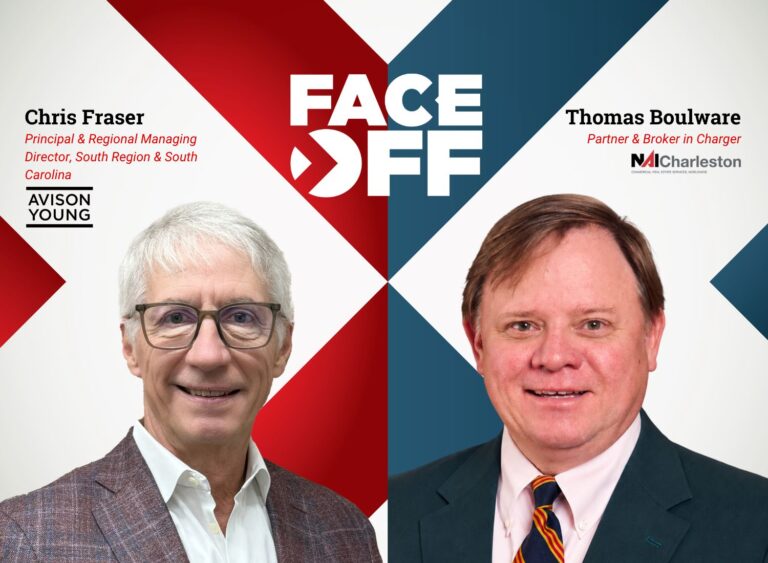
Yet infrastructure, affordability, and geographic constraint are the undercurrents beneath every deal. Chris Fraser, principal and regional managing director for the South Region and South Carolina at Avison Young, and Thomas Boulware, partner and broker in charge at NAI Charleston, are two of the market’s most experienced voices — and together they offer a ground-level portrait of a state managing the rare and complicated burden of winning.
How would you characterize where South Carolina stands right now?
Chris Fraser, Principal & Regional Managing Director, South Region & South Carolina, Avison Young: The South Carolina market is generally solid. We have not experienced the same headlines coming out of major markets such as Chicago, Los Angeles, or San Francisco. We are not immune to national trends. There are issues around financing office buildings, and we have too many industrial buildings because somebody said we needed a million-square-foot building, and 10 people decided to build one. Uncertainty surrounding world events has also caused people to pause.
However, we did not become terribly overbuilt, particularly in the office markets. Nobody is going to build much new product, while businesses continue to grow and expand. That growth is filling vacancies created when additional product entered the market. South Carolina is also an inbound residential market. Residential growth means we need more dentists, attorneys, places to eat, grocery stores, and other services, so retail continues to perform well. Our problem is managing the growth and managing the people. We are not facing the opposite problem of nobody coming, everybody leaving, and trying to save what we have.
Thomas Boulware, Partner & Broker in Charge, NAI Charleston: The market is strong. Over the last five-plus years, we have seen an influx of investors and developers from all over the world seeking investment opportunities in Charleston. We have a booming economy and a strong workforce to support businesses seeking to expand here.
All of the Charleston submarkets have been extremely active during this timeframe, and we expect that to continue for the foreseeable future.
Global trade is down in some markets, and inflationary costs and geopolitical conditions are also affecting activity.
The current administration is trying to incentivize more manufacturing in the United States rather than relying on imports. Locally, there were multiple distribution-type projects in the development pipeline, delivered in a 12–18-month period, which contributed to an elevated vacancy rate.
How are physical constraints shaping where growth can go?
Fraser: Charleston is geographically constrained. Unlike Greenville, it cannot expand in every direction because the ocean occupies half of the surrounding area. Rivers, bridges, and wetlands further divide the remaining land. Communities that integrate the services people need so residents do not have to leave for everyday activities are performing well. Mount Pleasant is an example. Twenty-five years ago, residents had to leave for many services.
Today, children can be born there, attend school there, earn a degree from Trident Technical College, and access shopping and healthcare within the community. Affordability remains a challenge because Mount Pleasant is expensive. These problems cannot be solved in isolation. Pushing on one side of the balloon causes the other side to expand and creates another issue. Land availability and construction costs are only part of the equation. Communities also need sufficient sewer capacity and power generation to accommodate businesses that want to locate here.
Boulware: If you look at Charlotte geographically, it can expand in every direction. In Charleston, half of our market is the Atlantic Ocean, so growth can only occur inland. To the north is the Francis Marion National Forest, a federally protected national forest of about 400,000 acres, and to the south is the ACE Basin, another federally protected area.
The river systems that drain from the inland portion of the state flow toward the ocean. As you move inland, wetlands help dictate where future growth can occur. When you look at an aerial map of our region, this will make sense.
Charleston experienced a significant amount of growth in a short period, and the pandemic accelerated the number of people seeking to move here. It has been challenging for local municipalities, water and sewer providers, and other utility providers to keep up with this new demand. Traffic generation is the biggest concern, and building roads and bridges across the Lowcountry to accommodate this new traffic is not cheap.
Where are the most compelling pockets of growth and redevelopment right now?
Fraser: The best office buildings — those offering the highest quality and strongest amenities — are successful and remain well occupied. As companies expand, the lack of capital for new construction is causing businesses and investors to reconsider an earlier generation of Class A office buildings. Investors are reinvesting in well-located, well-built properties that may have some age on them. Mixed-use development is especially relevant to office properties. Well-amenitized office buildings can include street-level retail that benefits from tenants working upstairs.
Those uses activate the street, create more vibrancy, and help support an 18-hour environment. Technology companies and businesses with younger workforces often want to be somewhere people can access everything they need within a short distance, preferably without getting into a car. Data centers are one example of the choices communities face. People worry that these facilities will consume power and water or increase utility rates. The counterargument is that data centers employ relatively few people and place less traffic on the roads.
Boulware: West Ashley has considerable opportunity. City of Charleston Mayor William Cogswell has assembled a strong team to improve and implement an existing comprehensive plan for this submarket. The Medical University of South Carolina acquired the former Citadel Mall in December 2025. The property is approximately 30 to 40 acres and will likely undergo redevelopment over the next 10 years as a regional medical hub. It’s located at the intersection of Interstate 526 and Sam Rittenberg Boulevard, which is a primary corridor through the heart of West Ashley.
At the opposite end of Sam Rittenberg Boulevard is Ashley Landing Mall, which is being redeveloped by Edens Development Group. The project includes a relocation of an existing Publix grocery store, approximately 320 apartments, and plans to create more of a destination retail hub. The city’s vision for Sam Rittenberg is to redevelop older properties by bringing new developed properties closer to the street, increasing their allowable height, creating more of a boulevard, and improving pedestrian activity.
Jamestown acquired the former Navy base in North Charleston along the Cooper River and is renovating many of its buildings. Apartments have been added, along with a design studio that brings together designers, planners, architects, and other creative professionals. The surrounding areas of the Navy Base — Lower North Charleston — are experiencing significant redevelopment along with the Hanahan submarket.
Want more? Read the Invest: South Carolina report.