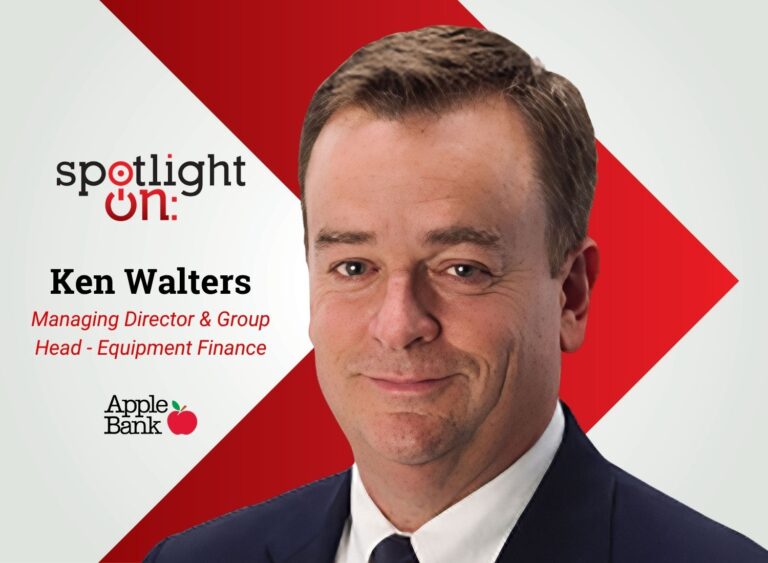

Spotlight On: Ken Walters, Managing Director & Group Head – Equipment Finance, Apple Bank
Key points:
- • Apple Bank’s equipment finance business surpassed $1 billion in new lending in 2025.
- • The Eagle Point joint venture is expanding financing options for higher-risk borrowers.
- • AI infrastructure and transportation assets are creating new equipment financing opportunities.
 October 2026 — In an interview with Invest:, Apple Bank Managing Director and Group Head of Equipment Finance, Ken Walters, discussed the bank’s expansion into equipment finance, the growth of its commercial lending businesses, and new opportunities created through its joint venture with Eagle Point Credit Company. “It’s really expanded our reach in terms of the types of companies that we can help and provide services to,” Walters said.
Join us at caa’s upcoming leadership summits! These premier events bring together hundreds of public and private sector leaders to discuss the challenges and opportunities for businesses and investors. Find the next summit in a city near you!
How does equipment finance fit into Apple Bank’s broader strategy for serving commercial clients?
I joined the bank in 2022 and brought a team over from another regional New Jersey bank that had been acquired. That brought the bank into equipment finance for the first time.
Shortly after joining, we had the opportunity to purchase the portfolio we had built at Investors Bank in New Jersey. I like to say that we effectively reached year five of our plan in two months, because we went from zero to almost $1 billion in assets by purchasing that portfolio.
The equipment finance group provides financing to companies throughout the U.S., but the bank can also provide commercial banking services to our equipment finance customers within our footprint. We are a large-ticket lender, targeting transactions from $5 million to $50 million-plus, so our clients are generally medium-sized to larger businesses. We serve asset-intensive companies in the New York area. One longtime customer is New York Waterway, the ferry company that brings commuters between New Jersey and New York.
The bank had been concentrated in local New York commercial real estate, but we’ve expanded and diversified the lending portfolio by entering equipment finance and lender finance, where we lend to non-bank lenders. We’ve also added subscription finance, some asset-based lending, and project finance.
Commercial aviation has also been placed under my team’s responsibility. We’ve hired a business development officer with significant experience in that space, and we’re trying to expand and diversify what we do there, including loans secured by commercial aircraft used by major carriers.
What have been some of the key milestones for your team over the past year?
From my team’s perspective, we had a record year in 2025. It was our first year closing above $1 billion in new business, which far exceeded both our plan and the prior year. We seem to be on track to achieve that number again this year.
We also launched a joint venture with a private credit fund, called Eagle Point Credit Company, in Greenwich, Connecticut. The joint venture expands our product capability within equipment finance beyond solely stronger bank-type credits. We can now serve the non-bank market, pursuing somewhat riskier, more turnaround-oriented credits, generating higher returns, and broadening our capabilities.
Eagle Point provides 80% of the capital in those transactions, and the bank provides 20%. My team originates and services most of the transactions. We do the credit underwriting along with Eagle Point, as well as the billing, collection, and monitoring.
We signed the JV agreements in late 2024 and closed our first transactions in 2025. We also obtained debt financing from other banks. Truist led a $500 million warehouse with Atlas-SP Partners participating in the line to support growth in the joint venture. The joint venture is called Newton Commercial Finance, playing off the Apple name and Sir Isaac Newton. We’re also potentially looking to do our first securitization before the end of the year. The joint venture has been a really exciting opportunity for the equipment finance business and has opened up a new market for the bank.
How does the joint venture with Eagle Point Capital expand the types of equipment finance opportunities you can pursue?
It really opens up a whole new market for us. We look at transactions on a risk-rating basis, and below a certain risk rating, transactions are generally not appropriate risk for the bank.
Through the joint venture, we can do somewhat riskier, lower-rated credits. We still view those transactions as manageable risks because we collateralize and structure them carefully. It expands what we can offer to our client base.
If we have a client or are approached by a company that has had a setback and is in a turnaround, that might not be a credit the bank can get comfortable with. It may be something the joint venture can pursue by structuring and collateralizing it appropriately. It’s really expanded our reach in terms of the types of companies that we can help and provide services to.
How do you identify the sectors and types of equipment where Apple Bank can provide the greatest value?
From the equipment finance side, we tend to lend against assets that retain their value well. In commercial aviation, for example, aircraft have long useful lives.
We also do quite a bit in the rail industry, financing railcars that have up to a 50-year useful life. We also finance maritime assets — not ocean-going vessels, but predominantly what we call brown-water assets, such as barges and tugboats, traveling through the Great Lakes or the U.S. river system. Those are also long-lived assets.
A lot of what we do involves transportation assets, construction assets, and similar equipment.
More recently, we’ve been looking at and completing some transactions related to AI, including in the energy space. Data centers require substantial amounts of power. There has been concern about data centers connecting to the grid, because the grid may not be able to keep pace with the growth in energy demand.
Several data centers are now building power generation off the grid. We are financing and working on a large transaction involving generators and turbines that power a data center without requiring it to draw power from the grid or add to the demands on the community’s power supply.
We’ve also done some transactions involving GPUs, the computing equipment used by these data centers. We’re approaching the AI market cautiously, because it is changing so quickly and presents its own risks and opportunities.
What are you seeing from businesses in terms of their equipment investment decisions today?
The biggest trends we’re seeing are the growth of AI and the resulting demand for the equipment that supports it — both compute equipment and power equipment. That has been a huge growth area in the market. A lot of it has been funded by private credit, although banks are participating to an extent.
Beyond that, 2025 was a record year for us in terms of new business, and I think 2026 will be equally as good.
Looking ahead, what are the biggest opportunities, and what would you like to accomplish as you continue building these platforms?
My team is now responsible for about $3 billion in assets between what we’ve built and what we inherited through the commercial aviation platform. We have a relatively small team of fewer than 20 people. We did $1 billion in new business last year and should do about the same amount this year, so I need to continue building the team to support that growth. We’d like to add direct salespeople to expand our market coverage. As we add direct salespeople and grow the business, we also need to expand the support team on both the credit and operational fronts.
For me, it’s about making sure the team continues to grow in a measured way so we can keep pace with the assets we’re managing while continuing to generate a strong level of new business.
The joint venture has added a great opportunity for the bank, but it has also added a lot of work. We’re now managing a warehouse facility and preparing for our first securitization. We need to make sure we have the right staffing to take on those additional responsibilities.
I’m also excited to see the joint venture continue to grow. We expect it to be a significant growth area.
Want more? Read the Invest: New Jersey report.