Invest: Charlotte 6th Edition Leadership Summit explores the demands of a growing region
Key points:
- • Charlotte leaders are focused on managing rapid regional growth.
- • Capital, workforce, and development pressures are reshaping investment decisions.
- • Collaboration and adaptable development remain central to long-term competitiveness.
 September 2026 — More than 250 business, civic and institutional leaders gathered Sept. 24 at Blumenthal Arts’ Blume Studios for the Invest: Charlotte 6th Edition Leadership Summit, hosted by caa. Discussions centered on a common question: How can Charlotte sustain its growth as capital markets, workforce needs, and development priorities change?
Join us at caa’s upcoming leadership summits! These premier events bring together hundreds of public and private sector leaders to discuss the challenges and opportunities for businesses and investors. Find the next summit in a city near you!
Abby Lindenberg, founder and CEO of caa, opened the summit by highlighting Charlotte’s economic transformation and the challenge of keeping pace with its expansion.
“Growth is no longer in question. Instead, the story is about keeping up with the rapid pace of change,” Lindenberg said. “For the business leaders in this room, Charlotte offers a clear blueprint for the future: resilience through diversification, strength through collaboration, and vision realized through bold, tangible development.”
For the summit, Charlotte Mayor Rob Harrington shared a letter welcoming attendees and emphasizing the role of collaboration in supporting the city’s growth. “Bringing leaders together for meaningful conversation is an important part of building a stronger community. The relationships formed and perspectives shared during this summit will help support Charlotte’s continued growth, economic vitality, and bright future,” Harrington wrote.
Charlotte charts its growth path
The morning’s discussions illustrated how challenges across industries are playing out as companies reconsider their real estate footprints, developers and investors navigate higher costs of capital, healthcare and education institutions plan around workforce constraints, and builders weigh speed against flexibility, infrastructure and long-term operating costs.
Tom Gabbard, CEO of Blumenthal Arts, opened with a welcome address in which he highlighted Blume Studios’ role in the redevelopment of the Iron District and connected arts investment with Charlotte’s broader economy. “All of that is not only good for the quality of life of our city, but creates jobs,” Gabbard said. “And we’re very proud of the fact that we can be an economic motivator, just as you are here.”
Capital enters a new cycle
Before the first panel, Jim Eubanks, Charlotte hub co-leader at Synchrony, pointed to the company’s changing real estate footprint as one example of how workplace patterns are shifting. Synchrony plans to move from a Ballantyne office with about 1,200 desks to a SouthPark location with about 200 seats for the same number of Charlotte associates.
“It’s the same mission with a smaller real estate footprint and more intentional collaboration,” Eubanks said. “We picked a spot that is alive. Restaurants, hotels, and energy around it in SouthPark, because when people choose to come in to work, the place should be worth the trip.”
The example provided a natural lead-in to the first panel, “The Next Credit Cycle: What Borrowers, Lenders, and Investors Need to Know About Charlotte Real Estate,” which examined an apparent contradiction in the market: Capital remains available, yet higher borrowing costs are making some deals harder to execute.
Moderated by Cheryl Richards, president and CEO of Catapult Employers Association, the panel featured John Bly, South Atlantic regional leader at Aprio; Zac Snyder, regional executive at Carter Bank; and Ted Wolfe, president of TowneBank Charlotte.
“The spigot’s on. Capital is flowing through the market,” Snyder said. “There’s more capital out there than I’ve ever seen in my entire career.”
The constraint, panelists said, increasingly comes from the amount of equity required to make projects work under higher borrowing costs. They also pointed to refinancing pressures and a renewed focus on sponsors, cash flow and long-term fundamentals.
“The last three to five years, the investors were buying the market,” Wolfe said. “Now they’re gonna have to buy the sponsor, the durable cash flow and the basis, and make it all work.”
Bly cautioned against relying on aggressive assumptions about where interest rates or other market conditions might move. Panelists instead emphasized stress testing, earlier refinancing preparation and relationships with capital partners that can withstand market cycles.
Institutions become economic engines
The second panel shifted the conversation from capital to the institutions supporting Charlotte’s workforce and communities.
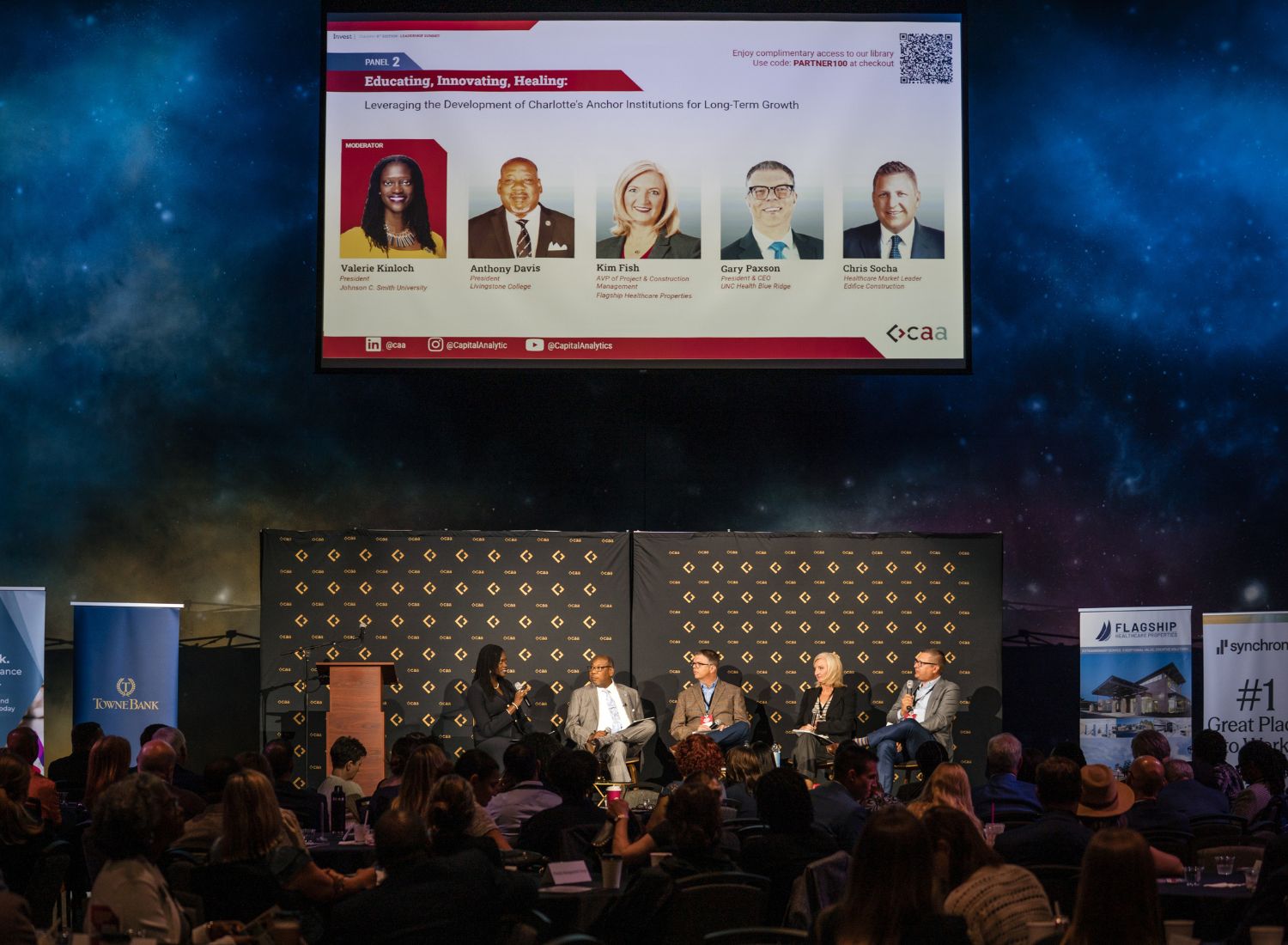
“Educating, Innovating, Healing: Leveraging the Development of Charlotte’s Anchor Institutions for Long-Term Growth” brought together leaders from higher education, healthcare, real estate, and construction.
Moderated by Valerie Kinloch, president of Johnson C. Smith University, the panel featured Anthony Davis, president and CEO of Livingstone College; Kim Fish, assistant vice president of project and construction management at Flagship Healthcare Properties; Gary Paxson, president and CEO of UNC Health Blue Ridge; and Chris Socha, healthcare market leader and vice president at Edifice Construction.
Davis said colleges and universities have an economic role extending beyond their traditional educational missions.
“As an anchor institution, we have a responsibility to not only stabilize, catalyze and revitalize the communities that we serve,” Davis said. “Our responsibility moves well beyond just education, but also empowerment and equipping communities so that this economic resurgence that we see is sustainable, but more importantly, scalable.”
The discussion connected institutional growth with workforce availability, housing, healthcare access, and infrastructure. Panelists also considered how facilities can be designed today for healthcare needs that could change substantially over their useful lives.
“I don’t think of the people in this room that any of us could predict what healthcare is going to look like 20 years from now, but I can guarantee you that whatever we guess it’s going to be, it’s going to be wrong,” Socha said.
Socha said that uncertainty makes flexibility more important, particularly when deciding which building systems warrant greater investment upfront because they will be difficult to change later.
Panelists also emphasized collaboration among healthcare systems, colleges, businesses, developers and surrounding communities as Charlotte works to expand its talent pipeline.
Building smarter
Charlotte’s physical growth took center stage during the final panel, “From Blueprint to Skyline: How Charlotte Is Building for Growth, Flexibility, and the Next Generation.”
Moderated by Matt Donato, partner at Echelon Risk & Cyber, the panel featured Zach Pannier, business unit leader at DPR Construction; William Haygood, managing partner at Boundary Street Advisors; and Kristian Hernandez, vice president of Carolinas Building Services at McKenney’s.
The discussion covered construction costs, infrastructure, data centers, energy efficiency, housing affordability and the changing expectations of the people moving to Charlotte.
Panelists said building for that growth will require greater coordination among owners, contractors, designers, operators and public-sector partners. They also stressed that smarter development does not necessarily begin with new construction or new technology.
“If you’re not measuring your building, how do you know how much better you can get?” Hernandez said. “Even before you purchase any new equipment, any new technologies, optimize what you have.”
The discussion expanded beyond individual buildings to the neighborhoods and infrastructure surrounding them. Haygood said investment will need to reach beyond Charlotte’s most established development corridors as the region grows.
“We need to be intentional about what happens in a lot of the other neighborhoods, because you need to spread that around,” Haygood said.
Across the three panels, the discussions pointed to a common conclusion that Charlotte’s future will depend on how the region manages growth — through disciplined investment, adaptable development, workforce preparation and collaboration across institutions.
A regional story
Shain Collins, senior executive director of Invest: Charlotte, closed the summit by returning to the regional relationships behind emerging economic opportunities.
“From Lancaster to Lincoln, York to Rowan and everywhere in between, the hundreds of leaders we speak to in producing our work each year help paint a picture of regionalism and a rising tide lifts all boats mentality that is inspiring to learn about and share,” Collins said.
The summit concluded with raffles sponsored by Blumenthal Arts and Carolina Ascent FC.
To read the brand-new Invest: Charlotte 6th Edition report, click here. (Subscription required.)
For conference panel discussions, please subscribe and stay tuned to our YouTube channel as videos are released following the summit.
About caa & Invest: Charlotte
caa is an integrated media platform that produces in-depth business intelligence through its annual print and digital economic reviews, high-impact conferences and events and top-level interviews via its video platform, Invest:Insights.
Invest: Charlotte is an in-depth economic review of the key issues facing the Charlotte economy, featuring the exclusive insights of prominent regional leaders. Invest: Charlotte is produced with two goals in mind: 1) to provide comprehensive investment knowledge on the region for local, national, and international investors, and 2) to promote the region as a place to invest and do business.
The report conducts a deep dive into the top economic sectors in the region, including technology, real estate and construction, infrastructure, banking and finance, healthcare, education, and tourism. The publication is compiled from insights collected from more than 200 economic leaders, sector insiders, political leaders, and heads of important institutions. It analyzes the leading challenges facing the market and uncovers emerging opportunities for investors, entrepreneurs, and innovators.
For more information, please contact:
Shain Collins
Senior Executive Director
786-598-7526
scollins@capitalaa.com












Want more? Read the Invest: Charlotte report.