





Face Off: DFW’s real estate and construction leaders on navigating a shifting market landscape
Writer: Andrea Teran
 November 2024 — The Dallas-Fort Worth (DFW) area is solidifying its status as a top U.S. real estate market, fueled by consistent demand across both commercial and residential sectors. DFW’s robust economy, affordable living, and strategic location continue to attract investors, residents, and corporations alike.
This environment has propelled DFW to the number two position nationally for apartment construction, with over 32,900 new units expected by the end of 2024, according to a RentCafe study, only surpassed by New York City. This construction boom is a response to high rental demand across North Texas, with cities like Dallas, Fort Worth, and Frisco representing the largest shares of new multifamily developments. While apartment construction is projected to slow slightly, 108,000 new apartments are projected by 2028.
According to the 2025 Emerging Trends in Real Estate report by the Urban Land Institute and PricewaterhouseCoopers, DFW is ranked as the number one U.S. market to watch. This recognition reflects the region’s resilience and appeal, with favorable conditions for both real estate investors and developers.
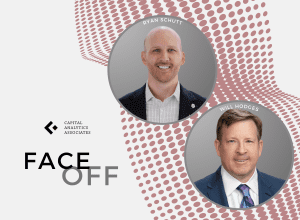
To provide insight into DFW’s evolving real estate landscape, Invest: spoke with Ryan Schutt, principal at HKS Dallas, and Will Hodges, president of Cadence McShane, to explore the region’s real estate outlook, challenges, and the innovative strategies shaping the future of development in North Texas.
What are some of the key drivers for DFW’s continued growth and appeal as a business destination?
Ryan Schutt: We’re seeing the suburban market still be the hot area for the Friscos, the Planos, the Colony, and McKinney. You’re seeing those massive billion-dollar projects that are giant mixed-use developments. In the urban core, we continue to see opportunities with the vacant office buildings and ownership groups coming in to create dynamic mixed-use developments. Across the board, it’s all about creating developments where people are finding financial success with diversity of use strategies.
We are seeing more cross-practice opportunities as well. Our sports practice partners with commercial mixed-use to provide value because an entertainment district is an essential part of making a stadium successful 24/7. You see that in Arlington with Live! by Loews in the backyard by the ballpark. The key to finding a successful, vibrant project is creating dynamic and diverse uses, creating 24/7 usability.
Another market where demand is higher than ever is mission-critical. Data centers are a huge driver in the architecture business. We can’t build them fast enough, especially with the immersion of AI; they need so much data, and they need all these processors. What we’re seeing are opportunities there to recycle the heat gain that’s created by these and how we can make these sustainable buildings and green buildings in ways that they need to be part of our ecosystem of the economy. We make them in a way that’s green, and sustainable.
Will Hodges: On the public sector side, there is a large deal of activity. Cadence McShane doesn’t do municipal work, but we do work with many school districts. There’s a lot of public sector opportunities and movement in that space with big public work projects, city projects, and bond programs that have passed. There’s a lot of activity in those markets. Industrial and manufacturing are starting to experience an upswing, and people are taking advantage of competitive construction pricing, as pricing is down in the construction market.
What makes Dallas a great place for a company to operate out of?
Schutt: In the last few years, we’ve gone from a handful of residents downtown to 15,000. That’s incredible. We’re seeing people choosing to live downtown, creating a vibrant urban core. I’m excited just about the continued growth that happens in Uptown with the large mixed-use developments happening in the Knox area. The urban redevelopment of all these large towers, including Comerica Bank, which was recently announced. These big empty office buildings are going to have a different life, and seeing that life cycle happening and where the downtown urban core is having a strong comeback is exciting. There’s so much potential still on the horizon that the momentum is not slowing here. I hope we can continue to add components that enhance our vibrancy, whether it’s another sports team or in other ways.
Hodges: Whether you’re a contractor, in real estate or in business, it’s a big market. During tough economic times, Dallas doesn’t seem to struggle quite as much as the rest of the country. I believe this is due to its diversity and business-friendly climate in the surrounding region. If one area isn’t welcoming to a developer, businesses can easily move to neighboring municipalities in the region that will welcome them with open arms. The size and diversity allows for a favorable place to do business.
The advantage to working in Texas is that there isn’t a high barrier to entry for contractors to come in and do business. There aren’t licensing requirements, and owners are generally welcoming to newcomers. Our business remains relationship driven. We want to do work for people we have strong relationships with. We differentiate ourselves with service. If a business’ competitive edge is based solely on low pricing, then you’re simply a cheap commodity, and you look the same to everyone. The advantage to being in a large market like Dallas is that there is generally enough work to go around, and you can always find someone that aligns with your work philosophy.
How are DFW real estate and construction firms leveraging technology to improve efficiency and stay competitive?
Schutt: Recently, in Grandscape, Cosm just opened, which is an immersive entertainment venue that blurs the line between the virtual and the real. It’s essentially an 87-foot diameter dome that fully immerses you in the sports and entertainment world. You can purchase tickets to attend an event there, and you are sitting in the midfield of a football game or you’re in the ring in the middle of a boxing match, or a soccer game, or name your sport. We don’t see Cosm as a niche thing just secluded to sports. Cosm could also apply to education and how we learn. We can use these things to teach in an immersive way. That’s a really exciting opportunity that just opened, and we’re proud of it. That’s a market we see becoming more and more prevalent, whether in entertainment, education or other applications.
AI is a hot word in our industry. We are taking the approach of being cautious but optimistic. We’re looking for what are the foundational ways that we can leverage this to improve our business analytics. We’re able to drive the tool in ways that allow us the opportunity to leverage our brain skills better. Let AI take a more mundane stance. We have to understand with AI the terms of the details when it comes to issues such as intellectual property and legal risks. We want to leverage it in a way that lets us use our time to service our clients better.
Hodges: We are trying to do more with less, so we need software and systems to help people be more efficient. This can be a challenge because we sometimes see software as a silver bullet, and there are no silver bullet solutions. We want to ensure the structure and how software is utilized is allowing people to truly operate more efficiently. We’ve invested time and energy into ensuring that when we make a software acquisition it is actually solving the problem, instead of unintentionally creating more work for people by having to navigate challenging products. All contractors typically use one of a few software programs. We partner with Procore to integrate our software to avoid redundancies, allowing for a single entry of data across platforms.
What strategies do firms in the DFW market employ to maintain competitiveness and manage workforce constraints?
Schutt: My focus is going to be on two target areas: internally building our culture and externally making ourselves have the strongest brand presence in Dallas. Our vision statement is through limitless thinking we will be the most influential firm in our industry. We have tons of talent. We have tons of resources. We have great young leaders and great energy coming in from our new hires. We just needed somebody to tie all that together and be the glue to make us all pull in the same direction so that we’re being and living our vision statement.
Hodges: All of these new, incoming companies are hiring, so finding the right people is an additional challenge we are contending with. This hiring competition is thinning the local pool of available talent. We are still doing the same amount of work, if not more, with the same amount of people. People will continue to be the biggest constraint, not only for our company, but for contractors in general. We have a partnership with TEXO, a construction association, which has created a program called “Build Better” that invested $1 million in an 18-wheeler semi-trailer that travels to high schools and trade locations. The trailer has simulators for students to sample and foster interest in trades and skilled work. Build Better partners with local higher ed, universities and trade schools to connect students with those programs to then funnel kids in those directions.
For more information, please visit: