Face Off: NJ’s community colleges align with employers to drive growth
Writer: Mariana Hernández
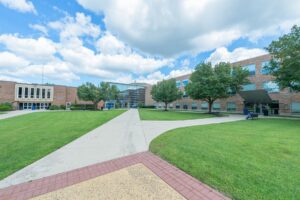
April 2025 — Rising tuition costs and changing job market needs are pushing community colleges in New Jersey to create more direct pathways to employment — a strategy to keep them competitive in a crowded field.
With life sciences, technology, and advanced manufacturing driving job growth in the Garden State, community colleges are forming partnerships and collaborating with employers to connect recent graduates with in-demand careers and local companies.
Invest: recently spoke with Lovell Pugh-Bassett, president of Camden County College, and William Austin, president of Warren County Community College, to discuss New Jersey’s higher education landscape and opportunities in the development of the future workforce.
How would you describe overall sentiment in the region toward higher education?
Lovell Pugh-Bassett:
There are several reasons why students may leave college. Many of the students in our “Back on Track” program face financial barriers, childcare challenges, or the need to choose between education and work. The community college sector serves a diverse population, ranging from 18-year-olds living with their parents to 65-year-olds with grandchildren. These students have various needs and competing priorities that may force them to pause their education. Our program aims to remove these barriers. For example, students with outstanding balances within a certain threshold can return without financial holds preventing them from registering. We also help students purchase textbooks, which can be particularly expensive in the science and healthcare fields. Additionally, we offer childcare vouchers and other resources to help students focus on their studies.

William Austin:
One aspect of community colleges is that until we got into high-tech programs, many degrees offered put people into entry level jobs in various low pay industries. The people in those industries are struggling because many times those working at non-skilled positions are earning the same amount, or even more, as those in occupations such as social services. This can be observed when comparing social workers and restaurant workers, for example. These students have been questioning why they would invest in a multi-year program to earn as much as someone without a degree. Increased competition for these jobs, as well as inflation, have made it difficult for people to choose college. Our school also must be cognizant of advancements in technology that may make some jobs obsolete in the future. There are still many questions about the future of AI in the workforce, but at WCCC take this into consideration when we determine what degrees we offer.
What initiatives should be taken to develop talent in New Jersey?
Austin: The purpose of a community college involves not only the traditional aspects of obtaining a degree but also to be an economic development driver in the community. Warren has agriculture and restrictions on land development, so it makes sense that our school offers corresponding programs. We should be looking at our own communities to determine how we should develop. For example, our AI programs are not offered for the sake of AI but are instead focused on the relationship to agriculture and drones. Our school is not trying to lean into trends; instead, we want to offer efficient, applicable programs.
How do you address the evolving needs of the labor market and ensure prepared graduates for today’s workforce?
Pugh-Bassett: We closely monitor trends and shifts in the labor market, population growth, and specific regional needs. Our Workforce Development division, in collaboration with our institutional research team, analyzes labor trends. Much of our work in this area is a response to the data we collect. For example, we are recognized as trailblazers in fields like manufacturing and cybersecurity, which are both high-demand and growing industries.
We also collaborate with the local government to identify workforce gaps and develop programs to address those needs. Organizations often reach out to us to create pathways that help build the labor force in specific areas. We gather this information both through data and through feedback from our partners.
What opportunities do you see for the higher education sector in the next few years?
Pugh-Bassett: One of the biggest opportunities lies in offering a balanced range of pathways that serve both the labor market and the academic and educational markets. Our goal is to support students seeking careers as plumbers, electricians, and HVAC technicians, as well as those pursuing a two-year degree to transfer to a four-year college or advance in the workforce. As a community college, we have the advantage of being more flexible than four-year institutions, allowing us to respond more effectively to changing student needs. Another opportunity is to market ourselves more effectively to change the stigma associated with community colleges. We want to position ourselves as a deliberate choice rather than a backup option. Whether it is a high-school graduate or an adult starting over after a life change, we aim to be a viable option that is part of their decision-making process. Our goal is to create viable citizens who contribute to their communities and pay taxes, ultimately making their local communities stronger.
Austin: In New Jersey there are more colleges than are needed, so I expect to see partnerships and consolidations. Though consolidation seems inevitable, the major question policymakers should be asking is if consolidation will put higher education out of reach for some people. The industry still seems to be facility-driven, so if we can find a way to diminish those costs, then it will be a win that we can pass onto the students. We will continue working in high tech by strengthening our existing degrees. The school will go through a re-accreditation process to ensure students are learning what we promise them and focusing on our institution’s mission. We will continue to serve our community the best we can and will actively foster our partnerships and collaborations in the future.
Top image via Camden County College
For more information, please visit:
https://www.warren.edu/