






New higher education strategies target future workforce
Key points:
- Universities across key U.S. markets are redesigning curriculum around experiential learning, AI integration, and workforce alignment.
- Institutions are expanding internships, microcredentials, and career pipelines to strengthen job readiness and talent retention.
- Higher education is increasingly positioned as economic infrastructure, linking access, applied skills, and regional growth.
 February 2026 — As the United States faces increasing global competition for skilled talent, and warnings of 75% of U.S.-based scientific brain drain, universities are no longer just degree-granting institutions, they are future workforce engines.
Join us at caa’s upcoming leadership summits! These premier events bring together hundreds of public and private sector leaders to discuss the challenges and opportunities for businesses and investors. Find the next summit in a city near you!
Across markets like New Jersey, Orlando, Pittsburgh, and Tampa Bay, institutions are redesigning how students learn, credential, and connect to industry.
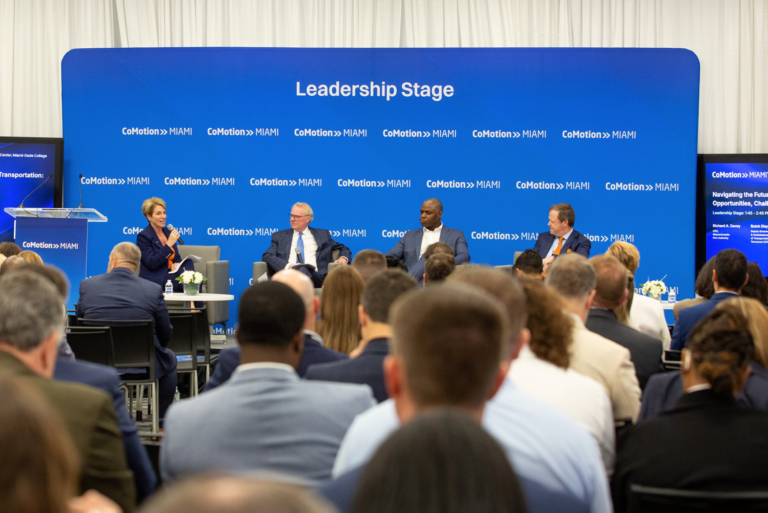
“When access, excellence, and workforce relevance move together, then we’re going in the right direction,” said Francine Conway, chancellor of Rutgers University–New Brunswick, at the recent Invest: New Jersey Leadership Summit, where education leaders in the state gathered to discuss this issue.
The alignment Conway alluded to is no longer optional. It is a national economic strategy that will define the global position of the United States in the years to come.
Experience over content
A big part of the push is a result of the emergence of generative AI, which is reshaping industries, with institutions shifting from static content delivery to applied, adaptive learning.
At Stetson University in Orlando, President Christopher Roellke described the shift as a need to focus on experiential learning.
“Teaching and learning are evolving. At Stetson, we don’t aim to compete on content,” Roellke said. “Instead, we compete on experience. We focus on what we call experiential, contemporary, and integrative learning.”
Similarly, David Birdsell of Kean University emphasized that transformation must extend beyond curriculum updates. “It can’t only be about what people learn in college. It has to be about how they learn in college.”
Since the arrival of powerful AI tools in education, the conversation has shifted from fearing replacement, toward enhancing human qualities, such as care, connection, and real-world guidance. AI can automate administrative tasks, personalize learning, and allow educators to spend more time creating safe environments for students to thrive.
This underscores the growing importance of fostering community and guiding learners toward credentials and skills that reflect goals beyond efficiency and content. In this view, AI isn’t diminishing the role of teachers but amplifying their capacity to deliver a deeper, more human educational experience.
In Tampa Bay, the University of Tampa operationalized that philosophy through initiatives like AI Across the Curriculum, Internships for All, and expanded microcredentials.
“UTampa’s educational philosophy blends intellectual development with practical readiness,” said President Teresa Abi-Nader Dahlberg. “We are enhancing academic excellence through agile curriculum delivery, expanded experiential learning, and innovative microcredentials that help students stand out in a competitive job market.”
This shift reflects broader workforce realities. The World Economic Forum’s “2025 Future of Jobs” data shows employers increasingly prioritize adaptability, digital fluency, and critical thinking — skills that extend beyond technical knowledge.
Given the technological evolution, around 170 million new jobs will be created around the world as a consequence of the digital transformation, while 92 million jobs will be displaced, such as cashiers, administrative assistants, and certain trade workers.
Career readiness as infrastructure
In Pittsburgh, Seton Hill University embedded career development from day one.
“We live in an intellectual and service-driven economy,” said President Mary Finger. “There are fewer and fewer career paths that offer long-term stability without postsecondary education. Today’s workforce requires critical thinking, technical skills, and the ability to adapt.”
Seton Hill’s “Fit for the World” program integrates career assessments, networking, and internships from freshman year forward.
“Career readiness at Seton Hill isn’t just about landing a first job,” Finger added. “It’s about building a mindset of engagement, service, and lifelong learning.”
That mindset aligns with broader workforce data. Credential stacking and ongoing professional certifications are increasingly tied to wage mobility and industry advancement. It allows individuals to accumulate accredited skills that will structure a career advancement opportunity in the long run.
Institutions are responding with executive education, short-term credentials, and industry-aligned certifications.
“We’re also expanding short-term and executive education programs, particularly in our business school,” Roellke said. “These programs cater to ongoing professional development and certifications, which we see as a significant growth area for private higher education in Florida.”
Ecosystems that keep talent home
In New Jersey, the conversation has expanded beyond graduation rates. Leaders are focused on retention — not just student retention, but regional talent retention.
Mark McCormick, President of Middlesex College, described the need for a state’s coordinated pipeline in each education level.
“When students can see from middle school through high school, to the two-year college, that there is a pathway that gets them to a high paying job, right here in their hometown, they often stay”, he said during a panel discussion at caa’s Leadership Summit.
To reduce out-migration of college-bound students, institutions are building intentional two-year to four-year pathways, alongside industry partnerships, to reduce that leakage.
At Essex County College, President Augustine Boakye framed community colleges as economic anchors.
“We see ourselves together with our four-year institutions as the drivers of our region’s economy, because we transform talent into a smart and skilled labor force, empowering individuals, families, local businesses and the state as a whole,” he said.
The competitive edge
Higher education is no longer measured solely by test scores or enrollment growth, since technology has changed the way students show their accomplishments. Increasingly, its success is tied to social mobility, industry alignment, and economic impact.
Rutgers reported during the Invest: New Jersey conversation that 84% of its New Brunswick graduates earn more within six months of graduation than when they entered. That is not just student success. It is a workforce strategy.
Across Orlando, Tampa Bay, Pittsburgh, and New Jersey, leaders are converging around the same insight: Higher education must integrate access, applied learning, and industry connectivity to secure the future workforce.
Rather than reacting to disruption, these institutions are redesigning their models. They are expanding microcredentials, embedding internships, launching AI-integrated programs, building community pipelines, and partnering directly with employers.
In an era defined by technological acceleration and global competition, higher education remains one of the most powerful tools for talent retention and economic growth across the nation.
In those markets that treat education as infrastructure and not just as instruction, the future workforce is already taking shape.
Want more? Read the Invest: reports.