
Spotlight On: Mike Allen, President, Barry University
Key points:
• Barry University is aligning academics with experiential learning and workforce needs to ensure strong career outcomes.
• AI is being embedded across all programs to build ethical, practical, and job-ready skills.
• Industry partnerships are strengthening affordability, relevance, and regional workforce impact.
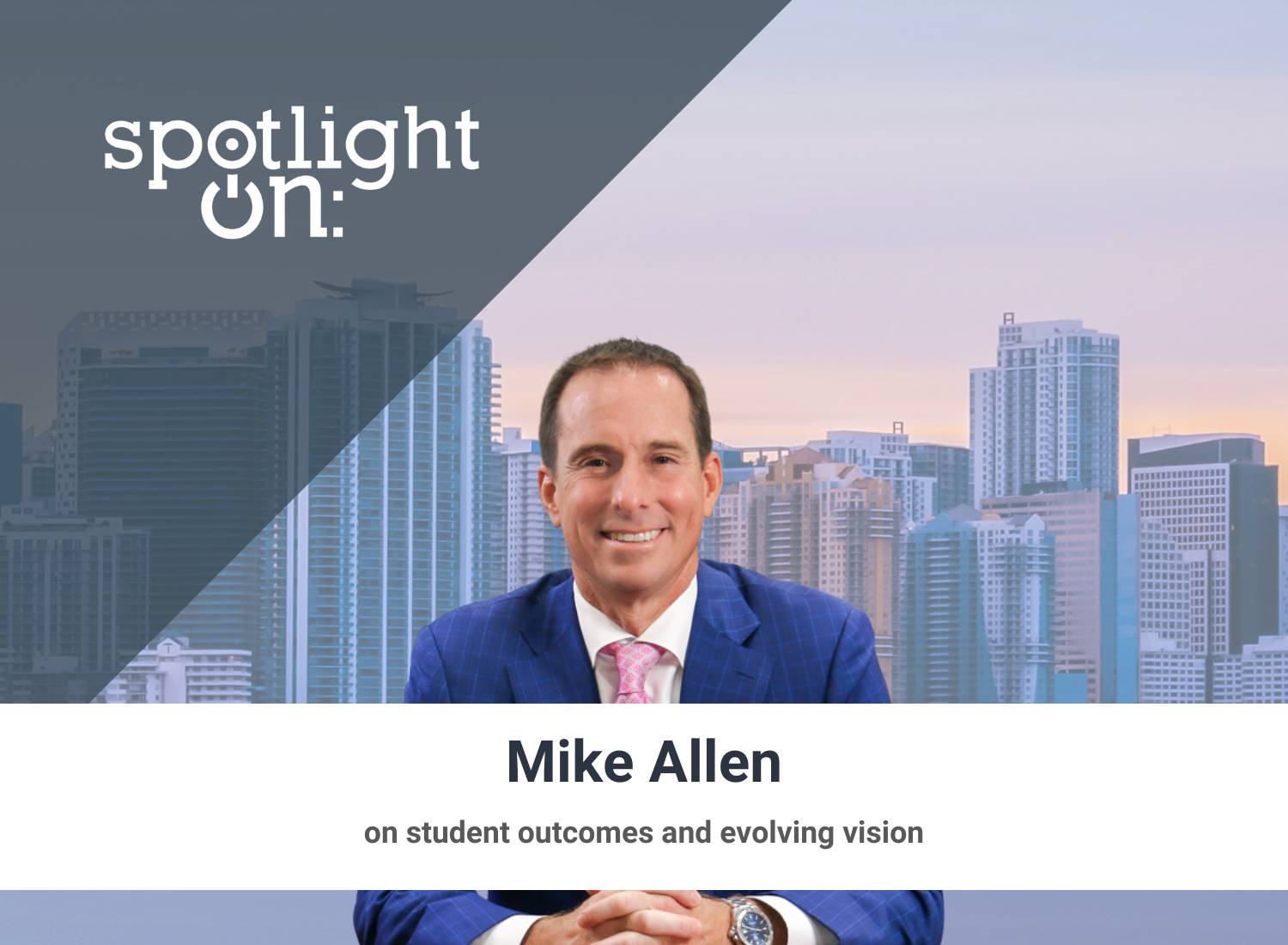 February 2026 — Invest: spoke with Mike Allen, president of Barry University, about how the institution is adapting to rapid change in higher education while staying focused on outcomes that matter for students and the South Florida economy. “The most important thing that a university can do for students is teach them how to think analytically,” Allen said.
Join us at caa’s upcoming leadership summits! These premier events bring together hundreds of public and private sector leaders to discuss the challenges and opportunities for businesses and investors. Find the next summit in a city near you!
How does Barry University balance academic rigor with holistic student support so graduates are ready for future careers?
Higher education has been operating in an environment where no two years are the same. Since 2020, universities have navigated pandemic disruption, inflation that directly impacted families, and challenges within the federal student aid system, all while facing the rapid acceleration of artificial intelligence. Through all of that, the constant has been the need to remain adaptable and focused on delivering value to students.
One way we think about this balance is through four guiding priorities. The first is student success. That means helping students finish what they start and supporting them all the way through graduation, while also ensuring they understand their vocation, gain access to internships, build practical experience, and translate that into strong career outcomes. Graduation alone is no longer enough.
The second priority is meeting the talent and workforce demands of South Florida, Florida, and the nation. We want graduates who are prepared to contribute immediately in their chosen fields.
Third is learning by doing. Hands-on, experiential education is no longer limited to healthcare. It applies across disciplines, and students need opportunities to practice what they are learning in real-world settings.
The fourth priority is partnership with industry and community organizations. We want to listen closely to employers, understand their needs, and make sure our curriculum aligns with the skills students need to succeed.
Together, these priorities allow us to maintain academic rigor while providing the support, experience, and relevance students expect.
Artificial intelligence is reshaping every industry. How is Barry University approaching AI in a meaningful way?
We launched the AI Center at Barry, and what became clear is that this work is not only about creating technology. Today, AI tools are increasingly accessible. What employers are really looking for is the ability to use AI effectively, responsibly, and ethically across disciplines.
Our goal is to infuse AI into everything we teach. Barry University offers more than 100 programs and majors, and AI is reshaping healthcare, business, finance, education, counseling, the arts, and more. The AI Center helps our faculty understand these tools and how to integrate them into coursework so students graduate with practical confidence, not just theoretical exposure.
The pace of change is real, and the expectation is that graduates can apply technology to deliver immediate value.
You began your tenure as Barry University’s seventh president in 2019 and led through significant disruption. How has your vision evolved?
During the pandemic, I often said the disruption would end, and we needed to be ready for what came next. While navigating those years, we never stopped planning for the future.
Afterward, we released a five-year strategic plan focused on recruiting students, ensuring student success, maintaining academic excellence, and building resources; pillars that will always matter. What has changed is how we pursue those goals.
The tools we use to recruit, advise, and support students are evolving rapidly. As a result, our planning horizon is changing as well. Going forward, our strategic plans will likely focus on shorter timeframes, closer to two years, because the pace of change makes long-range forecasting unrealistic.
In that context, the most important thing a university can do for students is teach them to think creatively and critically. Critical thinking, adaptability, communication, teamwork, and problem-solving are foundational skills that remain more essential than ever, especially as technology advances evolve.
Explore more from our Miami coverage:
Spotlight On: Paul Pavlou, Dean, University of Miami Herbert Business School
Florida braces for a historic generational wealth transfer
Spotlight On: Edgardo Defortuna, President & CEO, Fortune International Group
With rising costs and demographic shifts, how is Barry sustaining enrollment while keeping education accessible?
Students and families are asking higher education to be more efficient and affordable, and rightly so. Families make sacrifices to invest in education, and students want a clear pathway from enrollment to employment.
Barry University is focused on helping students complete degrees in the most timely and efficient way possible without compromising quality. That includes clearer degree pathways, stackable certificates, and credentials that allow them to build momentum while working toward long-term goals.
Affordability also requires thoughtful institutional choices and partnerships that allow us to support students through resources and financial assistance. Reducing barriers and making education attainable is central to our mission.
What are some examples of experiential learning that help students become career-ready?
Healthcare has long understood the value of learning by doing, but that model now applies across disciplines. Students need real-world experience to build confidence and competence.
One example is our Student Managed Investment Fund (SMIF), where students invest a portion of the university’s endowment. The fund’s value has grown significantly, but more importantly, students graduate with hands-on investment experience that makes them highly employable.
Another example is the Barry Ad agency. Students do marketing, advertising, and branding work and are expanding into partnerships with small businesses. These experiences reinforce professional expectations and prepare students for careers in marketing and communications.
Experiential learning is no longer optional. It is central to workforce readiness.
What role do partnerships play in student learning and community impact?
Partnerships work best when they align student interest with workforce demand. Healthcare is a clear example. South Florida faces ongoing shortages, and we work closely with major healthcare systems to ensure graduates are prepared to meet those needs.
Mental health is another critical area. We have brought together psychology, counseling, and social work under our School of Mental Health and Social Work to better serve community needs across all age groups.
Education is equally important. Teacher shortages are real, and partnerships like our work with Bloomboard help paraprofessionals become certified teachers efficiently while maintaining quality.
We also work beyond traditional degree models. A mortgage banking certificate developed with the Lennar Foundation addressed a workforce shortage and created a fast, practical pathway into the industry, with the option for students to return later for a four-year degree.
These partnerships show how universities and industry can work together to solve real problems.
How do athletics and campus life shape the student experience at Barry University?
A vibrant campus life is essential. Athletics, fine arts, music, theater, and student organizations all contribute to student engagement and belonging.
Athletically, we have intentionally expanded programs, growing from about 200 student-athletes to nearly 600 in recent years. New sports include men’s and women’s lacrosse and women’s flag football.
A partnership with nearby K-12 Miami Country Day School allowed us to expand and modernize athletic facilities in a way that benefits both institutions. These kinds of collaborations strengthen campus life and reinforce community connections.
What are your top priorities for Barry over the next two years?
Our focus remains on addressing critical community needs. That includes workforce development in healthcare, business, education, technology, mental health, emergency management, as well as continued strength in the arts and sports.
Higher education is evolving quickly, and Barry is well-positioned to thrive by staying focused on student success, strong partnerships, and preparing graduates to lead in a rapidly changing world.
Want more? Read the Invest: Miami report.