

Business investment opportunities surge in South Carolina
Key points:
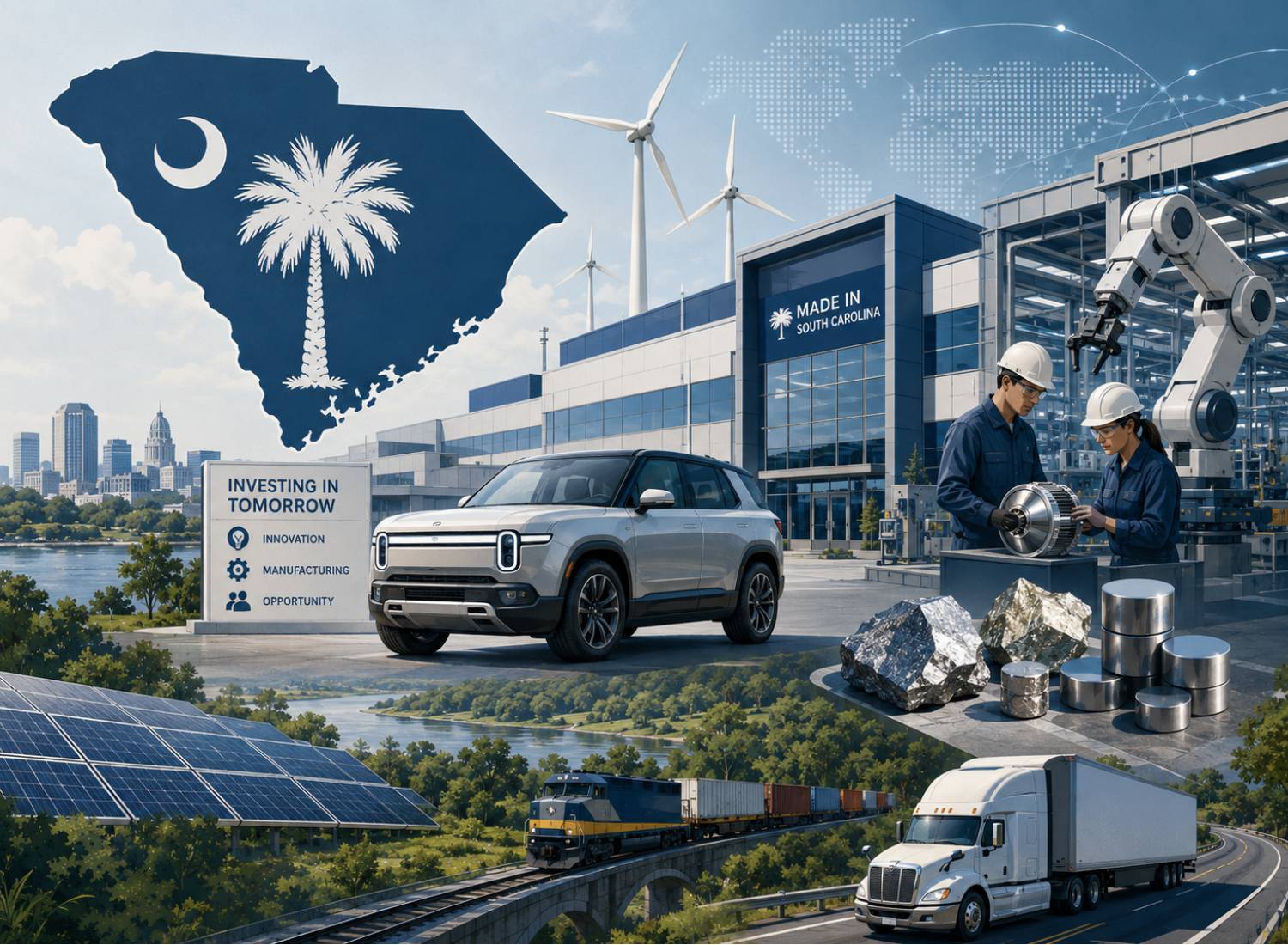 June 2026 — South Carolina is rewriting its manufacturing identity with remarkable speed. The state’s business investment opportunities have drawn more than $3 billion in committed capital in a single quarter, positioning the Palmetto State as one of the most active industrial investment markets in the nation — and placing it at the convergence of three supply chain shifts that will define the decade: electric vehicles, critical minerals, and clean energy production.
Join us at caa’s upcoming leadership summits! These premier events bring together hundreds of public and private sector leaders to discuss the challenges and opportunities for businesses and investors. Find the next summit in a city near you!
A supply chain breakthrough
The announcement that crystallized South Carolina’s 2026 moment came on June 3, when USA Rare Earth confirmed a $1.2 billion facility in Cherokee County to produce NdFeB permanent magnets and refined rare earth metals — materials essential to electric vehicles, wind turbines, and defense systems. The plant will employ approximately 490 workers when it opens in April 2028, according to SCBiz.com. China controls approximately 92% of global production of sintered NdFeB magnets, a concentration U.S. policymakers have identified as a critical strategic vulnerability. By selecting rural Cherokee County, USA Rare Earth delivers on a national security objective and a regional economic one simultaneously.
That announcement followed a string of major commitments accelerating through the spring. Ferrara Candy Company will deploy a $675 million investment in Orangeburg County on April 22, 2026, anchoring a 750,000-square-foot facility that will generate 1,000 manufacturing and corporate jobs over 10 years, with first production expected in 1Q29. The State of South Carolina issued up to $85 million in general obligation bonds for site and infrastructure development — a measure of how aggressively the state competes for transformative deals.
In Laurens County, Suniva entered agreements on April 14, 2026, to deploy a state-of-the-art 4.5-gigawatt solar cell manufacturing facility that brings 564 jobs, effectively scaling the company’s total domestic manufacturing capacity to over 5.5 GW by 2027. In Woodruff, Airsys established a U.S. hub for its manufacturing and corporate leadership with an investment expected to add 215 positions.
A state built for scale
Anchoring the investment wave is Scout Motors, the Volkswagen-backed EV company building a production campus in Blythewood. In April 2026, Scout opened a $25 million, 32,500-square-foot workforce training center in partnership with ReadySC and the South Carolina Technical College System — a direct investment in the state’s ability to supply trained workers for advanced manufacturing. The company has hired more than 600 South Carolina workers and targets 4,000 total jobs when full EV production of Traveler SUVs and Terra trucks begins in late 2027 or early 2028.
These commitments reflect a deliberate and long-standing industrial policy. South Carolina industries committed approximately $9 billion in capital investment in 2025 — the third-highest year on record — with nearly half flowing to rural employment areas, according to SCBiz.com. That rural distribution signals that the business investment opportunities materializing in South Carolina are reaching communities beyond the I-85 corridor, a political and economic imperative the state has spent years cultivating.
BMW’s Spartanburg plant provides the credibility benchmark that makes the state’s pitch compelling to new entrants. In 2025, the plant led the United States in automotive exports by value, shipping nearly 200,000 vehicles worth $9 billion. Alongside the existing presence of Michelin, Volvo, Boeing, and Mercedes-Benz, that track record has created a deep supply chain and engineering talent ecosystem that reduces onboarding friction for manufacturers arriving in the state for the first time.
At the labor market level, South Carolina’s job openings rate stood at 4.5% in December 2025, compared to 3.9% nationally, according to the U.S. Bureau of Labor Statistics. Total nonfarm employment reached 2,417,300 in December 2025, up 1.4% year-over-year. Manufacturing employment held at 260,800 as the sector awaits the ramp-up of Scout Motors, USA Rare Earth, Suniva, and other recently announced operations. The lag between announcement and payroll is structural in advanced manufacturing; the jobs follow the construction.
The national context amplifies why the moment is significant. The 2025-2026 tariff environment has intensified corporate decisions to build domestic production capacity. The federal push to break China’s dominance in rare earth processing elevated the Cherokee County project from a regional economic development deal to a national industrial policy priority. And the Southeast’s consolidation as the backbone of the U.S. EV supply chain — with South Carolina, Georgia, and Tennessee each hosting major assembly or component investments — has placed the region on every serious site selector’s permanent watch list.
For executives and investors tracking where capital is moving in 2026, South Carolina’s business investment opportunities have crossed from speculative to operational. Facilities are under construction, training centers are producing workers, and the rare earth supply chain the nation needs is being built county by county. The question is no longer whether South Carolina belongs in the national manufacturing conversation — it is how far the state can carry the momentum before the next investment cycle begins.
Want more? Read the Invest: South Carolina report.