
Palmetto State leads in business investment opportunities
Key points:
- • Ferrara Candy, USA Rare Earth, and Suniva together represent billions in new SC manufacturing commitments in 2026.
- • Small businesses make up 99% of SC firms and drove 71% of state job growth in the past year.
- • South Carolina’s workforce training infrastructure is a key driver of its manufacturing resurgence.
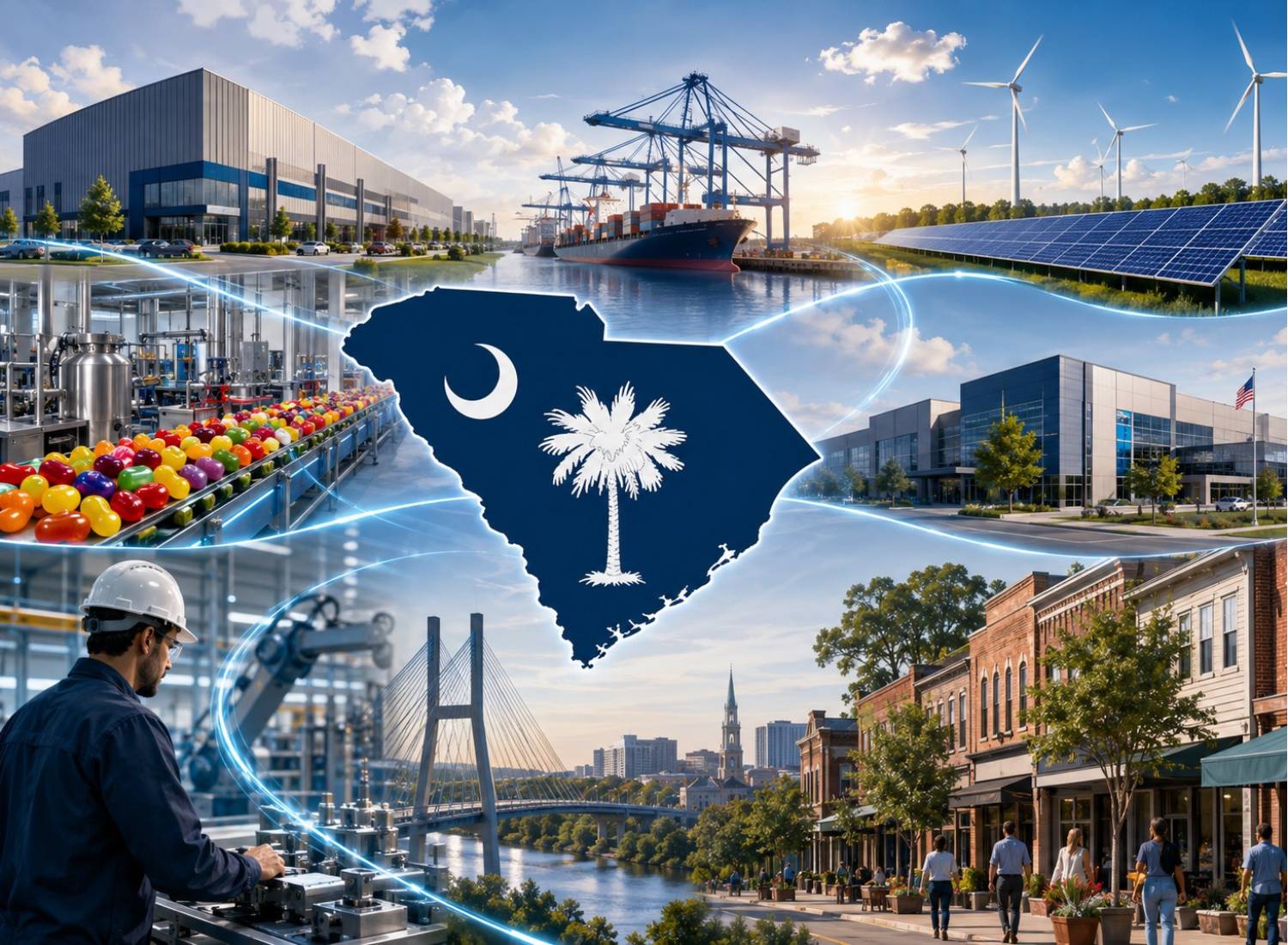 July 2026 — South Carolina is stacking up business investment opportunities at a pace that few states can match, with a series of landmark industrial commitments in 2026 signaling that the Palmetto State has emerged as a primary destination for capital across sectors — from sugar confections to critical minerals and clean energy — and that the wave shows no sign of cresting.
Join us at caa’s upcoming leadership summits! These premier events bring together hundreds of public and private sector leaders to discuss the challenges and opportunities for businesses and investors. Find the next summit in a city near you!
The scale of investment arriving in South Carolina defies easy summary. In Orangeburg County, Ferrara Candy Co. — the maker of Nerds, SweeTarts, and Jelly Belly — announced a $675 million commitment to build a 750,000-square-foot manufacturing facility. The project will create 1,000 manufacturing and corporate jobs over the next decade, with first production lines projected to launch in the first quarter of 2029. The State Fiscal Accountability Authority authorized $85 million in General Obligation State Economic Development Bonds to offset site acquisition and infrastructure costs, according to the South Carolina Department of Commerce. The announcement stands as one of the largest single manufacturing commitments in the state’s recent history.
That figure is not an outlier. In Cherokee County, USA Rare Earth selected Bailey Park in Blacksburg for a $1.2 billion manufacturing campus expected to create nearly 400 to 500 jobs while expanding the domestic rare earth supply chain — a strategic priority as national policy pushes hard to reduce dependence on foreign suppliers for materials critical to defense, technology, and energy sectors. Together, these two projects alone reflect the kind of capital concentration that reshapes regional economies for a generation.
Diversified statewide investment
The pattern extends statewide. In Laurens County, solar technology firm Suniva announced a $350 million facility expanding domestic solar cell production capacity by 4.5 gigawatts while creating 564 jobs — part of South Carolina’s growing positioning as a hub for clean energy manufacturing.
In Woodruff, Airsys opened its 60-acre global headquarters backed by a $60 million investment and plans for 215 jobs. Focused on mission-critical cooling infrastructure for data centers and AI computing, corporate teams are already operating from the site, with full manufacturing scheduled to begin in the first quarter of 2027.
Additionally, Scout Motors opened a $25 million workforce training center in Blythewood in May as it continues construction on its full South Carolina production campus. In Oconee County, Austrian firm Mosdorfer committed $44.55 million to its first U.S. manufacturing facility, adding 107 jobs.
These business investment opportunities are materializing against a national backdrop of accelerating reshoring. Tariff uncertainty and supply chain vulnerabilities have pushed manufacturers across industries to build or expand domestic production capacity inside U.S. borders. South Carolina’s combination of ReadySC workforce training programs, competitive incentive structures, port access through Charleston, and a business-aligned state government has placed it in a strong position to capture that momentum. The Ferrara project’s incentive package, including ReadySC training assistance and job development credits from the Coordinating Council for Economic Development, illustrates the full toolkit the state is deploying to close major deals.
Dual-track economy
The industrial attraction story runs alongside a more granular measure of the state’s economic foundation. According to the U.S. Small Business Administration, small businesses account for 99% of all firms in South Carolina and employ 863,326 people — approximately 43% of the state’s private workforce. Between March 2023 and March 2024, those firms generated a net 25,358 new jobs, representing 71% of all job growth in the state during that period. In 2025, the SBA approved 1,042 loans totaling $692 million to South Carolina small businesses, with the largest concentrations in food services, retail, health care, and construction.
That small-business foundation plays a direct role in supporting the state’s larger manufacturing expansion. As incoming manufacturers establish operations, they generate procurement demand — for local suppliers, logistics providers, professional services firms, and component makers — that flows through the surrounding business community. The Ferrara project includes a formal supplier and vendor outreach process managed through the SC Department of Commerce, specifically designed to connect the incoming operation with the existing South Carolina supplier base, a model that has become standard practice for major industrial projects in the state.
For executives and investors evaluating where business investment opportunities are consolidating in the Southeast, South Carolina’s first half of 2026 presents a clear picture. The state is not attracting investment at the margins — it is building a diversified industrial foundation across sectors and geographies that reflects both national policy priorities around reshoring and the deliberate, sustained work of state and local economic development officials.
As the second half of the year opens, the challenge for the state’s business leadership will be ensuring that the workforce pipeline, infrastructure investment, and institutional capacity scale at the pace the capital commitments demand, and that the resulting economic gains flow through to the communities and small businesses that form South Carolina’s economic backbone.
Want more? Read the Invest: South Carolina report.