
Spotlight On: John Zavitsanos, Managing Partner, AZA
Key points:
- • AZA’s trial-first approach sets it apart in high-stakes commercial litigation.
- • Strong trial preparation often leads to better settlements and outcomes.
- • The firm prioritizes preserving its culture as it grows.
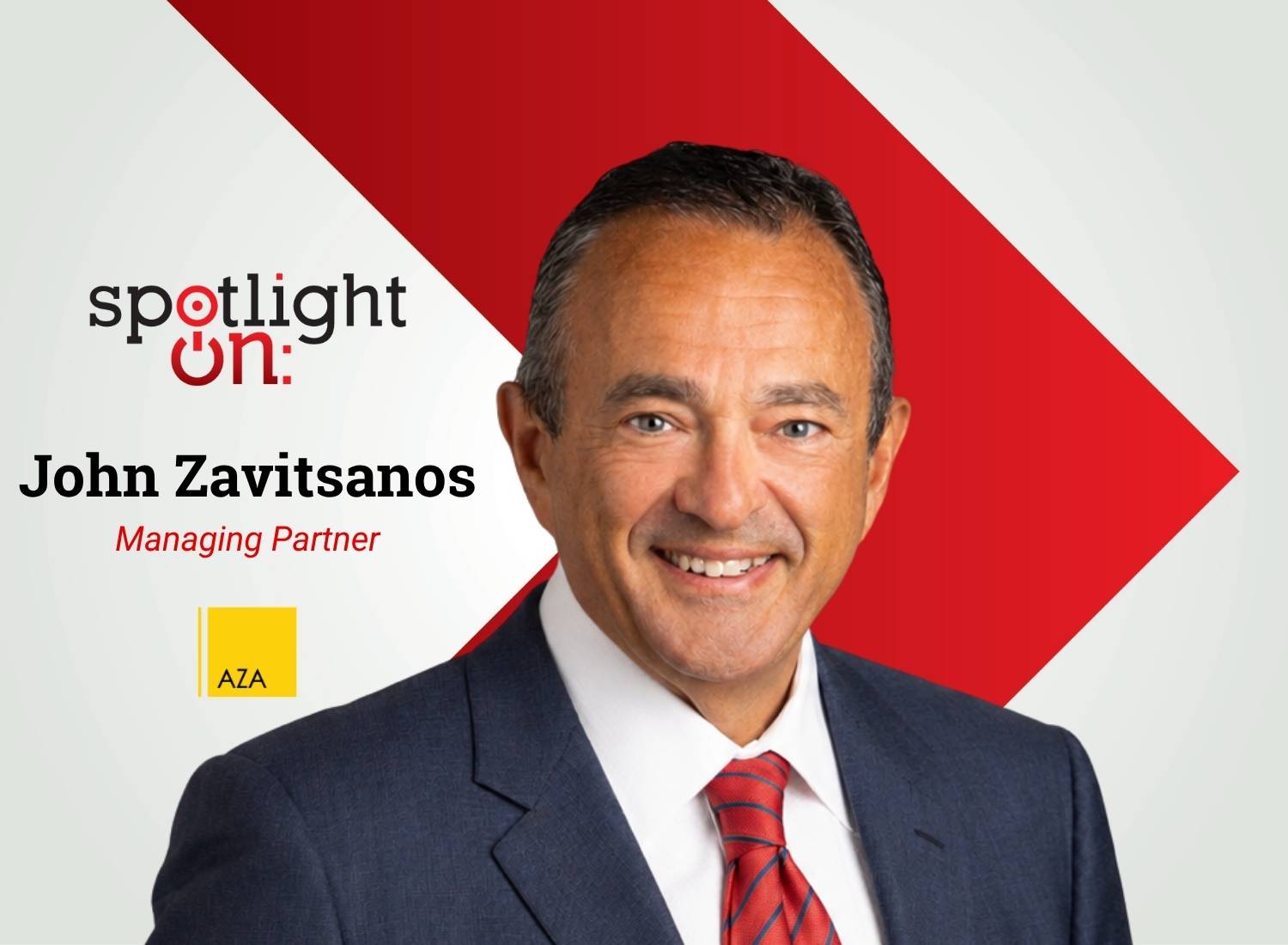 July 2026 — In an interview with Invest:, John Zavitsanos, managing partner of law firm AZA, outlined the trial-first philosophy that has made the Houston litigation boutique one of the most formidable in Texas. “We push to get to trial as fast as possible. The irony is that this almost always produces a better outcome — often a much better settlement — than endlessly pressing the other side for a deal,” Zavitsanos said.
Join us at caa’s upcoming leadership summits! These premier events bring together hundreds of public and private sector leaders to discuss the challenges and opportunities for businesses and investors. Find the next summit in a city near you!
What has been the key to building AZA into a trial-focused firm that is consistently hired right before important cases go to court?
Over the last 20 years, there has been a major consolidation movement in the legal industry. Firms that once had 500 lawyers are now considered midsized. Many of today’s largest firms — some with 2,000 to 4,000 lawyers — are primarily focused on business transactions: IPOs, financing, and real estate deals. That shift created a real opening for litigation boutiques, and we were formed 35 years ago to fill exactly that space.
In Houston, there are probably five or six truly elite boutiques. We are one of them. What sets us apart is our trial frequency and the quality of our people. Last year, we went to trial 18 times — an extraordinary number. Firms with 2,000 lawyers might have two or three trials a year. We average 15 to 20. This year, we had six trials before the end of March.
To sustain that, we hire selectively. First, we look for exceptional academic credentials — people who graduated with honors from the Top 10 to 15 law schools in the country. Second, we look for toughness, and typically that means finding people who have overcome real obstacles in life. People whose starting point was a little further back than average.
Third, and this is critical, we get our young lawyers into the courtroom right away. That means every single lawyer at our firm has been to trial. No other firm can say that. That matters enormously because you simply cannot give an intelligent answer on the value of a case — how much to settle for, what the risk is — unless you have been to trial frequently enough to know what juries are doing today.
How does that trial-first philosophy influence your strategy compared to firms that prioritize settlement?
There is a pattern that plays out at many firms. They pitch a company, get hired on a major case, bill millions in legal fees, and then, as the trial date approaches, the lawyers begin to panic because they have never actually been to trial. They disguise that fear with a basket of excuses: the jury might be unpredictable, the judge doesn’t like us, we’ve gotten some bad information. What they’re really saying is they don’t know what they’re doing in a courtroom.
Our approach is the opposite. We push to get to trial as fast as possible. The irony is that this almost always produces a better outcome — often a much better settlement — than endlessly pressing the other side for a deal. If you are genuinely prepared to go to trial, the other side knows it, and they capitulate. It’s the same principle Ronald Reagan applied to nuclear deterrence: The best way to avoid a fight is to be fully prepared for one. If they don’t settle, we go to trial. And in trial, I believe we are the best because we do it constantly, and we get real feedback from real juries about what works and what doesn’t.
How do you decide which cases are worth taking to trial?
We cover the full spectrum of commercial litigation, but we genuinely prefer cases that have a higher-than-average probability of actually going to trial. Our firm is built for it — our people, our processes, our entire operation is set up to push cases toward the courtroom. Cases that are purely settlement-driven? I’m honestly indifferent to those.
Because we hire the best people and pay at the same market rate as the largest firms in the world, we tend to be more expensive than smaller competitors. That means some smaller businesses can’t afford us, and I don’t like that. So we always carry a handful of cases that we handle for free, in exchange for the client’s commitment to push the case to trial. That keeps our young lawyers sharp and in court. We like fights where the stakes are high and the other side isn’t going to back down easily.
What do you look for when quickly assessing whether a case can still be won?
There are several moving parts. First, who is the judge? Every judge is human, and every human being has different tendencies, different things that irritate them. We do extensive research on every judge we appear before. Second, who are the lawyers on the other side? We study their weak spots and think carefully about how to use that to our advantage.
Third, where is the case being tried? AI has become a powerful tool here. There are now services that let you run demographic surveys on the community where the case is proceeding — how do people there feel about doctors, hospitals, insurance companies, and personal injury claims? We take that data and build it into how we present the case to the jury.
Finally, we think carefully about which of our lawyers should handle which witnesses. If you have a quiet, meek witness in their late 70s, I am not the right match for that cross-examination — I might come across as a bully. But a younger, aggressive witness who thinks he knows everything? That’s exactly the kind of matchup I want. We’re constantly asking: What combination gives us the best chance of winning?
What is driving your growth strategy, and how do you scale without losing your boutique, trial-focused culture?
That question keeps me up at night, frankly. Our culture is the most valuable thing we have, and it is the hardest thing to preserve as we grow.
I describe how we operate here as a family — not in the greeting-card sense, but in the real sense. Real families fight with each other, and they know exactly where the soft spots are. But if something happens to one of them, everyone shows up. That’s how we work. Critically, money is not our goal. It’s a consequence of what we do. If you ask our partners to name the five most important things at the firm, nobody will say money. In 35 years, we’ve never fought about money. That is almost unheard of in a law firm.
I used to say I would never open a satellite office because I believe in the power of people seeing each other every day. When you’re physically present with colleagues, it’s hard to be petty or resentful — you’re forced to work through it. Distance is where problems develop. So when we opened our Dallas office, I made a commitment to be there as often as possible.
All of these large firms from New York, Washington, Chicago, and Los Angeles are moving into Houston right now because we have more corporate headquarters than almost any other city in the country. When they arrive, they call our people and offer them extraordinary amounts of money. So far, every one of our people has told them no because they know what we have here is special. My job is to make sure it stays that way.
Want more? Read the Invest: Houston report.