


Spotlight On: Nick Wolda, President, Visit The Woodlands
Key points:
- • The Woodlands is building on record tourism by expanding convention and meeting opportunities.
- • Strong visitor spending is helping support local services and long-term economic growth.
- • Tourism is strengthening The Woodlands’ appeal as a destination for business, investment, and talent.
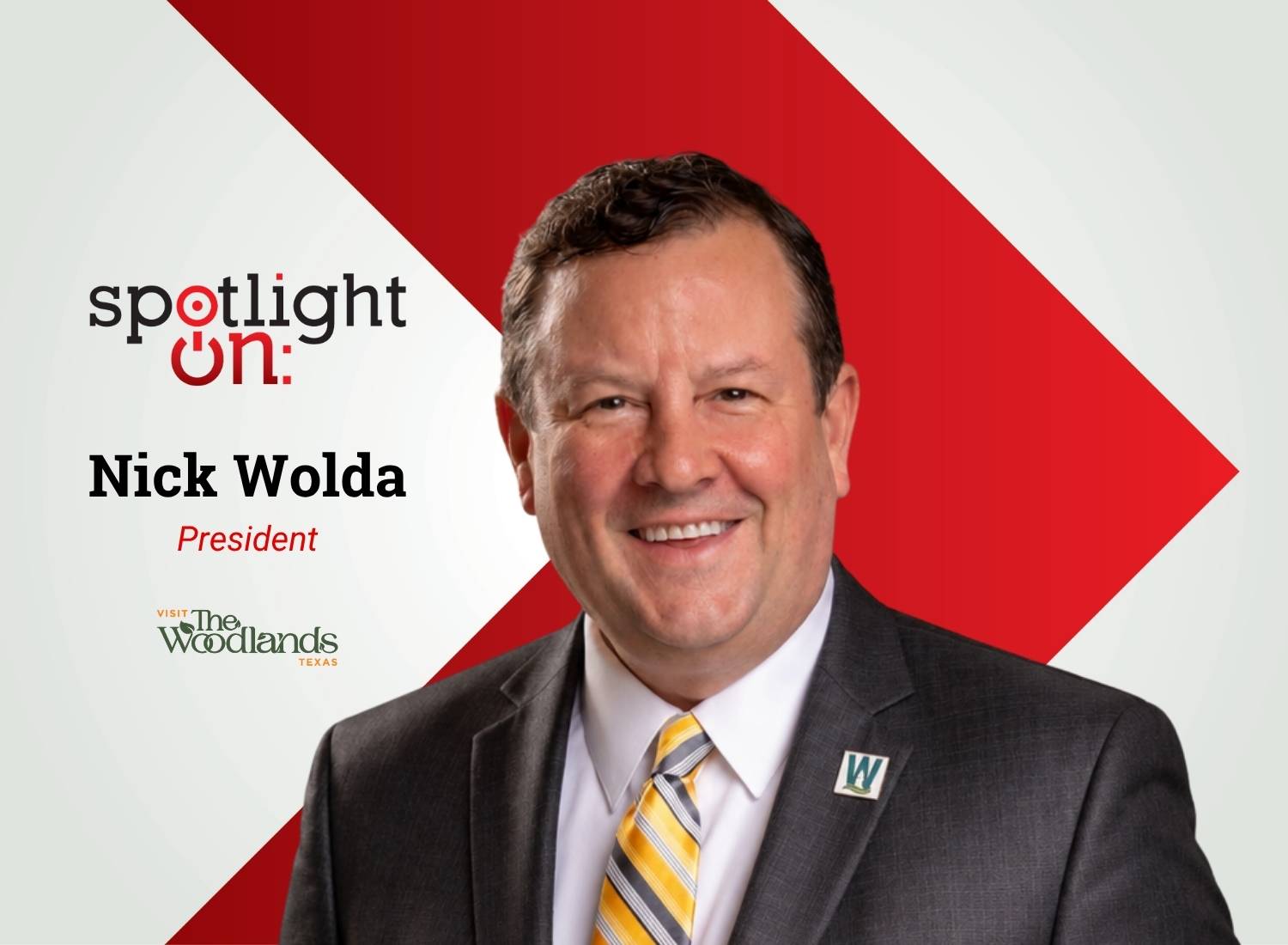 July 2026 — Invest: spoke with Nick Wolda, president of Visit The Woodlands, about how record-setting performance in recent years is shaping the community’s next phase of tourism growth, from convention demand to long-term economic development. “If you create a place where people want to visit, you’ll create a place where people ultimately want to work,” Wolda said.
Join us at the Invest: Houston 3rd Edition Leadership Summit! This premier event brings together hundreds of Houston’s business and regional leaders to discuss the challenges and opportunities for businesses and investors. Buy your ticket now!
How would you describe the overall health of the tourism economy today, and what is driving performance in 2026?
We are coming off two strong years. 2024 was a record year for our hotel properties, and 2025 was close to that high-water mark. The bigger point is that we achieved that without major new product coming online, meaning no additional hotels or a meaningful increase in room inventory.
We measure success largely through three revenue streams that support The Woodlands Township: hotel occupancy tax, sales tax, and a mixed-use beverage tax. We are not a city. We are a special-purpose district of roughly 123,000 people, and our model relies heavily on visitor spending to support local services and priorities.
According to state data we recently released, visitor spending in The Woodlands is $555 million per year. A lot of people recognize The Woodlands as a great place to live, and it has national and international visibility, but many still do not think of it first as a place to visit. We are not a traditional tourism destination in the way people think of San Antonio or Scottsdale, but we do attract significant corporate and convention meetings, meaningful leisure travel — especially from within Texas — along with international visitation from markets like Mexico. Overall, demand is healthy, and we feel good about 2026 as The Woodlands continues to evolve.
After a period of record occupancy, what is the next phase of growth for The Woodlands?
A major focus is the meetings and conventions segment, and the limiting factor is hotel supply and hotel mix near our convention assets. We recently released a study that quantified business that had to choose another location because we did not have enough rooms or the right type of rooms for the group’s needs. We do not like to frame it as lost business, but it is demand we could not fully capture.
We have a convention center on our Waterway, and it is in a sweet spot for groups that bring roughly 600 to 800 delegates. The hotel connected to that facility, The Woodlands Waterway Marriott, has 345 rooms, so many groups require multiple overflow hotels. That is why additional room supply within close proximity to the convention center is a priority, and it is a topic we are actively discussing with stakeholders and potential developers.
The Woodlands is largely built out in single-family housing, so the most visible growth opportunity is in our town center, where there are still parcels that can be developed. Meetings matter because they generate economic activity in a way that fits our community. A convention can be happening with hundreds of delegates and many residents would never notice, but those visitors are filling rooms, dining in our restaurants, and spending in our shops. That infusion is part of what keeps the community economically healthy.
Our model is unusual because over half of our township budget is supported by hotel and sales taxes. That structure helps keep local tax rates lower than they otherwise would be, so we pay close attention to how we perform in tourism and economic development.
How competitive is The Woodlands compared to downtown Houston and other Texas destinations when it comes to corporate meetings and events?
We are competitive, and we also collaborate. We work closely with colleagues across the region and participate in Visit Houston’s Around Houston approach, where multiple communities and attractions go to market together when Houston is leading national or international outreach.
Houston is built for large conventions, and we are not trying to compete for events with 10,000 or 20,000 delegates. We focus on our sweet spot, but planners will often evaluate Houston and The Woodlands, or Sugar Land and The Woodlands, at the same time. We also compete with other Texas markets, and even destinations outside the state.
We have landed groups that previously met in Miami and Nashville and are now coming to The Woodlands. Location helps us. We are centrally positioned within the continental United States, and we are close to the international airport — we like to say there are no stoplights or stop signs between IAH and The Woodlands. You can reach our town center quickly from the airport, which matters to planners thinking about ease of arrival and overall experience.
How are meeting planners and leisure travelers behaving differently today compared to a year ago, especially in terms of budgets or booking timelines and expectations?
I would not say there is a dramatic year-over-year shift. In the meetings space, especially for associations, booking cycles are often two, three, or four years out. We are always bidding on future dates, and we have booked business into 2028 and 2029. At the same time, we still pursue shorter-window opportunities, and we are currently pitching groups that could be here within six months.
The bigger trend is that face-to-face connection is back. The disruption of 2020 is now in the rearview mirror for most organizations, and people want to be together. Associations want members together. Companies want employees and customers together. That human element drives the demand for meetings.
We see it in our pipeline. Leads are at an all-time high, and site tours and site visits are at an all-time high. When planners visit, it often becomes more a question of when they will return than whether they will return. We take pride in the environment, public safety, and the overall look and feel of the community, and that experience is a meaningful differentiator.
Major venues and events continue to draw attention to The Woodlands. How are you planning to convert that event-driven traffic into longer stays or repeat visits?
One of the practical challenges for hotels is Sunday night occupancy. If you proposed a way to move Sunday nights from 45% to 80%, we would feel like we won the lottery. So we focus on strategies that extend stays.
If a meeting is scheduled Tuesday through Thursday, we ask whether there is a way to encourage attendees to arrive earlier, such as Sunday, and spend an extra day here. The Woodlands has an environment that supports that. Our town center is urban in design and architecture, but it is surrounded by millions of trees. Along the Waterway, there is a sense of tranquility even in a downtown setting.
We try to tell that story clearly: once you get here, you can breathe, refocus, and enjoy the environment. If you are coming for business, consider staying an extra day. That is how you begin to build longer stays and, over time, repeat visitation.
From a broader business perspective, how does a strong visitor economy support corporate relocation, investment, and overall economic development in the community?
If you create a place where people want to visit, you’ll create a place where people ultimately want to work. When people want to work somewhere, they ultimately want to live there. That cycle connects tourism, talent, and long-term investment.
The Woodlands has tangible attributes, such as nature, planning, waterways, and a walkable town center, but there is also an experience that people feel when they are here. Many describe it as a bubble, and it is difficult to fully explain until you see it.
We have examples of executives visiting for a concert at The Cynthia Woods Mitchell Pavilion or for a golf tournament and leaving with a different perspective, thinking that this is where they want their employees to live and work. The Woodlands is home to corporate headquarters of many sizes, and those decisions are often made because leaders want a place where employees can live, work, and enjoy a strong quality of life.
We coordinate closely with our economic development partners. Our focus is leisure travel, weekends, conventions, and corporate meetings, while their focus is corporate relocation. But the audiences overlap. A visitor who comes for a meeting may decide to open an office, relocate a headquarters function, or invest here because they want to experience this place more often. That is how a strong visitor economy supports broader economic development outcomes.
Want more? Read the Invest: Houston report.






