
Spotlight On: Ryan Mills, Office Managing Partner, Atlanta, CohnReznick
Key points:
- • CohnReznick is helping clients navigate cautious capital markets with financing, transaction advisory, and project finance expertise.
- • The firm is expanding into new markets and investing in AI and technology to improve efficiency and client service.
- • Strong relationships and high-touch advisory remain central to CohnReznick’s long-term growth strategy.
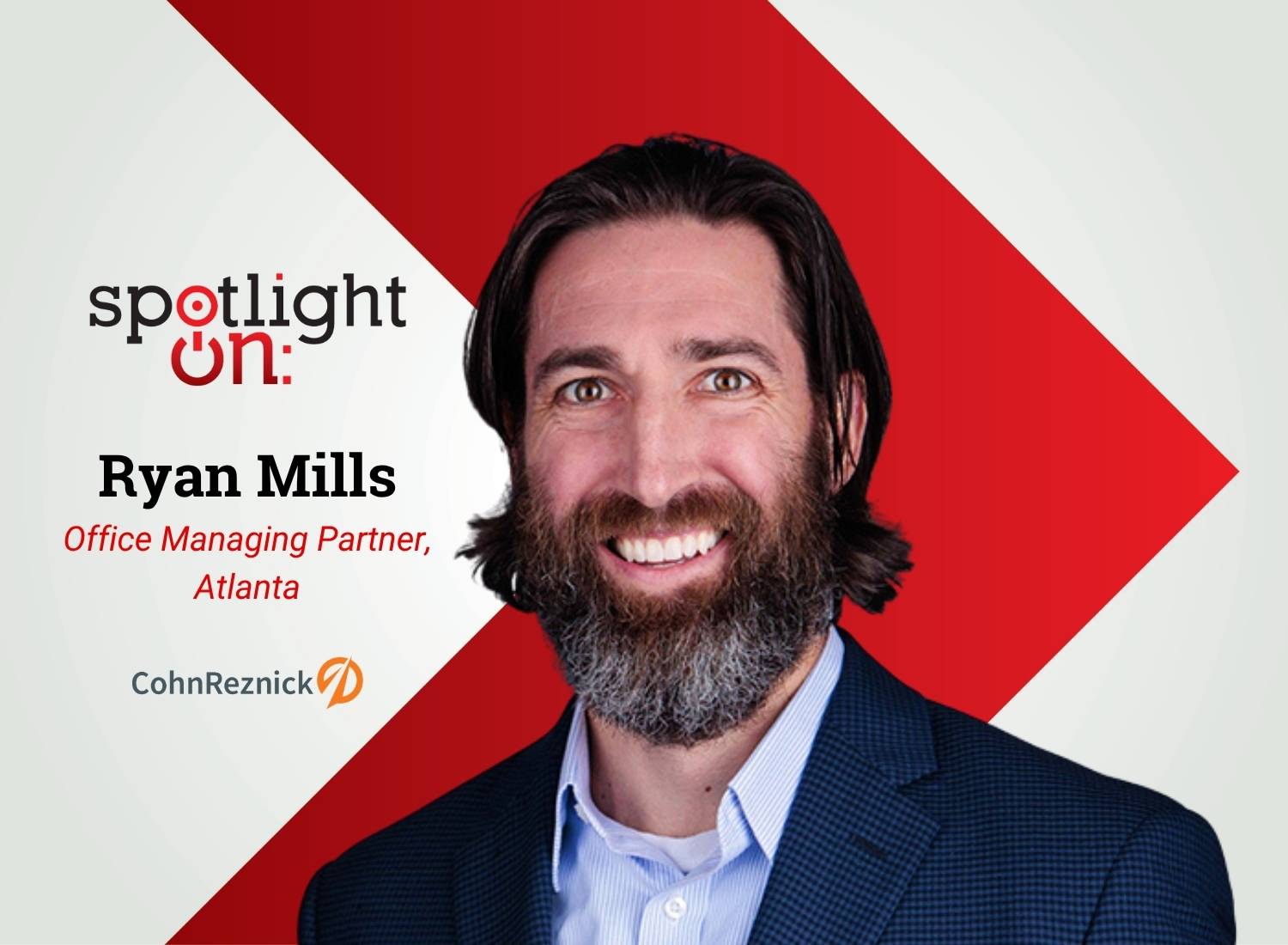 July 2026 — In an interview with Focus:, Ryan Mills, office managing partner at leading professional services firm CohnReznick, discussed trends in commercial real estate, the firm’s investment in technology, and its expansion plans. “The best thing you can hope for is to have a client want to go to you because they know they are going to get the answer they need and the help they need,” Mills said.
Join us at caa’s upcoming leadership summits! These premier events bring together hundreds of public and private sector leaders to discuss the challenges and opportunities for businesses and investors. Find the next summit in a city near you!
What trends are you seeing in commercial real estate and affordable housing, and how is CohnReznick helping clients navigate uncertainty in capital markets and financing?
The trends we are seeing, especially in commercial real estate and affordable housing, are similar to last year. Things are still moving slowly. We are seeing more activity than in previous years, but the dam has not broken yet. Capital markets are still hesitant.
We work with private equity groups, lenders, and clients across different parts of the capital stack. We can help clients through introductions, project finance, and modeling. Within affordable housing, we are adept at assisting clients who are trying to figure out how to get projects funded.
We also help with exits. If clients are looking to exit a deal or buy out the limited partner, our project finance group can assist with pricing and strategies for exiting or re-syndicating.
Within commercial real estate, we also have our client accounting services group. Some clients are trying to scale back from a cost standpoint, and back-office accounting is one of those areas where we can assist.
CohnReznick recently secured outside investment to accelerate growth and innovation. How has that changed the firm’s strategic priorities?
It has allowed us to grow in a way that we were not able to before. Within the last year, we moved into the Minnesota market, and there are a few others that we are either identifying or will be moving into in the near future. The investment we received has allowed us to do that in a smart way. We can be strategic and thoughtful about acquisitions and transactions. We are identifying markets that we need to be in, identifying industries where we need more depth, and finding firms we can partner with to help bridge that gap.
From a technology standpoint, the capital has allowed us to explore new technologies for tax, audit, and accounting services. We are trying to make our audits more efficient and stay on the cutting edge as the industry evolves.
From a talent standpoint, it is allowing us to find partners in industries where we want a bigger presence and helping us make sure we are right-sized and have the right people in the right spots.
How are clients responding to the growing role of technology in accounting and consulting, and where do you see the biggest opportunities?
Thus far, our clients have asked questions about it, but it has not been a huge topic of conversation. Their biggest concern is ensuring they continue to receive the quality of service they are accustomed to when working with CohnReznick. We have assured them that our service is not going to change. If anything, technology is going to help us be more efficient and better able to serve them.
We are seeing opportunities in using AI as a double-check or quality-control review on the items we are producing. It is not being used in place of doing the work. We are not simply plugging work into AI.
It is being used as another tool in the tool belt to help us be more efficient, improve quality, and make sure we are providing the service we promised we would provide.
What industries are driving the most growth in the Southeast, and how is CohnReznick positioning itself to support those businesses?
In the Southeast, real estate, though slower, is still continuing to grow. We are still seeing expansion there, especially in Atlanta and in our Miami office. Those are two of our biggest growth industries.
We expect real estate to continue growing. We are also seeing additional growth in technology. Though it may not be as big in the Southeast as in some other regions, it is continuing to expand, and we are taking a renewed focus on how we can properly service those companies.
I will add a caveat to that by saying I am a commercial real estate partner, so that is where my focus is. Within the Southeast, we are seeing strong growth, but it is not quite as rapid as everyone was hoping it would be at this point.
How does CohnReznick differentiate itself from larger firms when advising growth-oriented businesses that are balancing compliance demands with innovation?
With growth-oriented businesses, we recognize that companies can only focus on so many things. When a business is growth-oriented, one of the last things it often worries about is accounting, because it is viewed as an overhead expense. We are used to that because we work with so many clients in that position.
We assist those clients by recognizing that their primary focus is raising capital or securing the next deal. To help with that, we provide as much high-touch service as possible so they do not have to focus as much on the accounting aspect of the business.
We are always available to provide guidance within a reasonable level. If we are doing an audit, we have to remain independent, and if we are doing tax work, there are certain lines we cannot cross. But we make sure we are providing clients with the highest level of service and as many touchpoints as possible.
Because of our deep experience with clients in growth stages, especially on the tax side, we can identify when a client reaches a certain level and needs to start thinking about tax strategies. If there is a capital event ahead, we help make sure they are well-positioned and not overpaying on taxes.
Are you seeing increased demand from private equity and investors for operational guidance beyond traditional audit and tax services?
Absolutely. We have seen a lot of growth within our transaction advisory services. A lot of that comes from clients that we may have previously provided audit services for, but no longer do. Because our independence issues have changed, we are able to provide other services to them. It is also often where we are introduced to new clients.
We have many relationships with private equity groups, so as transactions are happening, we work with them to provide due diligence, quality of earnings reviews, and other services to make sure the information they are receiving is accurate.
We are seeing an uptick in that as more private equity transactions take place. That creates opportunities for us to assist those groups, and then down the line, there may be audit work or tax work we can help with.
What role can technology and advisory firms play in helping affordable housing and public sector projects remain financially viable while still serving communities?
A lot of times, we help through our project finance group, which can help with projections, calculations, and identifying whether a project is viable.
One of the big things we do is our New Markets Tax Credit Conference in Miami. At that conference, syndicators, developers, and other participants needed to make a deal happen, and all converged to have those conversations. We are able to put those people in one room and hopefully help get deals done.
As projects hit different points in their lifecycles, we work actively with clients to make sure they are aware of the implications. If they are in year 15 or now outside of their LURA, we help them understand what that means and identify areas where there could be pitfalls.
Looking ahead, what do you hope clients and employees will say distinguishes CohnReznick from other professional services firms in the market?
The thing I would hope differentiates us is what I have always strived for, which is that we provide world-class client service.
Even with changing technologies and the globalization of certain services within firms, I would hope clients identify CohnReznick as the accounting firm they can trust, the one that provides the service they are looking for, and the one that is always there when they need it.
As a client service firm, the best thing you can hope for is to have a client want to go to you because they know they are going to get the answer they need and the help they need. No matter how things change, I want CohnReznick to be known for its personal touch and exceptional client service.
Want more? Read the Focus: Atlanta report.