



Charlotte Business news today: A towering $36.5M bet
Key points:
- • Singerman and Riverside paid $36.5M for the former Two Wells Fargo Center at 301 S. Tryon.
- • Charlotte Council holds a Sept. 28 hearing on historic landmark status for the 1971 tower.
- • Landmark status could save developers over $350,000 a year in property taxes.
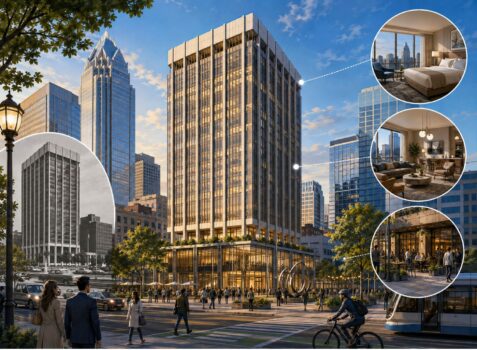 August 2026 — Uptown Charlotte is about to get a second act for the tower that once announced the city’s arrival as a banking capital. Charlotte business news today centers on 301 S. Tryon St., the 32-story former Two Wells Fargo Center, where a Chicago investment team has agreed to pay $36.5 million for the full city block, Axios Charlotte reported , and begin converting the 1971 skyscraper into a mix of hotel rooms, apartments and street-level retail, with a redesigned public plaza.
Join us at the Invest: Charlotte 6th Edition Leadership Summit! This premier event brings together hundreds of Charlotte’s business and regional leaders to discuss the challenges and opportunities for businesses and investors. Buy your ticket now!
Singerman Real Estate and Riverside Investment and Development closed on the property earlier this year and are now asking Charlotte’s Historic Landmark Commission to designate the tower a local landmark, a status that would unlock significant tax relief in exchange for design oversight on any future exterior changes.
The building’s history explains why the request matters beyond one real estate deal. Built in 1971 and once the tallest structure in North Carolina, the tower helped anchor Charlotte’s reputation as a regional banking hub. The city would eventually turn into the country’s second-largest banking center. That legacy is what the new owners are betting on: rather than demolish a dated office building in a market still working through post-pandemic vacancy, they plan to lean into the tower’s mid-century pedigree, marketing its scale and Uptown address to hotel operators, residential developers, and retailers who want a foothold downtown without building from scratch.
The financial mechanics are where the story turns into a broader lesson about how cities are handling aging office stock. If the Historic Landmark Commission approves the designation, Charlotte estimates the developers could save more than $350,000 a year in property taxes at the tower’s current assessed value, an incentive designed to offset the higher cost of adaptive reuse compared with a routine renovation.
The developers are separately pursuing National Register tax credits, a federal program that can cover a meaningful share of qualified rehabilitation costs for historic structures. Stacking local and federal incentives on top of a below-market acquisition price is becoming the standard playbook for turning 1970s and 1980s office towers into something a modern tenant actually wants, and Charlotte’s Uptown submarket has more of that vintage stock than almost any city its size.
Charlotte’s office market has plenty of company nationally. Vacancy in older, amenity-poor towers has stayed elevated across most major U.S. downtowns even as leasing for newer buildings has recovered, pushing owners of aging assets toward conversion rather than a wait-and-see approach.
What sets 301 S. Tryon apart is the combination of size, address and symbolic weight: converting the building that helped make Charlotte a banking town into hotel rooms and apartments is the kind of story that resonates with residents in a way a generic office-to-residential deal does not. It also gives the city a test case for whether historic-landmark status, typically associated with much older buildings, can be stretched to cover a 1970s tower without setting a precedent that ties up every future redevelopment in design review.
The timeline will now take the decision to Charlotte’s City Council. A public hearing on the landmark designation is scheduled for Sept. 28, with a council vote to follow. That gives the developers a firm date to build community and business support, and gives skeptics of the tax break a chance to weigh in before it becomes final.
Council members will have to balance a straightforward economic argument, that the incentive makes an otherwise marginal conversion pencil out, against questions about whether extending preservation tools to newer buildings dilutes their purpose. Either outcome will shape how the next owner of an aging Uptown tower approaches redevelopment.
For Charlotte’s broader business community, the deal is worth watching regardless of how the vote lands. A successful conversion would add hotel rooms and housing units directly in the financial district at a moment when Uptown’s daytime office population has not fully returned to pre-pandemic levels, giving restaurants, retailers and transit ridership a shot of the foot traffic they lost. It would also hand other owners of dated Uptown office towers a tested financing template, pairing local tax relief with federal historic credits, that could accelerate similar projects across the skyline the original tower helped build.
If the vote goes through, Charlotte will have turned a symbol of its banking past into a working example of how legacy cities keep aging towers relevant.
Want more? Read the Invest: Charlotte report.