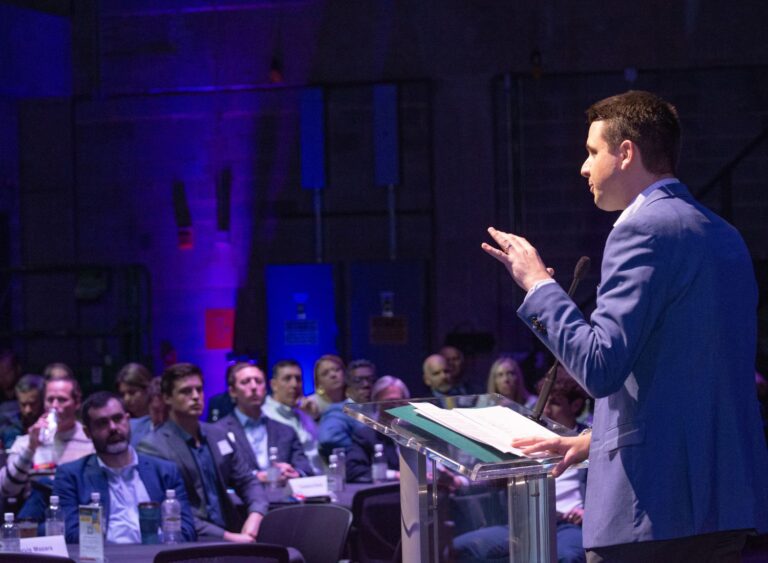


Michael Cabanas, Regional Managing Director, Fiduciary Trust International
 Invest: sat down with Michael Cabanas, regional managing director at Fiduciary Trust International, to discuss how families are navigating cross-border complexity, intergenerational wealth transfer, and a rapidly changing market. In Miami, he sees resilient investors emerging from a year of political uncertainty, shifting tariffs, and accelerating AI adoption. For Cabanas, the foundation is discipline: “We learn early on that successful investing isn’t about timing the market; it’s about time in the market.”
Over the past year, what changes have had the biggest impact on you and your team at Fiduciary Trust International?
At the start of 2025, we knew a new U.S. president was coming in. There was a lot of excitement, but also some real uncertainty. No one knew exactly which policies would take shape, how tariffs might change, or what would ultimately happen with the large economic package under debate.
Even with those open questions, the year turned out far better than many expected. By year-end, markets were up double digits, corporate earnings were stronger, and interest rates had not only come down but also were clearly moving lower. That combination has gone a long way toward restoring confidence and optimism among both clients and colleagues.
The other major theme has been artificial intelligence. There’s been enormous investment in AI infrastructure and capabilities, but most companies are still in the early stages of putting it to work in a meaningful way. We see 2025 as the year of infrastructure investment, with 2026 shaping up as the point when all that investment starts to translate into real, practical changes in how businesses and individuals operate, including in wealth management. It’s disruptive, it’s exciting, and it’s something we spend a lot of time analyzing.
How does Fiduciary Trust International approach cross-border planning, and what are the most common challenges you see?
One of the biggest challenges we see is more conceptual than technical. In the United States, estate and tax planning is largely built around trust structures. In many parts of Europe and Latin America, that’s simply not the norm. Families and business owners are much more accustomed to holding assets through companies or LLCs.
When individuals and families bring assets onshore, often with the support of strong outside counsel, our role is to help bridge that gap and guide them through a structure that can feel unfamiliar at first. For families coming from jurisdictions where the rule of law may be less predictable, the idea of being a beneficiary of a trust, without technically owning the assets, can feel unsettling.
Alongside their attorneys, we spend a significant amount of time explaining how the framework works, why it’s designed to protect them, and the advantages it offers for multijurisdictional families and businesses. Cross-border planning has always been part of Miami’s story, but the pace has clearly accelerated since the pandemic. Starting that planning early and building comfort with the concept of trust structures has never been more important.
.How do you approach intergenerational wealth transfer, especially balancing growth and preservation while preparing younger generations for stewardship?
Communication is everything. No two families are exactly alike, but many successful families share a common thread: the desire to protect their children from mistakes that could derail their lives. In practice, that often means shielding the next generation from the experiences that helped their parents become successful in the first place.
Struggle plays an important role in helping all of us reach our full potential, and when it’s removed too early, say at age 10, 15, or even into their 20’s, those lessons often show up later, and usually in much harsher ways.
I recently read something that really resonated with me: we’re less likely to regret what we didn’t do for our children, but far more likely to regret what we didn’t let them do for themselves. That idea gets to the heart of intergenerational planning. Parents are often only as happy as their least happy child. Our role is to help families design both the structures and the conversations that give children room to fail, learn, and ultimately thrive, while still preserving the family’s long-term goals.
How is technology changing the way Fiduciary Trust International delivers wealth management, trust, and custodial services?
We’re in an experimentation and preparation phase. As a firm, we have a corporate license to use AI tools within a closed ecosystem, which ensures that anything we input stays inside the organization. We’re also able to draw on broader data sets to help research ideas and sharpen our thinking.
There are still important considerations around security, privacy, and governance, so we’re moving thoughtfully, but we’re absolutely curious about learning new ways to implement the technology effectively.
On a personal level, I took an AI prompting course at the University of Texas McCombs School of Business and have encouraged many of our colleagues to do the same. I often describe AI as the best intern you could imagine, one with access to virtually all of human knowledge. But just as you wouldn’t send an intern’s first draft straight to a CEO or a client, you can’t send what AI initially produces out the door. Human judgment, experience, and context still matter. What will change is the amount of busy work we do, and that’s where technology can drive real productivity gains.
In today’s volatile global economic environment, how has Fiduciary Trust International adapted its investment strategies and risk-management approach?
Our philosophy has always been to stay focused on the long term and not get pulled off course by short-term volatility or headlines. If you look at the S&P 500 over a year or two, it can feel unsettling to imagine investing your family’s entire nest egg in that environment. But when you zoom out to 10, 20, or 30 years, you see a different picture. We learn early on that successful investing isn’t about timing the market; it’s about time in the market.
That said, discipline doesn’t mean standing still. When tariffs were shifting and markets sold off earlier this year, we stayed committed to buying high-quality companies, diversifying globally, and keeping portfolios aligned with each client’s time horizon.
We tend to be late adopters of new technologies, but when we identify durable businesses in areas like semiconductors and AI infrastructure, we start with modest positions and build over time. Quality, diversification, and patience remain the pillars of our approach to risk.
When you look ahead, how do you see the role of firms like Fiduciary Trust International evolving?
I believe our role will continue to evolve with broader changes in society. As analytical tools become more widely available, communication and education will matter more than ever. We already focus heavily on educating clients through webinars on topics like selling a business, women and wealth, and AI. And with the largest generational wealth transfer in history underway, preparing the next generation is critical.
We also see the investment landscape broadening. In recent years, a small group of large technology companies has driven a disproportionate share of returns, but as new technologies are adopted across other businesses, we expect more sectors to benefit. This reinforces the importance of diversification beyond the mega-cap names.
Ultimately, when families evaluate a firm like ours, they’re asking three simple questions: can you help us, can we trust you, and do you care about us? As long as we continue to show clients the answer is “yes” to all three, firms like Fiduciary Trust International will remain highly relevant for affluent and ultra-high-net-worth families globally.