Spotlight On: Miriam Singer, President & CEO, Jewish Community Services of South Florida
Key points:
- • JCS is responding to rising food, housing, and mental health needs across South Florida.
- • Data and measurable outcomes guide programs, funding, and resources.
- • Collaboration among nonprofits, businesses, and government strengthens regional resilience.
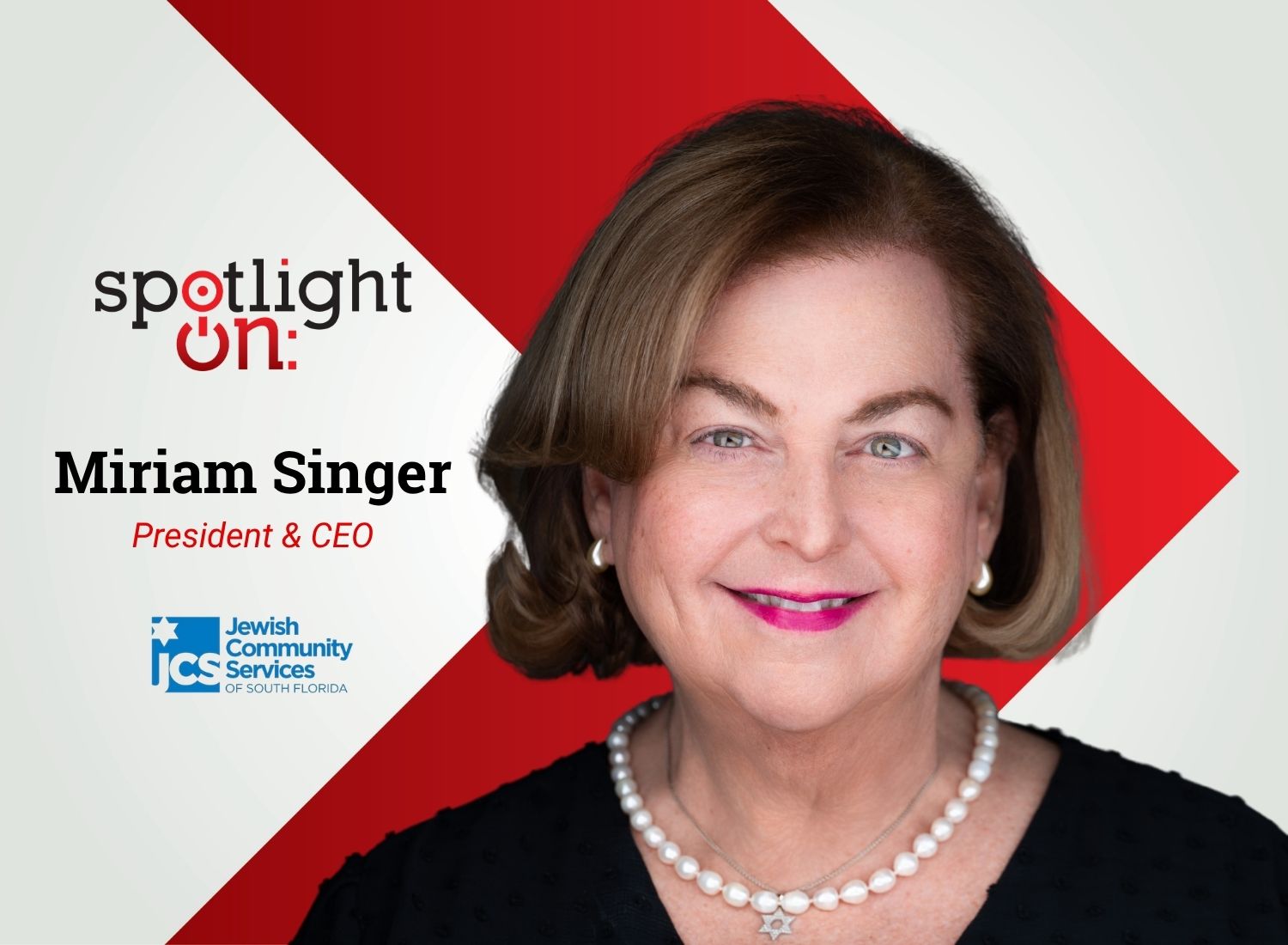 August 2026 — Invest: sat down with Miriam Singer, president and CEO of Jewish Community Services of South Florida, to discuss the mounting pressures facing the nonprofit sector, the growing intersection of human services and economic resilience, and why measurement, accountability, and cross-sector collaboration are essential to sustaining a healthy regional economy. “A strong community rests on a three-legged stool: business, government, and social services,” Singer said.
Join us at the Invest: Miami 11th Edition Leadership Summit! This premier event brings together hundreds of Miami’s business and regional leaders to discuss the challenges and opportunities for businesses and investors. Buy your ticket now!
What have been the main challenges and emerging opportunities for the nonprofit sector in South Florida over the past year?
The reality is that 2025 was a year of uniquely traumatic challenges for the nonprofit sector, particularly in the areas of food insecurity, housing instability, and emotional wellness. We have seen a dramatic increase in South Florida residents coming to Jewish Community Services and our broader safety-net agencies seeking help to survive for the first time.
People are making impossible decisions. They are choosing between paying for insulin or putting food on the table, between repairing a car or feeding their children. Even comparing with times in need during the pandemic, we are seeing new levels of desperation and an increase in the number of individuals and families suffering from food insecurity, housing and illness.
Compounding that reality has been a reduction in government funding that trickles down to local communities. A clear example was the pause in SNAP benefits in November. In Miami-Dade County alone, nearly half a million people rely on SNAP to make it through the month. The average SNAP benefit is $200, which may not seem like a large amount, but when it pauses, the consequences are immediate.
At JCS, we serve tens of thousands of people each year across more than 20 human and health services, and home care programs. In the midst of these challenges, we recognized an opportunity to build bridges, to bring together community energy and resources in a way that can respond quickly and effectively to urgent needs.
How do you assess the effectiveness of JCS’ programs, and what metrics guide your decision-making?
We love this question because it goes straight to the heart of how we operate. We run our agency as a business. A business with compassion, but a business nonetheless. We are in the business of caring for frail and vulnerable individuals of all ages, from toddlers to our oldest client, who is 109 years old.
Every program we run has assessment tools, treatment plans, and clearly defined feedback loops. That includes evaluation by the professional working with a family or individual, direct feedback from the person receiving services, and third-party data where appropriate. For example, our 2-1-1 program uses a secret shopper model run by a local university, which provides independent performance data.
We are also a CARF-accredited agency. CARF is a rigorous accreditation process that evaluates non-profit agencies against best practices, including clinical standards supported by research. In late December, we received our three-year reaccreditation for every mental health program we operate. For the first time in our 106-year history, we also achieved accreditation across all of our case management programs.
Our case management work includes serving nearly 400 Holocaust survivors, with an average age of 95. It includes services for survivors of domestic abuse through our Shalom Bayit Program, where we are currently serving about 180 individuals, including 85 children. It also includes our New Americans Program, supporting individuals who have recently arrived in South Florida and need help navigating systems so they can become self-sufficient contributors to a healthy economy.
As part of treatment planning with our clients, we identify specific indicators of success. In business language, those are key performance indicators. We use those metrics to assess outcomes for clients and to guide strategic decisions about which programs to expand, adapt, or sunset.
If another organization is already providing the same service in the same way, we move in a different direction. We try to stay agile, using business principles to determine where we can add the most value. If demand is high for a service, we focus on marshalling resources, securing grants, pursuing government appropriations, and engaging corporate partners, because the community’s need has spoken to us.
How does data from programs like 2-1-1 and crisis services shape your priorities?
The 2-1-1 line is an information and referral line for Miami-Dade and Monroe counties, with about 4,500 resources in its database. It helps connect people to essentials such as food distribution, childcare, employment support, and healthcare services. It is offered free of charge, with strong coverage in Spanish, English, and Haitian Creole, plus additional languages, as needed.
We also operate the 24/7 988 suicide and crisis lifeline for Miami-Dade and Monroe. Together, 2-1-1 and 988 help us do two things at once: serve people “in crisis the moment,” and capture data on what needs are rising across the community. That data informs funding priorities, program design, and how we tailor service delivery.
We have used that approach repeatedly, from adapting food distribution models during the pandemic to responding quickly when public benefits are disrupted. For a nonprofit of our size to make impact at scale, the essential bridge is trust. The secret sauce has always been our reputation for high-quality care and the confidence of our investors, including businesses, corporations, individual donors, family foundations, and government partners.
What strategies does JCS use to raise awareness of its services, particularly among people who may not know help is available?
Our brand is elevated by a proven reputation, and that confidence and awareness grows through action. When a crisis happens – the collapse of a building, a pandemic, or a residential fire – we show up. We call municipalities and community partners and ask what is needed. Our team provides what we can directly, and we bring other partners into the fold to respond collaboratively and effectively.
An example of the quality of our work and partner agencies involved a threat to eliminate countywide funding for non-profit services. JCS convened agencies across the community. We organized press conferences, wrote editorials, and generated earned media across print, radio, and television. We told the story of what would happen if the funding disappeared.
That collaboration was successful. Miami-Dade County ultimately approved more than $26 million after we faced the possibility of going from full support to zero. The outcome reflected what can happen when nonprofit leaders, government partners, and elected officials align around needed solutions.
Is there anything else you would like business and civic leaders to understand about the role of nonprofits in the regional economy?
A strong community rests on a three-legged stool: business, government, and non-profits. Business alone does not function without the government. Government alone does not function without non-profit support and reach into our diverse communities. When the three sectors work together, there is a complementarity that allows expertise to align, resources to stretch further, and outcomes to improve.
The purpose is not only to respond to crises, but to build bridges towards self-sufficiency, so residents going through trauma can heal, survive, thrive, and ultimately contribute back to the economy that supported them through hard times.
An auditor recently asked me directly what keeps me up at night. My answer was hunger, and the reality that in a community as extraordinarily wealthy and safe like ours, residents are still suffering from hunger and homelessness. Organizations like ours have the challenge and privilege of bringing those worlds together. Our responsibility is to honor that privilege through accountability, quality, and a relentless focus on impact, while also marshalling our resources and strengthening the broader safety-net to meet the needs of the moment.
Want more? Read the Invest: Miami report.