


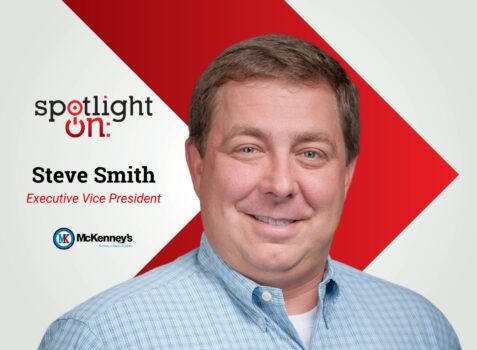
Spotlight On: Steve Smith, Executive Vice President, McKenney’s
Key points:
- • Labor constraints and rapid technology adoption are reshaping construction.
- • Healthcare and data centers are fueling Charlotte’s construction demand.
- • McKenney’s is expanding capacity while prioritizing sustainable growth and culture.
 August 2026 — In an interview with Invest:, Steve Smith, executive vice president of construction company McKenney’s, highlighted labor constraints and accelerated tech adoption as major forces shaping the industry. “Everyone is trying to figure out how to either avoid being displaced by AI or how to use it to augment and improve their work,” Smith said.
Join us at the Invest: Charlotte 6th Edition Leadership Summit! This premier event brings together hundreds of Charlotte’s business and regional leaders to discuss the challenges and opportunities for businesses and investors. Buy your ticket now!
What changes in the past year have most impacted McKenney’s work across its markets, and how has the company adapted?
Rather than a change just in the past year, it’s more of a continuing trend in terms of labor that’s affecting everyone in our market. Having all the right people available to do the work needed to build these projects has been a challenge. That applies to both fieldwork and office roles. It takes a wide range of skill sets to deliver large, complex projects, and the availability of that talent has remained tight. While it’s not necessarily a new issue, it has not gone away.
The other big factor is technology. Again, it’s not that technology itself is new to our industry, but the pace of change has accelerated. That might be the most significant shift we’ve seen. Everyone is trying to figure out how to either avoid being displaced by AI or how to use it to augment and improve their work. That applies across the planning and management side of construction. There are aspects of the job, particularly installation work in the field, that AI can’t replace. But everything leading up to that point? There are increasing opportunities to drive efficiency and improve productivity.
If I had to call out one thing that’s changed more dramatically in the last 12 months compared to the year before, it’s the speed and breadth of how these tools are being applied. And I expect that to continue accelerating over the next several years.
Why is Charlotte a key market for McKenney’s, and what makes this region ideal for your continued growth?
We’ve had a long-standing presence in Charlotte for more than 35 years. We’ve built up solid infrastructure here: fabrication capabilities, logistics, and most importantly, a strong base of employees who live in the area. That foundation has positioned us well as Charlotte has grown into one of the country’s most dynamic markets.
The construction market here has remained active and relatively steady. Like everywhere else, we saw some hiccups, particularly in commercial office development, as companies worked through their return-to-office strategies. That shift created uncertainty around how much space companies actually needed, how to lay it out, and how to balance employee expectations with organizational culture.
There was a point when the workforce had most of the leverage, asking for maximum flexibility and amenities. But that pendulum has started to swing back. Some people found that working from home full-time wasn’t as ideal as expected. They missed the human interaction and energy of being in the office. We’re seeing a shift toward hybrid work, which seems to be where most companies and employees are landing.
That whole process disrupted the commercial market, but it feels like we’re starting to reach a new equilibrium.
How has Charlotte’s evolution shaped McKenney’s investments in the region?
Much of what we’ve done in recent years has been about preparing for future demand. While commercial office slowed, healthcare remained steady. The demand for medical facilities isn’t going anywhere, and many systems saw this period as an opportunity to invest in long-term infrastructure.
More recently, we’ve seen a surge in mission-critical work, particularly around data centers. Charlotte has become a highly attractive market for that kind of development. It has available power capacity, competitive rates for high-usage customers, and plenty of land in proximity to the metro area. There’s also a well-established fiber network in the region, much of it built to support the banking industry. All of those factors make Charlotte an ideal location for mission-critical construction.
Right now, all three of our core markets, healthcare, commercial office, and mission-critical, are picking up simultaneously. That convergence is a big driver behind our continued investment here. We’ve expanded our footprint, increased our shop and warehouse capacity, added office space, and grown our team. The key is that we made these moves before the current surge, so we’re not scrambling to catch up. We’re ready for it.
How do complex projects like the airport’s energy infrastructure reflect McKenney’s capabilities and approach?
We’re intentional about the work we pursue. We have a broad skill set and internal capabilities that allow us to take on complex, high-stakes projects, but that doesn’t mean we take on everything. There are plenty of jobs we’ve passed on because they didn’t align with our strengths, timing, or capacity.
There are many ways to approach mechanical systems. Some fall in our wheelhouse, and others do not. When we decide to take on a project, we want to do it with excellence. If we can’t do that — if we’re not the best fit — we’ll be honest about it with the client.
The central energy plant project at the airport is a great example. It was a capacity-driven initiative. With the airport expanding, they needed to increase their cooling capacity, and we delivered that in an efficient, forward-looking way. It wasn’t solely about energy savings; it was about building infrastructure that could scale with demand.
What sets McKenney’s apart in how it chooses and manages projects?
Our philosophy is to make sound business decisions first, then apply those principles to construction. We don’t just want to be a great mechanical contractor; we want to be a great business that happens to specialize in mechanical systems.
That means we evaluate projects based on fit. We look at our current capacity, our expertise, and the client’s expectations. We’d rather let someone down once up front by saying no than let them down over the next 18 months by struggling through a job we weren’t prepared to take on.
It also means staying disciplined. We don’t chase every opportunity. We focus on the work we’re truly great at and where we know we can deliver lasting value.
What are McKenney’s top priorities for the next two to three years?
We’re expecting significant growth in the local market, and our goal is to grow right along with it. We’re not chasing size just for the sake of being the biggest. If our market share is X, and the market doubles, we want to maintain that share and grow sustainably.
One of our biggest internal priorities is continuing to be a great place to work. We’ve been recognized as one of Charlotte’s Best Places to Work multiple times, and that recognition matters to us, not because of the plaque but because of the feedback we get from our team. We listen, we adapt, and we work hard to improve based on what we hear.
Hiring is a huge part of that. If we get the hiring process right, McKenney’s can be the last company someone needs to work for. We want to be the right fit for our people just as much as they’re the right fit for us. That approach helps us build a strong culture and stay ready, instead of reacting after the fact.
What is your outlook for McKenney’s and the Charlotte market?
Charlotte is on the verge of substantial growth, especially in sectors like mission-critical. The challenge will be having enough labor to meet the coming demand. Whether it’s electricians, plumbers, carpenters, or HVAC specialists, the labor pool isn’t going to be large enough to handle it all locally.
That could mean longer timelines for projects or bringing in outside labor, which puts more pressure on housing, hotels, and infrastructure. It’s a good problem to have in terms of economic activity, but it still requires careful planning.
We’ve worked to get ahead of that by building our team and expanding our resources in advance. That puts us in a strong position, but no one will be totally immune to the challenges.
Our mission remains consistent: to be the best place to work and the best partner to work with. If we treat our people the way we want them to treat our customers, everything else tends to follow.
Want more? Read the Invest: Charlotte report.