

Pittsburgh advanced manufacturing hub keeps expanding
Key points:
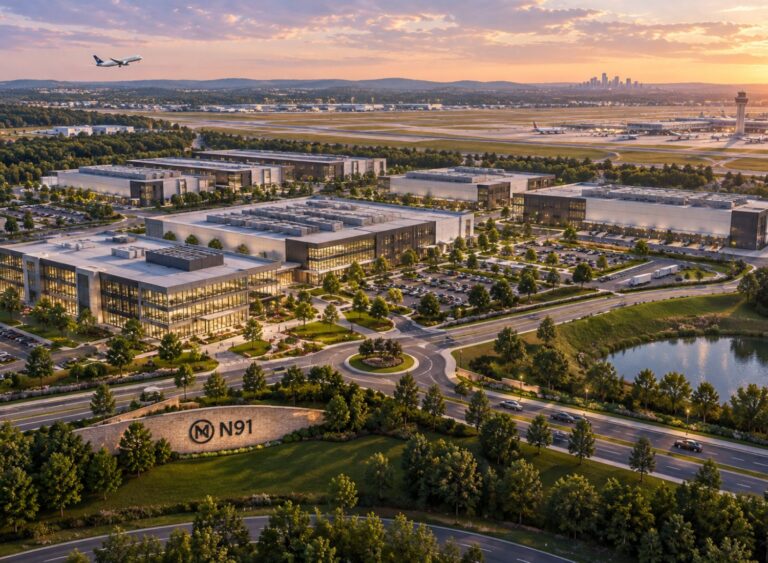
- • RIDC’s Neighborhood 91 campus is adding a 108,000-square-foot building, with a third already under consideration.
- • GE Vernova’s $166 million expansion across Allegheny and Westmoreland counties adds 714 new jobs and signals confidence in the region’s industrial workforce.
- • Carnegie Mellon University and the University of Pittsburgh anchor a talent pipeline that keeps Pittsburgh advanced manufacturing competitive against other U.S. markets.
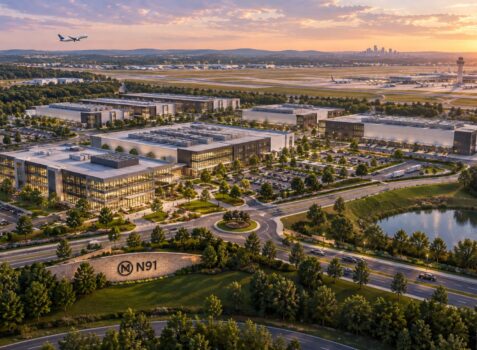 September 2026 — Pittsburgh advanced manufacturing is getting bigger. The Allegheny County Airport Authority approved a ground lease for a new 108,000-square-foot building at Neighborhood 91 back in April. The expansion shows Pittsburgh’s advanced manufacturing cluster now draws sustained capital, not one-off projects.
Join us at caa’s upcoming leadership summits! These premier events bring together hundreds of public and private sector leaders to discuss the challenges and opportunities for businesses and investors. Find the next summit in a city near you!
Neighborhood 91 keeps building
RIDC is the master developer of Neighborhood 91, which the Allegheny County Airport Authority owns adjacent to Pittsburgh International Airport. RIDC’s existing multi-tenant building sits fully occupied by Cumberland Additive, HAMR Industries, Metal Powder Works, RJ Lee Group, Westmoreland Mechanical Testing and Research, and Jeol Additive. Construction on the new 5.8-acre building began back in spring, and RIDC Senior Vice President Tim White called the campus “a foundational asset for our region — a location that has already become home to an industry cluster in advanced manufacturing,” as cited by the Pittsburgh Business Times. White also confirmed several prospective tenants have already expressed interest, and RIDC is weighing a third N91 building once the second leases up.
The groundbreaking itself drew Allegheny County Executive Sara Innamorato and Allegheny County Airport Authority CEO Christina Cassotis, who called Pittsburgh “the global home of advanced manufacturing,” according to 3D Printing Industry. The $16 million building carries funding from Allegheny County and the Commonwealth of Pennsylvania, alongside equity from RIDC. Nearby, ATI opened a 132,000-square-foot Additive Manufacturing Products facility certified to ISO 9001 and AS9100D standards, and it has already secured a production contract from Bechtel Plant Machinery Inc. for the U.S. Naval Nuclear Propulsion Program. That contract offers a concrete benchmark for the kind of production-grade additive work now anchoring the region.
RIDC’s strategy extends well beyond N91. According to the Pittsburgh Business Times, PennSTART is emerging as a hub for autonomous technology companies, Mill 19 has become a robotics concentration point next to Carnegie Mellon University’s new Robotics Innovation Center, and the New Kensington Advanced Manufacturing Park, anchored by Re:Build Manufacturing, is extending the region’s industrial footprint further. N91 also sits close to RIDC’s 500-acre Park West Industrial Park, a former Westinghouse Electric Corporation property that now houses 1.8 million square feet of office, flex, and industrial space across more than 60 companies.
GE Vernova doubles down
Capital keeps arriving beyond the airport corridor. GE Vernova will invest $166 million to expand its Findlay Township and Rostraver Township operations, creating at least 714 new jobs and retaining 735 existing positions, according to Business Facilities. The Commonwealth is contributing $6 million, including a Redevelopment Assistance Capital Program grant and a WEDnetPA workforce-training grant. Allegheny Conference CEO Stefani Pashman tied the deal to a broader state strategy, saying Pennsylvania identified “energy and manufacturing as two key pillars of opportunity.” Pashman also stated that the investment is “a direct validation” of the region’s energy leadership and advanced manufacturing growth priorities.
Talent pipeline deepens
None of this works without a workforce, and Pittsburgh’s institutions are the throughline every source in this story returns to. Carnegie Mellon University’s Next Manufacturing Center and the University of Pittsburgh’s Center for Advanced Manufacturing coordinate research and talent development across the region’s advanced manufacturing base. That academic infrastructure sits behind hard numbers: the region counts 2,864 manufacturing companies, 92,164 manufacturing employees, and $17.8 billion in manufacturing GRP as of 2025, backed by 2,853 engineering graduates and 1,077 trade-program graduates in 2024.
Community College of Allegheny County’s West Hills Center, Community College of Beaver County’s Shell Center, and Westmoreland County Community College’s Advanced Technology Center all feed that pipeline directly. Startup Genome ranks Pittsburgh 23rd nationally among emerging ecosystems, citing its advanced manufacturing and robotics sectors specifically.
That talent base is exactly what site selectors now weigh most heavily. Advanced manufacturing site selection has fundamentally shifted from a cost-and-incentive calculation toward one built on workforce depth and infrastructure resilience, according to Area Development. Fewer, higher-skilled workers now carry more institutional knowledge per role, which raises the cost of choosing a region without a deep technical bench. Pittsburgh’s legacy as a steel-industry hub still shapes that bench today, with contract manufacturers pointing to the region’s engineering talent, materials expertise, and “Robotics Row” tech corridor as reasons the city can lead a second manufacturing era, according to Mirian Solutions.
The region’s civic conversation is starting to catch up to the investment data. Local development voices frame Pittsburgh’s opportunity as bigger than any single industry win, arguing the city’s advantage lies in strengthening its own authenticity and talent retention rather than chasing comparisons to Austin or Nashville. That framing matters for executives evaluating Pittsburgh, since the region is competing on identity and quality of life as much as on incentives.
For executives weighing Western Pennsylvania, the next twelve months carry three concrete tests. Watch whether RIDC formally commits to a third Neighborhood 91 building, whether GE Vernova’s Rostraver and Findlay Township hiring hits its 714-job target on schedule, and whether additional manufacturers follow ATI and Wabtec into production-grade additive contracts. Each outcome will show whether Pittsburgh advanced manufacturing converts current momentum into durable market share.
Want more? Read the Invest: Pittsburgh report.