

Pittsburgh chases America’s next AI data-center hub
Key points:
- • Pennsylvania’s data-center capacity could jump nearly 4,000% by 2036, generating an estimated $12 billion in annual output, according to the Pittsburgh Business Times.
- • Beaver County alone hosts three major projects, while Washington and Allegheny counties face their own contested hearings.
- • Local resistance is intensifying — 74% of Pennsylvanians now oppose a data center in their community, and Pittsburgh’s mayor has ruled one out within city limits.
 August 2026 — Pennsylvania‘s data-center capacity could rocket from about 182 megawatts today to more than 7,300 megawatts by 2036, a nearly 4,000% increase, according to the Pittsburgh Technology Council. That buildout could generate roughly $12 billion in annual in-state output and support close to 19,400 jobs. The question is whether Pittsburgh becomes the AI data-center hub capturing that growth, or a cautionary footnote in it.
Join us at caa’s upcoming leadership summits! These premier events bring together hundreds of public and private sector leaders to discuss the challenges and opportunities for businesses and investors. Find the next summit in a city near you!
Beaver County, ground zero
The Pittsburgh Business Times has mapped proposed AI data-center sites across nearly every county surrounding the city, and its Springdale reporting shows how these deals actually move: Allegheny DC Property Co. closed a $14.3 million land purchase, and consultant Brian Regli said construction could begin in 2027, with the facility operational by 2028.
Beaver County has emerged as the most concentrated cluster. At Shippingport, crews are converting a former coal-fired plant to natural gas partly to power an adjacent data center. In Midland, developer Chuck Betters is pursuing a site at the old Allegheny Technologies mill. A third proposal targets the former Pittsburgh International Race Complex in Big Beaver. Lew Villotti of the Beaver County Corporation for Economic Development backs the first two projects for reusing industrial land but opposes the racetrack site, saying developers should meet four tests: reuse former industrial land, supply their own power, run closed-loop water systems, and give something back to host communities.
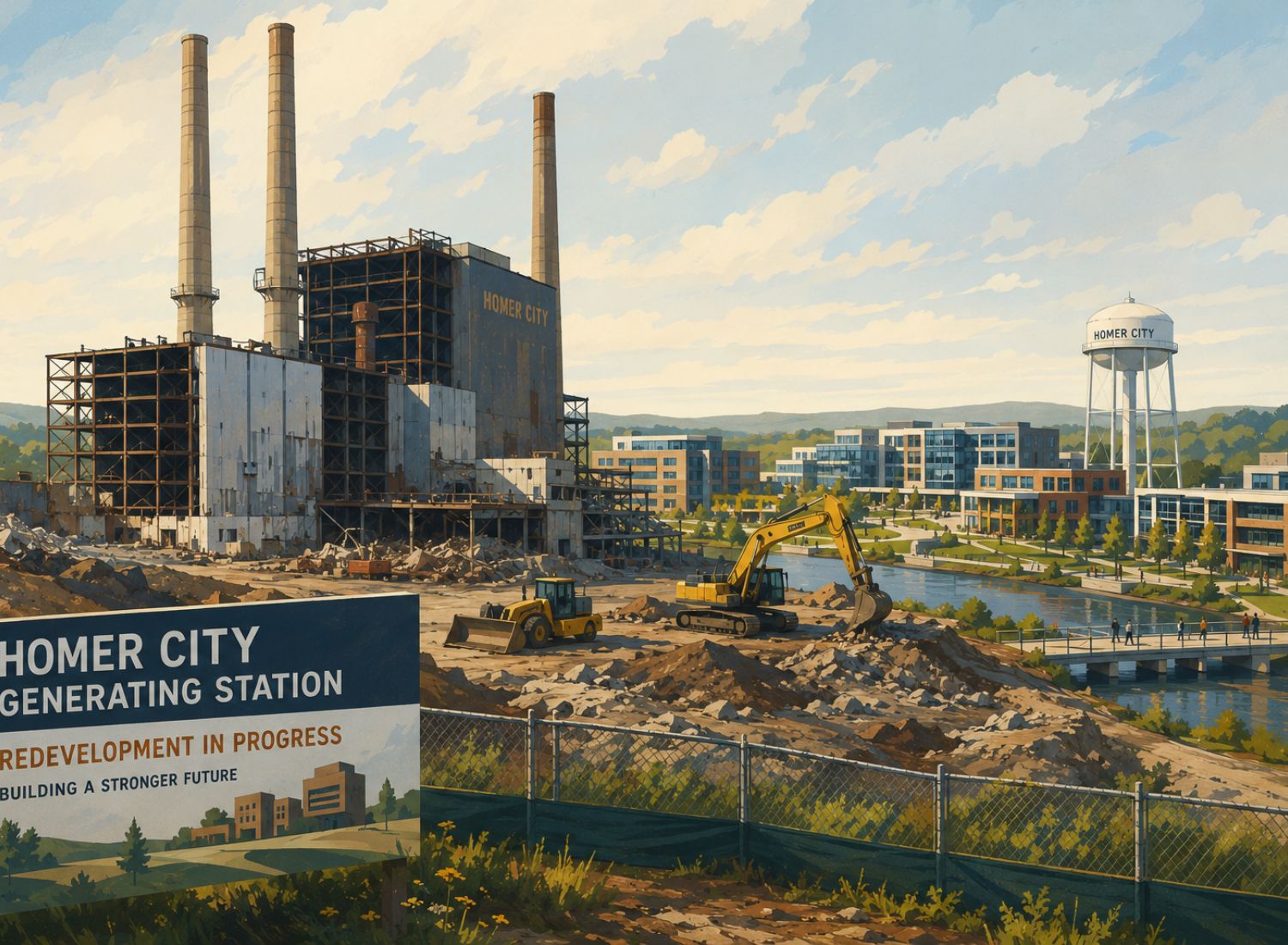
Labor sees urgency in the pipeline. “It creates a lot of jobs for western Pennsylvania, and no one’s poised better than western Pennsylvania to build data centers,” said Ken Broadbent of Pittsburgh Steamfitters Local 449, as cited by CBS News. The $10 billion Homer City redevelopment in Indiana County reflects that scale. It broke ground this year on a former coal plant site and will draw enough natural gas to power more than half of the homes in Pennsylvania.
Old industry, new fights
Not every county is embracing the pipeline as readily. In Hanover Township, Washington County, a standing-room-only hearing weighed a conditional-use permit for an eight-building campus at Starpointe Business Park, a 126-acre former strip mine. Site owner Alex Paris has a sales agreement with Texas-based Prime Data Centers and says the project would generate $10 million to $15 million a year in local tax revenue, but two attorneys representing residents challenged the township’s jurisdiction to hear the application at all.
South Strabane Township, also in Washington County, felt the same pressure before any formal filing existed. Officials there posted online that “there will be NO agenda items pertaining to Data Centers,” while confirming in December 2025 that CNX had explored the possibility on a large parcel, according to Pittsburgh Magazine.
Developer projections reviewed by Pittsburgh Magazine range up to 3,200 acres, $25 billion in investment, and more than 15,000 construction jobs per campus — figures Dave Spigelmyer of Project Hummingbird, which is planning a data campus at the former Robena Mine site in Greene County, describes simply: “We’re taking a brownfield and turning it into a jobs-producing engine.”
Not everyone in the industry’s path is convinced the math holds. Matt Lang of Springdale put the trade-off bluntly: “If we’re constantly having power outages, if we’re paying more for electricity bills, if our property values go down, I can’t see that outweighing all of that.” Pittsburgh Mayor Corey O’Connor has already drawn his own line, telling TribLive he would not support a data center happening in the city of Pittsburgh.
Power, water, and pushback
The Lawrence Berkeley National Laboratory found data centers accounted for 4.4% of national electricity use in 2023 and projects that share could reach 6.7% to 12% by 2028. Residential electricity rates nationally have already risen 32% from 2014 to 2024, and wholesale prices near hyperscale centers spiked as much as 267% over that span, per federal and industry data cited by Pittsburgh Magazine.
“Rising costs have already showed up in our bills because of the speculation of data center build,” said state Sen. Lindsey Williams, D-Allegheny, who is working on rate-protection legislation. Penn State law professor Hannah Wiseman said one bill requiring data centers to cover their own infrastructure costs remains stalled in the state Senate after passing the House in March, according to CBS News.
Some see a fix closer to home. A recent Pittsburgh Post-Gazette letter to the editor argued that hydroelectric capacity on the Allegheny River offers a practical option for the region’s power and cooling needs as data-center pressure grows — a reminder that Pittsburgh’s three rivers remain an underused asset in the power debate. Meanwhile, public sentiment keeps hardening. According to Quinnipiac, polling found 74% of Pennsylvanians would oppose an AI data center in their community, up from 68% in February.
Executives evaluating Pittsburgh should track three signals over the next two quarters: whether Hanover Township’s Aug. 31 vote sets a precedent for jurisdiction disputes, whether the state Senate moves on the stalled infrastructure-cost bill, and whether Beaver County’s cluster of projects meets Villotti’s four-part test. Together they will show whether Western Pennsylvania converts its mapped-out pipeline into financed, operating capacity — or becomes another chapter in the national data-center backlash.
Want more? Read the Invest: Pittsburgh report.