
Jacksonville Florida business news today: Rents hold
Key points:
- • Mesa Capital Partners acquired Satori Town Center, a class-A community near St. Johns Town Center.
- • Jacksonville has averaged nearly 40,000 in annual population growth since the pandemic.
- • The property runs close to full occupancy, with average rents just under $1,700 a month.
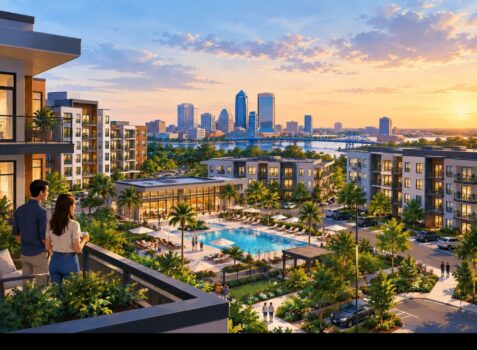 September 2026 — A steady stream of new residents into Northeast Florida is now showing up directly in who owns Jacksonville‘s apartment buildings. Jacksonville Florida business news today centers on Satori Town Center, a class-A apartment community near St. Johns Town Center that Mesa Capital Partners has acquired as one of its newest Florida holdings, News4JAX reported, betting that the metro’s population growth will keep filling units near the city’s busiest retail corridor.
Join us at caa’s upcoming leadership summits! These premier events bring together hundreds of public and private sector leaders to discuss the challenges and opportunities for businesses and investors. Find the next summit in a city near you!
The deal adds a third Northeast Florida property to Mesa’s regional portfolio at a moment when institutional buyers are increasingly treating Jacksonville less as an afterthought behind Miami, Tampa and Orlando and more as a market worth a dedicated local strategy.
Paul Berry, president and chief operating officer of Mesa Capital Partners, tied the acquisition directly to demographic momentum rather than a short-term rent play. “Jacksonville over the last, let’s say since COVID, it’s probably averaged almost 40,000 positive population growth per year,” Berry said, describing a pace of in-migration that has made Northeast Florida one of the more closely watched multifamily markets in the Southeast among institutional buyers looking past the more expensive coastal metros to its south. That kind of sustained population growth is the single figure institutional multifamily investors watch most closely before committing capital to a metro, since it is the clearest available signal of durable rental demand rather than a temporary post-pandemic bump.
The location was central to the thesis. Satori sits within roughly 15 minutes of downtown Jacksonville and close to the jobs and retail clustered around St. Johns Town Center, a positioning Berry said the firm prioritizes deliberately. “Our bias would be having a property that’s close to the jobs and the retail with a short commute to the beach,” he said, describing an investment approach built around convenience rather than simply chasing the lowest purchase price. The property is already performing close to capacity: Berry put occupancy at roughly 96% full, with average rents just under $1,700 a month, in line with the broader competitive set of communities near the town center.
A mirror of national patterns
Jacksonville’s multifamily market is being pulled by the same forces reshaping in-migration patterns nationally, as households and employers continue relocating from higher-cost coastal metros toward Sun Belt cities offering more housing for less money.
That national shift has made Florida’s non-coastal, less glamorous metros — Jacksonville chief among them — attractive to institutional multifamily buyers who spent the last several years bidding up Miami, Tampa and Orlando to the point where yields compressed sharply, leaving less room for the kind of returns Mesa Capital Partners is now targeting further north along the Florida coastline. Mesa Capital Partners is not new to the metro: the firm already owns the Julington community in Mandarin and has a development underway in Palm Coast, making Satori its third Northeast Florida position rather than a one-off bet, and giving the firm a broader read on the region’s rental market than a single-property investor would have.
Berry was candid that the same population growth fueling demand also creates a risk multifamily investors watch closely: overbuilding. “You don’t want to constrain growth. And at the same time, you don’t want to overbuild,” he said, a balance that has tripped up other Sun Belt multifamily markets where a wave of new supply delivered faster than population growth could absorb it, pushing rents down and concessions up. For now, Berry said the competitive set around Satori is running close to full, a sign that Jacksonville’s current supply has not yet caught up with the pace of new arrivals — though that gap is exactly what draws new development pipelines into a market.
What happens next will depend on whether Jacksonville’s population growth holds at its post-pandemic pace or cools toward historical norms, a distinction that will determine whether the current run of near-full occupancy across the metro continues or gives way to the softer conditions already showing up in some faster-building Sun Belt peers.
Investors and developers watching the metro will be looking for Mesa Capital Partners’ next move — additional acquisitions would signal continued confidence, while a pause would suggest the firm sees supply beginning to catch up with demand near St. Johns Town Center and beyond. Either way, Berry’s read on the metro’s trajectory carries weight precisely because it comes from a buyer with capital already committed across three separate Northeast Florida properties, not a passing observer weighing in from outside the market.
Want more? Read the Invest: Jacksonville report.