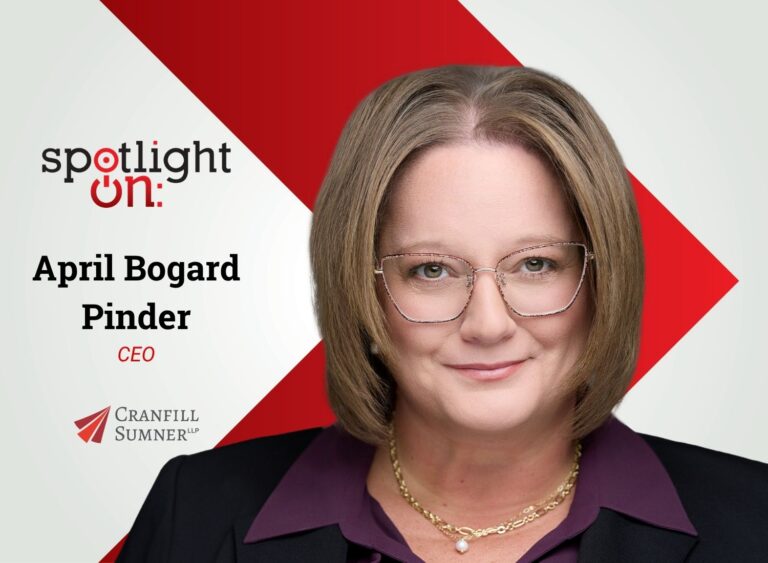






Spotlight On: April Bogard Pinder, CEO, Cranfill Sumner LLP
Key points:
- • Clients increasingly expect proactive, strategic legal guidance beyond transactional support.
- • AI is improving efficiency while preserving the importance of human judgment.
- • Strategic growth, operational excellence, and talent remain key priorities.
 September 2026 — Invest: spoke with April Bogard Pinder, CEO of Cranfill Sumner LLP, about how law firms are evolving to meet rising client expectations, embrace technology, and operate as strategic businesses. “Our goal is not to be reactive, but to be ready,” Pinder said, underscoring the firm’s focus on proactive, business-minded legal counsel.
Join us at the Invest: Raleigh-Durham 4th Edition Leadership Summit! This premier event brings together hundreds of Raleigh-Durham’s business and regional leaders to discuss the challenges and opportunities for businesses and investors. Buy your ticket now!
How would you describe the legal services landscape, and what trends are shaping how firms support their clients today?
Three major trends are converging. First, client expectations have evolved significantly. They no longer want transactional support. They expect insight, responsiveness, and a true strategic partnership. The legal and regulatory environment has become more complex, and when you layer that with geopolitics and local market dynamics, clients need advisers who can turn complexity into actionable guidance.
Second, technology and AI are moving from experimentation into real adoption. The focus is now on practical use cases that reduce friction, improve judgment, and give time back. That matters because both clients and employees are looking for flexibility, purpose, and more meaningful engagement in their work.
Third, there is a governance evolution underway. Law firms are increasingly operating as sophisticated businesses. You are seeing a shift from traditional managing partner models to more professionalized leadership structures, including CEOs. That clarity allows better decision-making, stronger accountability, and more proactive planning. Our goal is not to be reactive, but to be ready.
How are businesses approaching legal risk and compliance in a more complex regulatory environment?
There is a growing recognition that reactive legal support is no longer enough. Clients want proactive guidance. They want advisors who can anticipate risk, not just respond to it.
Technology helps by removing some of the transactional burden, which allows attorneys to focus on higher-value thinking. That means spending more time understanding a client’s business, industry, and specific challenges. There is no one-size-fits-all solution. It is about bringing together the right insights and connections to help clients make informed decisions before issues arise.
What trends are you observing in areas such as cybersecurity, corporate governance, and labor and employment?
In labor and employment, the biggest shift is around talent. Today’s workforce is looking for purpose, clarity, growth, and trust. Organizations have to be intentional about how they attract, develop, and retain talent across multiple generations with different expectations. Career paths are no longer linear, so firms need to invest actively in engagement and development.
On corporate governance, the focus is on creating structure without rigidity. I often describe governance as guardrails. It is about establishing repeatable rhythms and processes that support strong decision-making while still allowing flexibility. Good governance is not about restriction. It is about clarity and alignment.
Cybersecurity is one of the most significant operational risks firms face. It requires constant vigilance and thoughtful investment. Technology should be seen not only as an enabler but also as a protector. It helps identify risks, safeguard information, and support more efficient operations.
How are law firms adapting to the growing demand for more practical, business-focused legal advice?
This shift has been a long time coming. Clients are no longer looking for legal providers who simply execute tasks. They want partners who understand their business and can provide forward-looking advice.
That means thinking holistically about how we serve clients. It is not just about drafting agreements or handling disputes. It is about understanding their risks, identifying opportunities, and helping them navigate complexity. Law firms must operate as businesses advising other businesses, and that requires a broader, more strategic mindset.
What role is technology playing in reshaping legal work, and how are firms thinking about AI in day-to-day operations?
There is understandable caution around AI, particularly regarding ethics, security, and data governance. Those concerns are valid and necessary in the legal profession.
However, AI should be viewed as an enabler. It allows firms to automate routine tasks and free up time for deeper, more strategic work. Clients are not looking for automated interactions when they need legal support. They want human insight and judgment.
A useful analogy is the introduction of Excel. It did not eliminate accountants; it enhanced their ability to provide insight. AI is doing something similar for legal professionals. It enables better research, faster analysis, and more meaningful client engagement.
What industries or sectors are driving the most demand for legal services right now?
Rather than one specific industry, demand is being driven by increasing complexity across all sectors. Changes in technology, regulation, and customer expectations are affecting every business.
As a result, organizations are seeking professional expertise to help them navigate that complexity. The focus is less on industry-specific demand and more on the need for strategic guidance that goes beyond transactional work.
How are firms identifying new opportunities for growth as client needs continue to evolve?
Growth requires a deliberate and data-driven approach. Firms need to evaluate how their services align with client needs and where they can expand to provide more comprehensive support.
For example, we have expanded into areas such as government affairs, cybersecurity, intellectual property, and mergers and acquisitions. These additions allow us to serve clients more holistically.
Growth must also be intentional. It involves decisions around talent, services, and market positioning. Firms can no longer rely solely on organic growth. They need a clear strategy for where they want to go and how they plan to get there.
How does your firm’s business development approach support that growth?
Our goal is to give attorneys a programmatic approach they can adapt to their season of professional and personal life, their practice, and their client base. We want to provide a framework they can customize rather than a rigid formula.
Autonomy is important to attorneys. The idea is to give them a foundation they can use to decide how active they want to be in the community, in conferences, in media, and in relationship-building more broadly. That structure helps them grow organically while also encouraging them to think strategically about what comes next.
How do you see the role of law firms evolving as clients look for more integrated and strategic advisory support?
Law firms are moving away from being purely transactional service providers and becoming trusted advisors. Clients want someone they can turn to for guidance, someone who understands their business and can help them evaluate risks, opportunities, and trade-offs.
That means building long-term relationships and supporting clients throughout their journey, not just at specific moments. It is about being part of the decision-making process and helping clients navigate uncertainty with confidence.
What are your firm’s priorities over the next three years?
Our focus is on readiness. We want to be prepared across people, process, technology, and talent. That includes investing thoughtfully in technology, optimizing our operations, and continuing to develop and support our people and talent. We are also focused on maintaining an entrepreneurial spirit while building the structure needed to scale effectively.
At a high level, our priorities fall into three pillars: strategic growth, operational excellence, and talent optimization. Those pillars guide how we invest, how we evolve, and how we position ourselves to serve clients in an increasingly complex environment.
Want more? Read the Invest: Raleigh-Durham report.