


Dallas-Fort Worth business news today: Chip town
Key points:
- • Sherman’s population grew roughly 20% between 2020 and 2025, reaching about 52,000.
- • Texas Instruments, GlobalWafers and Coherent all supply components tied to Apple devices.
- • Coherent is partnering with Nvidia to expand production of AI infrastructure components.
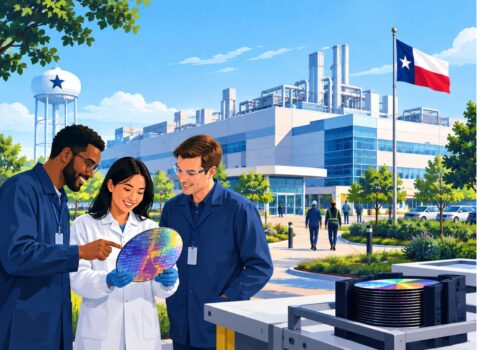 September 2026 — An hour north of Dallas, past cornfields and cattle pasture, a town of 52,000 has become one of the most important addresses in the American semiconductor supply chain. Dallas-Fort Worth business news today centers on Sherman, Texas, a North Texas city just south of the Oklahoma border whose population has grown roughly 20% since 2020 as chipmakers move in, Axios Dallas reported, with Texas Instruments’ SM1 plant, GlobalWafers America, and Coherent all now operating there.
Join us at caa’s upcoming leadership summits! These premier events bring together hundreds of public and private sector leaders to discuss the challenges and opportunities for businesses and investors. Find the next summit in a city near you!
All three companies supply components that end up in Apple’s iPhones and iPads, and Coherent has separately partnered with Nvidia to increase production of indium phosphide wafers the companies describe as forming the optical backbone of modern AI infrastructure.
Sherman’s growth is a case study in how quickly a small city can be reshaped by a handful of large industrial tenants. The town, founded in 1846 and named for Texas Revolution hero Sidney Sherman, had spent generations as a modest college town anchored by Austin College, a private liberal arts school that has operated there since 1876. That identity is now sharing space with fabrication plants and cleanroom facilities built to feed some of the most demanding supply chains in global technology.
Mayor Shawn Teamann has leaned into the contrast between Sherman’s rural approach roads and its industrial base. “You have to pass by cornfields and cattle to get here. But once you’re here, you have everything you need,” Teamann said, according to the report.
That “everything you need” pitch extends to infrastructure: Sherman holds water rights to Lake Texoma, one of the country’s largest reservoirs, which Teamann said gives the city room to scale. “We have the ability to pull water from the lake, treat it and send it out into the pipes to all of our businesses and residents, which gives us the ability to be efficient and to be scalable,” he said.
Scalability Already Being Tested
That scalability is being tested already. The Texas Department of Transportation is expanding U.S. 75 through the area specifically to address the traffic congestion that has followed the population and industrial growth, a sign that infrastructure planners are treating Sherman’s boom as durable rather than temporary. Road capacity, water rights and a four-year college supplying local talent are the kind of unglamorous fundamentals that manufacturers weigh heavily when deciding where to locate multibillion-dollar facilities, and Sherman appears to have checked enough of those boxes to draw three major tenants in the same supply chain.
The Sherman buildout also plugs directly into a national story about where AI infrastructure gets built. Coherent’s partnership with Nvidia to scale indium phosphide wafer production ties a North Texas factory floor to the same AI datacenter boom driving investment decisions from Virginia to Arizona. For a region best known nationally for finance, logistics and corporate relocations, Sherman’s emergence as a semiconductor and optical-components hub gives Dallas-Fort Worth a foothold in the physical manufacturing side of the AI buildout, not just the software and data-center side that has dominated headlines elsewhere in the region.
The concentration of three major suppliers in one small city also illustrates how semiconductor supply chains have clustered geographically even as companies talk publicly about diversifying manufacturing locations. Texas Instruments, GlobalWafers and Coherent could each have located expansion capacity elsewhere in Texas or in other states offering their own incentive packages, but all three chose Sherman specifically, suggesting that once a supply chain begins to cluster around shared infrastructure, labor pipelines and permitting relationships, the advantages of staying put start to outweigh the appeal of starting fresh somewhere else.
That clustering effect extends the Dallas-Fort Worth region’s economic story well past its traditional strengths in banking, logistics and corporate headquarters relocations. Regional economic development officials have increasingly pointed to Sherman as evidence that North Texas can compete for advanced manufacturing investment that might otherwise go to established chip hubs in Arizona, Ohio or Texas’s own Austin area, giving the broader metro a manufacturing counterweight to the office-based growth that has defined Dallas-Fort Worth’s expansion for the past two decades.
What happens next will hinge on whether Sherman’s infrastructure keeps pace with the companies now depending on it. The U.S. 75 expansion is underway but unfinished, and a 20% population increase in five years puts real strain on housing, schools and municipal services. How well Sherman manages that growth will determine whether it becomes a durable manufacturing hub or a cautionary tale about industrial growth outpacing the infrastructure built to support it.
Want more? Read the Invest: Dallas-Fort Worth report.






