
People remain South Carolina tourism’s biggest asset

Key points:
- • South Carolina tourism posted a record $31 billion economic impact in 2025, with hotels and vacation rentals bringing in $6 billion.
- •Visit Myrtle Beach tracks more than 50 hotel renovations and new builds, while Auro Hotels plans the state’s first JW Marriott in Greenville.
- • Industry leaders argue that staff, residents, and local stories sustain growth more than new buildings do.
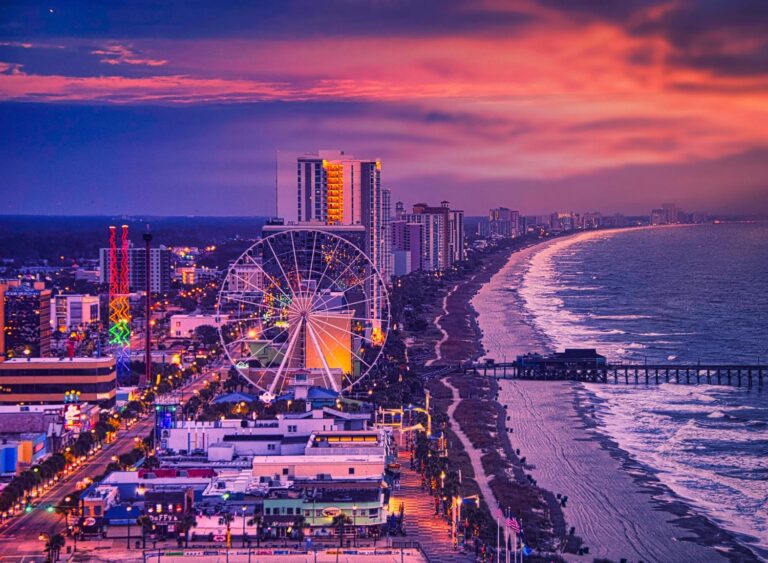
 November 2026 — Visit Myrtle Beach President Stuart Butler credits people, not beaches, for the record run in South Carolina tourism. Asked what sets his market apart, he looked past its 60 miles of coastline.
Join us at caa’s upcoming leadership summits! These premier events bring together hundreds of public and private sector leaders to discuss the challenges and opportunities for businesses and investors. Find the next summit in a city near you!
“It comes down to the people,” Butler said in an interview with Invest: South Carolina. “Myrtle Beach is still quintessential Americana because it is a melting pot of people from all over.”
Across the state in Greenville, Auro Hotels President and CEO DJ Rama runs a 38-hotel portfolio on the same principle. He sees his associates, not his buildings, as the product.
“We’re in the business of serving people through people,” Rama told Invest:. “The guest experience comes down to how our associates feel and how they connect with others.”
The numbers back their optimism. South Carolina tourism generated a record $31 billion economic impact in 2025, according to the South Carolina Department of Parks, Recreation and Tourism. Hotels and vacation rentals brought in a record $6 billion in revenue.
Families hit the road
Rama has watched travelers trade long-haul trips for drive-to getaways, often in the middle of the week. He described the shift in his leisure markets. “People are getting in their cars, making plans, and creating experiences with their families. In our leisure markets, we have seen a tremendous pickup, including guests checking in on Sunday and checking out on Tuesday,” he said in an interview with Invest:.
He credits remote work for much of that flexibility. Greenville and Charleston outperformed previous years despite higher gas prices and inflation, and Rama sees a simple reason. “People recognize that time is the only commodity we have, and they are choosing to use it to create meaningful experiences with their families.”
On the coast, search data tells the same story. Tripadvisor’s 2026 Summer Travel Index ranked Myrtle Beach the most-searched domestic summer destination, ahead of New York and Chicago, and a leading pick for the Fourth of July.
Butler ties that attention to change at home in an interview with Invest:. New leaders at the Greater Myrtle Beach Collaborative, the school district, and the university have drawn the region’s 14 municipalities closer than at any point in his tenure. “There is a sense of collaboration that I have never seen in the 25 years I have been here. Everyone is seeing the opportunity and is willing to work together to seize it.”
Capital follows demand
That momentum draws capital into lodging. Butler sees the Grand Strand’s hotel stock in the middle of an upgrade. “We are tracking more than 50 major hotel renovations or new-build hotel projects, so accommodations are elevating.”
In the Upstate, Rama enters markets before they peak, betting on where they will stand a decade out. “We want to predict where a market will be in 10 years. Entering early gives us a lower cost basis, and value compounds as the market develops.”
Greenville proves the point. Auro plans to develop South Carolina’s first JW Marriott, a 335-room hotel in the historic Bowater Building that will anchor the city’s $500 million Falls Park Conference District along the Reedy River.
Rising costs make early entry even more valuable. Looking back at Auro’s downtown Greenville properties, Rama acknowledged that “some of those projects would not underwrite today because construction costs have risen beyond what consumers are willing to pay.”
Service over finishes
New rooms alone do not earn loyalty, Rama argues. He judges a hotel by its people rather than its design. “You can invest in the most beautiful lobby and the finest finishes, but without the human touch, none of it means much.”
That conviction dates to 1973, when his family opened a 40-room motel. His mother cleaned rooms, and his father rented them.
Auro takes no Wall Street or private equity capital, so it can hold assets for the long term and give managers stability. Rama points to tenure as the proof. “Our general managers have an average tenure of more than 18 years. People are looking for a family-owned business that treats them right and does the right things for them.”
The company backs that loyalty with a $2 million scholarship fund for associates’ children. A separate Sunshine Fund helps staff through sudden hardship.
Butler applies the same thinking to marketing. Visit Myrtle Beach has shifted from paid advertising toward human-centered storytelling because travelers want connection as much as attractions. “People no longer travel to destinations solely because of the place. They travel because of the experiences they can have, and increasingly those experiences involve not just things to do but interactions with other people.”
He cites Winna’s Kitchen downtown. Owner and chef Jess Sagun rebuilt her life after addiction and homelessness, and guests there can buy a $5 meal for someone in need.
Butler sees stories like Sagun’s as the engine of the organization’s economic mission. “Our job is partly economic development. That is the outcome. But the way we do economic development is through storytelling.”
Room to spread out
Growth brings risk, and Butler watches for it on two fronts. “We look at sustainability through two lenses: resource sustainability and human sustainability. We have seen places, especially in Europe, struggle with overtourism.”
His answer is to steer visitors beyond the SkyWheel and the Boulevard toward smaller communities. Conway, for example, renames itself the City of Halloween every October.
Residents matter too. Tourism helps fund the restaurants, theaters, and daily beach upkeep that locals enjoy, and Butler wants them to see that link. “We have to tie tourism to quality of life through local media, social media, ambassadors, and storytellers. Then the community becomes part of the solution.”
The next three years
Both leaders plan well beyond the next season. Auro is building a 300-acre nonprofit retreat in South Carolina that Rama’s father and uncle first envisioned. In Myrtle Beach, Collaborate 2031 — the region’s first communitywide strategy — aims to attract young talent and national employers.
Butler calls the region the fastest-growing in the country, with more young families who first came as visitors now putting down roots. For executives tracking South Carolina tourism, he expects the coast to look very different soon. “Three years from now, Myrtle Beach will be a different place. It will be bigger, but I think there will be even more opportunities here than people can begin to imagine.”
Want more? Read the Invest: South Carolina report.