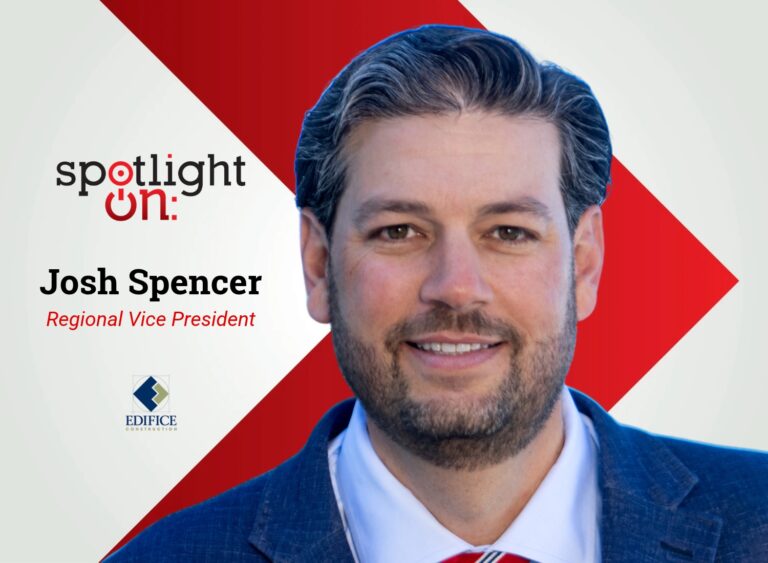

Spotlight On: Josh Spencer, Regional Vice President, Edifice Construction
Key points:
- • Edifice’s Charleston office has grown to 42 employees since 2020.
- • Edifice and Barton Malow are building the $1.2B New Roper Hospital.
- • Edifice expects its footprint to expand north and south within five years.
 November 2026 — In an interview with Invest:, Josh Spencer discussed Edifice Construction‘s Charleston growth, public projects, adaptive reuse, and technology. “Our experience in the Carolinas and the type of work we do translated well to supporting Charleston’s population growth,” Spencer said.
Join us at caa’s upcoming leadership summits! These premier events bring together hundreds of public and private sector leaders to discuss the challenges and opportunities for businesses and investors. Find the next summit in a city near you!
How has the Charleston office grown over the past year?
We’ve grown pretty tremendously this past year, driven by local government, healthcare, and general office and upfit work. We’ve seen a large increase in the local government sector, including work with the City of Charleston, Dorchester County, Moncks Corner, The Town of Summerville, and the Town of Kiawah Island. That is keeping us busy and driving much of our growth. Since 2020, we’ve gone from a handful of Charleston based employees to 42 in the office.
Edifice has worked in the Lowcountry for roughly 20 to 25 years, but we planted a permanent flag in 2020 with our first office on Meeting St. Our culture, experience in the Carolinas and the type of work we do translated well to supporting Charleston’s population growth. We build schools, fire stations, police stations, churches, office buildings, parks, hospitals, and other community facilities that support the growth Charleston has experienced since COVID.
What are municipalities asking Edifice to build?
We’re building two fire stations for the St. Johns Fire District on Johns Island to support the island’s significant growth. In Summerville, we’re constructing a municipal court, police headquarters, fire headquarters, and a new fire station. We continue to find opportunities in Dorchester County and Summerville itself. Summerville is on the upswing, with a strong food scene and restaurants drawing people from out of state, and it has been a great client.
The town of Kiawah is also expanding, and we’re building a beautiful performing arts center with high-end acoustics and a small, intimate venue as an addition behind its town hall. The City of Charleston is one of our most important clients. We have several major programs underway with the city, including its flagship municipal operations complex. We call it City Ops. It will bring community divisions, including trash, transportation, storm, and parks and recreation, onto one campus in the neck area of the peninsula.
We’re also working on the Lowline, a roughly 1.7-mile pedestrian and bicycle path down the peninsula. It is a community amenity and a north-to-south transportation corridor that can help combat traffic. I see it as a legacy project and hope that 50 years from now, we can say we were part of the first phase.
What does the Navy Yard project show about adaptive reuse?
The Navy Yard is probably my favorite project to date. I studied historic preservation at the College of Charleston, so I love old buildings and adaptive reuse. Our Charleston and Charlotte offices are examples of creative adaptive reuse. Buildings that are 100 or 120 years old can be challenging, but the Navy Yard structures were built so well by the Navy that they’re virtually indestructible.
They have immense concrete footings, massive concrete pilings and columns, and great floor-to-ceiling height. They were ideal candidates for adaptive reuse and could have been converted to almost any mixed use. We completed core-and-shell redevelopment and have stayed active on campus through upfits for fabric, furniture, and lighting manufacturers. It has become a hub for residential and commercial design.
Storehouse 9 is predominantly apartments, but its ground floor contains maker spaces where small-business owners can operate pottery studios from their living spaces. It embodies Charleston’s creative spirit, and I think it is only the beginning of what will happen at the Navy Yard. We’re potentially targeting work there in different forms for the next 20 years. The project earned our first Carolopolis Award, which made us proud. A new rooftop Italian restaurant by Indigo Road, who operates other Charleston restaurants, also shows the caliber of activity emerging at the Navy Yard.
How are costs and supply chains affecting projects?
Our biggest supply-chain hurdles are structural steel fabrication and delivery timelines, which have increased drastically over the past six to eight months. Some of that comes from massive data center projects in the Southeast that demand a lot of steel. We’ve worked creatively with design partners on early-release steel packages and on selecting steel shapes and types based on what is available.
Lead times are also rising for mechanical, electrical, and plumbing specialties, including generators, automatic transfer switches, large electrical panels, and large HVAC equipment. I think regional data center growth contributes to those delays and consumes significant MEP resources and manpower. Data center projects attract workers with potentially higher pay. We have strong subcontractor relationships and know the caliber needed for our jobs. Our stable subcontractor group often differs from the companies working on data centers, but those firms can still lose workers to higher-paying, around-the-clock data center projects.
How difficult is it to secure skilled construction workers?
The labor market is demanding, but we’ve always been a relationship-driven company, and our partnerships with subcontractors are important. We treat them fairly, write fair subcontracts, and pay them on time. We also hold quarterly subcontractor appreciation events, such as barbecues or gatherings, so we can spend time together outside work and know one another differently. These events allow us to connect as partners, without the pressures of the project.
How are BIM, drones, and AI changing construction?
Drones are flying everywhere. Over the past 10 to 15 years, BIM coordination and 3D virtual construction have become part of our daily business and are integrated into every project. We model every building regardless of type or size, and our construction technology department handles much of that work internally. For adaptive reuse and renovation projects in Charleston, we like to conduct a laserscan to create a point-cloud of the existing structure at the front end of design. We have that technology and equipment in-house, and it gives us a walkable 3D model of an existing space even when no drawings are available.
It is useful for early design concepts, pricing, and preconstruction. During construction, we use DroneDeploy software to fly sites weekly. We overlay project plans on GIS data to compare actual topographic contours and the new contours we’re creating in the field with the design documents. DroneDeploy also lets us quantify work in place. If we excavate a retention pond and create a large pile of dirt, the drone can calculate how many cubic yards are in that pile.
Where do you see the biggest opportunities ahead?
Our focus is growing and maintaining the healthcare market, one of our three leading markets in Charleston. We have flagship clients in Roper and MUSC and see continued growth in our area with new providers moving into town. Currently under construction is one of the largest healthcare projects in the Southeast, the New Roper Hospital in North Charleston. This $1.2B project is being delivered by a joint venture between our good friends at Barton Malow and ourselves. Healthcare has boomed for us in Charleston over the past few years, with providers arriving from the Charlotte, Greenville, and Upstate areas. We want to support those clients and that growth.
The second focus is public work. We work with most major counties in the area, particularly Dorchester, Berkeley, and Charleston. I believe our footprint will expand north and south over the next five years to places including Beaufort, Bluffton, Hilton Head, and Savannah. Myrtle Beach and Horry County are also difficult to ignore. We see significant growth in Georgetown and Horry County and are investigating those markets for future expansion. Another focus is our interior special projects group. About four years ago, we saw a need to support larger clients such as the Navy Yard and Jamestown through core-and-shell projects followed by smaller interior upfits. We’ve grown that market tremendously and see major potential ahead.
Want more? Read the Invest: South Carolina report.