Bold isn’t reckless: The ROI of prudent leaders
Key points:
- • Nvidia stock dropped as much as 14% after allegations about Jensen Huang.
- • AMD posted record $13.4 billion revenue, up 45%, driven by data centers.
- • Study of 1993–2005 found male-led firms pursued more acquisitions and debt.
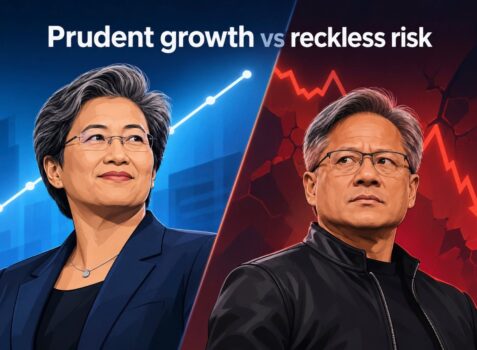 November 2026 — On Thursday, Nov. 12, two things happened. Yahoo Finance named AMD’s Lisa Su its 2026 CEO of the Year. And, after 33 years, Jensen Huang resigned as CEO of Nvidia.
Join us at caa’s upcoming leadership summits! These premier events bring together hundreds of public and private sector leaders to discuss the challenges and opportunities for businesses and investors. Find the next summit in a city near you!
Uncomfortable truth: that one day tells you more about leadership than a year of keynote speeches.
I’ve been thinking about two words that don’t get enough credit in the C-suite: prudent and thoughtful. They’re not trendy and rarely make headlines. But they also keep companies alive. And in my experience, women bring them to the table time and again.
Let me show you what I mean, starting with what happens when they’re missing.
What reckless costs
The New York Times reported that five Nvidia employees alleged a romantic relationship between Huang and a subordinate, and Reuters reported a second relationship with another employee. Huang has acknowledged being unfaithful to his wife and apologized to his family and employees. The rest, including the reported ties to a woman U.S. officials suspect of spying for China, is still allegation and investigation. Huang’s side, relayed by Trump, is that he had “absolutely no idea.”
The market’s reaction was not subtle. Nvidia’s stock dropped as much as 14% on the news, roughly $546 billion at the open, before closing down 4.3%. Wired puts the damage from the whole scandal at more than a trillion dollars.
Then came the comeback campaign. Elon Musk wants Huang back, and his case isn’t about conduct. It’s about leverage: “Many of those deals were a handshake with Jensen, not a written contract,” he said. A “Stand With Jensen” letter says Huang deserves “due process, not mob justice,” and has more than 172,000 signatures. Due process matters. The investigations should finish, and Anthony Scaramucci is right that no director with fiduciary duties should bring Huang back until they do.
But think about what Musk actually said. Billions of dollars in deals rest on one man’s handshake. That isn’t a defense of Huang. That’s an indictment of the governance. Prudent companies put it in writing and build a bench.
I’m not saying every man is reckless. Huang built one of the most valuable companies in the world. I’m saying bold and reckless are different things, and the difference shows up in the numbers.
The evidence for prudence
Start with the research. In a peer-reviewed study in the Journal of Financial Economics, Jiekun Huang and Darren Kisgen found that firms led by men pursued acquisitions more often and issued debt more often than firms led by women. And the market noticed: acquisitions by male-led firms earned announcement returns about 2 percentage points lower. The authors read it as relative overconfidence. A Smith School of Business write-up of the work notes the trade-off: the women-led firms tended to grow more slowly. Prudent isn’t the same as fast. But the study covered 1993 to 2005, so it’s a data point, not a verdict.
Now look at a more recent case. Yale economists, in an NBER working paper reported by Reuters, estimate that Tesla’s U.S. sales between October 2022 and April 2025 would have been 67% to 83% higher, roughly 1 million to 1.26 million more vehicles, without what they call the “Musk partisan effect.” It’s a working paper, not a final word. But it’s a striking example of a very bold bet that didn’t pay.
The quiet case for Lisa Su
Prudent doesn’t mean timid. Lisa Su has made big bets. She just makes them with discipline.
Su has run AMD since 2014. On Nov. 3, AMD reported record revenue of $13.4 billion, up 45% from a year earlier. Non-GAAP earnings per share rose 74%. Data center revenue hit $8.5 billion, up 97%. The company guided to about $17 billion for the fourth quarter. And her own summary was almost boring: “Demand for our Instinct and EPYC products continued to strengthen.”
Boring is the point. Look at the strategy underneath. It’s data-center first. That segment is now about 63% of AMD’s revenue, in the same quarter that client and gaming revenue fell 8%. AMD says customers including Anthropic, Meta, Microsoft, OpenAI, and Oracle are already running workloads on its first Helios rack systems. It has agreed to acquire Taalas, which it says adds specialized inference chips. And, according to Futurum Research’s read of the earnings call, AMD says it has already secured wafers, substrates, advanced packaging, and memory for much higher growth in 2027.
The market noticed. Reports put AMD’s stock up about 158% this year, while Nvidia is down 7%.
Women-led companies are having a moment
Women still run only a small share of America’s biggest companies. According to a post from the investing app Autopilot, 48 companies in the S&P 500 had a woman as CEO in 2025. The same post looks at the Hypatia Women CEO ETF, which owns only U.S. companies with a female CEO. It’s up 19.6% so far in 2026, versus 11.5% for the S&P 500. Over the past year, it’s up 24.3% versus 13.5%.
Here’s “the catch,” as the post points out: Since the fund launched in early 2023, it’s up 58% while the S&P 500 is up 104%. One great year doesn’t mean women-led companies always win. Those are stock returns, not company profits, and it’s one fund. But it is not a handful of stars carrying the weight. The fund holds 162 companies, and none of its top holdings is bigger than about 1.7% of the fund, as of August. As the post puts it, the companies most investors never look at can sometimes beat the big names.
That’s the point. Women-led companies are having a good year, and the discipline behind it is worth studying.
Here’s what I take from all of this:
• Treat prudence as a strategy. It isn’t timid. It’s the discipline of choosing your risks.
• Focus. Pick the part of the business that is growing, and put your best resources there. Su did.
• Supply discipline. Secure what you need before the demand arrives. Don’t promise growth you can’t deliver.
• Long-horizon bets. Su has been at it for more than a decade. Build the thing that pays off in year five, not just this quarter.
• Put the deals in writing. If your business lives in one person’s handshake, build a bench.
• Same standard, every time. Judge leaders by their results and judgment, whoever they are.
I’m not here to convict anyone before the investigations are done. I’m here to point at what the numbers keep telling us.
Bold is fine. Reckless is expensive. Prudent pays.
Want more? Read the CEO insights.