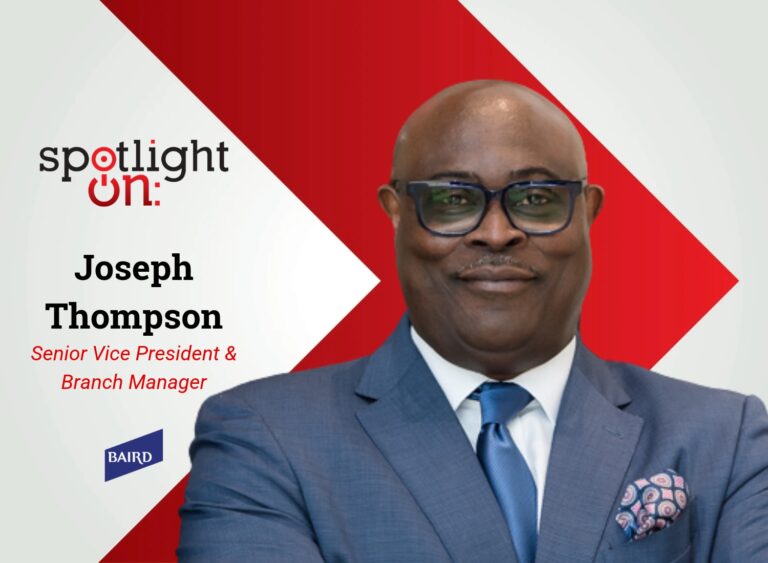

Spotlight On: Joseph Thompson, Senior Vice President & Branch Manager, Baird
Key points:
- • Employee ownership lets Baird take a long-term view.
- • Baird advisors build full plans, coordinating with attorneys and tax professionals.
- • Western Pennsylvania business owners are prioritizing succession and exit planning.
 November 2026 — Baird‘s employee-owned structure, planning-led approach and commitment to long-term relationships shape how its Western Pennsylvania advisors help clients navigate market volatility, business transitions and multigenerational planning, Joseph Thompson, senior vice president and branch manager at Baird, told Invest:. “Investments are never viewed in isolation. We start with the client’s full financial picture, understand what matters most, and tailor the advice accordingly,” Thompson said.
Join us at caa’s upcoming leadership summits! These premier events bring together hundreds of public and private sector leaders to discuss the challenges and opportunities for businesses and investors. Find the next summit in a city near you!
How does Baird’s employee-owned model translate into stronger outcomes for clients?
Employee ownership is a meaningful differentiator because it aligns the firm’s people with the clients and communities we serve. We have no outside public shareholders pressing us to manage for the next quarter. That gives us the freedom to take a long-term view, invest in capabilities clients need, and make decisions consistent with their best interests.
Ownership also creates accountability. Associates have a personal stake in the firm’s future, so collaboration, stewardship and service are not abstract ideas. We think like owners, and that mindset shows up in how we care for relationships, protect the firm’s reputation and support one another in delivering advice.
How has Baird expanded its services beyond investment management?
Our work begins with understanding the client and building a plan around their goals. The first conversation is not simply about products or performance. It is about where the client is today, what they want to accomplish and what could prevent them from getting there.
From there, we take a comprehensive view of cash flow, retirement income, Social Security, taxes, risk, estate planning, trust needs, business interests and wealth transfer. Baird’s financial and estate planning resources, together with Baird Trust and other specialists, allow the advisor to bring the right expertise into the conversation. Baird does not provide tax or legal advice, so we also coordinate with the client’s attorneys and tax professionals when appropriate.
Investments are one part of that larger plan. Advice for a 40-year-old building wealth will look different from advice for someone who is 70 and drawing income, and two clients of the same age can still have very different priorities and family circumstances. Our job is to tailor the strategy, test the trade-offs and help the client make confident decisions over time, including how assets may eventually pass to the next generation.
How are you helping clients remain focused amid market volatility and political uncertainty?
Markets react quickly to geopolitical events, policy changes, tariffs and elections. Those events can create real uncertainty, but a short-term headline should not automatically become a long-term investment decision.
We help clients maintain perspective through regular conversations, market commentary, research and access to specialists. More importantly, we keep returning to the financial plan: what the money is for, when it will be needed and how much risk the client can reasonably accept.
When circumstances materially affect a client’s plan, we address them directly and adjust deliberately. The goal is not to ignore volatility. It is to separate noise from information that truly changes the client’s financial picture. Clear, timely communication helps clients stay informed without making emotional decisions that could undermine long-term goals.
Where can artificial intelligence enhance financial services, and where does personal advice remain essential?
Artificial intelligence can make financial professionals more effective. It can help organize information, summarize notes, support research and identify topics that deserve attention. Baird is investing in technology, but any output still requires experienced human review, verification and judgment.
I have used several AI platforms and see significant potential, especially as a productivity tool. At the same time, the standard cannot be speed alone. Advisors remain responsible for accuracy, suitability, confidentiality and the quality of the advice they deliver.
Technology can support the relationship, but it cannot replace it. A client’s advisor understands the history behind the numbers, the family dynamics, competing priorities and the reasons a decision may feel difficult. That context is built through years of conversation and trust.
AI can provide information, but it cannot sit across the table, listen carefully and exercise judgment with empathy. In wealth management, the human connection remains essential, particularly when decisions involve retirement, the sale of a business, a family transition or the loss of a loved one.
What financial trends are you seeing among business owners and retirees in Western Pennsylvania?
Across Western Pennsylvania, we are seeing business owners think more seriously about succession, continuity and eventual exit options. Sometimes the next generation wants to continue the company, and sometimes it does not. The earlier an owner understands the available paths, the more choices that owner is likely to preserve.
Baird’s Business Owner Solutions resources can help advisors begin those conversations and provide an informal range-of-value estimate for planning purposes. It is important to be precise: that estimate is not a formal valuation and cannot be relied upon for tax or legal purposes. When a formal valuation is needed, the client should work with a qualified independent professional. Our role is to coordinate the planning around the owner’s goals, timing, family and potential liquidity event.
Retirement planning raises equally personal questions: Have I accumulated enough? How much can I spend? Will my resources last? We model different choices and have candid conversations about the trade-offs. Sometimes the answer is that a client can retire as planned. Other times, working longer, spending differently or adjusting the goal may create a more durable outcome.
Western Pennsylvania is a close-knit region where trust and relationships carry tremendous weight. When clients ask for advice, they are giving us significant responsibility. We honor that by being straightforward, even when the most responsible recommendation is not the easiest one to hear.
How does the Wexford office build relationships that extend beyond investment management?
Many advisors in Wexford have served clients for decades. The branch’s roots include Hefren-Tillotson, a Pittsburgh firm known for hands-on service, deep local relationships and financial education, including a long-running radio program that welcomed questions from the public.
When Hefren-Tillotson became part of Baird in 2022, we worked hard to preserve that relationship-driven culture while adding broader planning, trust, technology, research and specialist resources. The combination is powerful: large-firm capabilities delivered with the accessibility and familiarity of a local team.
Referrals remain an important source of new relationships because clients are willing to introduce us to family, friends and colleagues. That is a meaningful expression of trust, and we never take it for granted. Public education and community engagement also continue to create opportunities for people to learn from our advisors before they ever become clients.
Wexford was recognized as a Baird Branch of the Year, reflecting its growth, planning culture, client service and successful transition to Baird. But the recognition matters most because of how the team earned it: by staying available, collaborative and focused on clients.
Our role often extends beyond portfolio decisions. A client may ask whether a new car, second home or family gift fits within the plan. We help evaluate the numbers, explain the trade-offs and connect the decision to the client’s broader goals. In that sense, a strong advisor becomes a financial life coach: someone who helps a client make thoughtful choices, not simply manage investments.
What role should wealth management firms play in improving financial literacy?
Financial literacy is essential, and the responsibility extends beyond current clients. Too many people reach adulthood without practical experience in budgeting, credit, saving, investing or understanding the long-term effect of financial choices.
Baird’s internship programs are designed to give students meaningful work, exposure to experienced professionals and a clearer view of careers in financial services. In Private Wealth Management, strong internships can also help branches identify future talent while giving students first-hand experience with the industry.
Locally, we look for practical ways to make financial concepts approachable for students. Simulated investment exercises, discussions with professionals and exposure to real career paths can turn abstract lessons into something tangible. The goal is not to tell young people what to buy. It is to help them ask better questions, understand risk and begin building sound financial habits.
Want more? Read the Invest: Pittsburgh report.