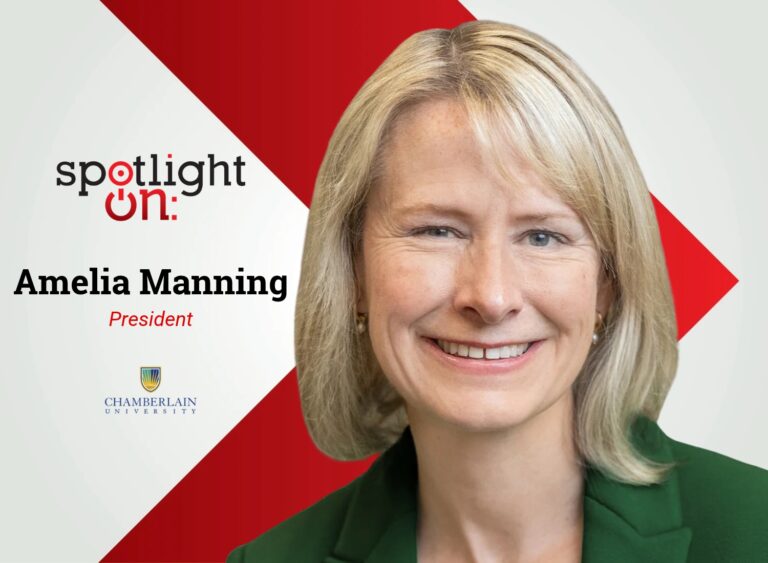

Spotlight On: Amelia Manning, President, Chamberlain University
Key points:
- • Chamberlain, the largest U.S. nurse producer, serves more than 40,000 students.
- • Partnerships with SSM Health and Advocate Health shape its affordability approach.
- • Chamberlain trains students on AI tools through Google Cloud, Hippocratic AI, and HelloAI.
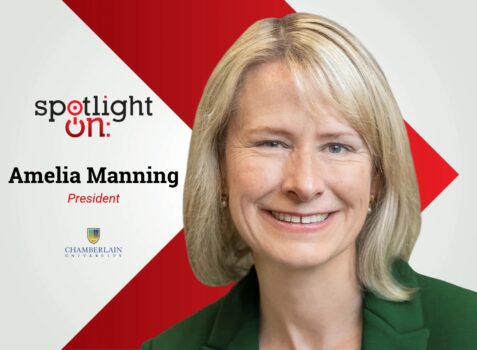 November 2026 — In an interview with Invest:, Amelia Manning, president of Chamberlain University, discussed the institution’s commitment to nursing education, workforce partnerships, artificial intelligence, and student resilience. “It’s one thing to teach people the technical skill of being a nurse. It’s a whole other thing to help them understand what it means to care,” Manning said.
Join us at the Invest: Jacksonville 5th Edition Leadership Summit! This premier event brings together hundreds of Jacksonville’s business and regional leaders to discuss the challenges and opportunities for businesses and investors. Buy your ticket now!
What is your overview of Chamberlain University and its mission?
Chamberlain University has maintained a deep commitment to nursing education for more than 135 years. Over time, we have added programs that extend into the broader healthcare landscape, but we remain particularly focused on educating pre-licensure nurses.
We are equally committed to providing access and opportunity for the students we serve. We want our institution and the nurses we educate to reflect the communities in which they will work because we believe that representation can make a meaningful difference in patient outcomes. We meet students where they are when they arrive with the aspiration to become nurses, and we help them move toward that goal.
Chamberlain is the largest producer of nurses in the United States. We serve more than 40,000 students and have more than 150,000 alumni. We are tremendously proud of the impact those nurses have in the communities where they live and work.
What priorities have had the greatest impact on the university over the past year?
We have been particularly focused on three areas. The first is receiving the feedback we need from health systems and other partners to ensure that we are producing nurses who can contribute almost from their first day on the job. We have invested considerable effort in strengthening those relationships so that the feedback can inform our curriculum and our overall approach to preparing nurses.
Our second priority is ensuring that everything we do from a curriculum, pedagogical, and clinical simulation perspective leads to the outcomes our students need to be ready for the workforce.
The third priority is affordability. We are being thoughtful about how we address that question for students, and much of that work connects directly to our partnerships. We have developed strong proof points with SSM Health and Advocate Health that are changing how we think about alignment among students, the university, and the health system.
Those partnerships help clarify what the student is responsible for, how the institution should contribute, and what health system partners are willing to do to make education more accessible and affordable for future nurses.
How can educational partnerships help health systems address their workforce needs?
About 70% of health system executives say educational partnerships work and are important to filling their talent pipelines, according to the Covista Care Capacity Monitor. Yet many health systems do not fully use those partnerships as a tool for meeting their staffing needs.
Our relationships with SSM Health and Advocate Health are becoming proof points for how to build an engaged partnership model. Similar to aligning on affordability, the goal is to align the interests of students, the university, and health systems so that all three are working together to address workforce needs.
That alignment is important because each party has a role. Students need an accessible pathway into the profession. Universities need to deliver strong academic and clinical preparation. Health systems need a workforce that is ready to contribute. When those interests are brought together thoughtfully, the partnership becomes much more effective.
How is artificial intelligence changing healthcare education and workforce preparation?
Artificial intelligence is clearly on the minds of health system executives. According to the Covista Care Capacity Monitor, about 73% want new hires who already know how to use some of the AI tools they will encounter in the workplace, while 60% say their current workforce also needs to be reskilled to use those tools effectively.
Chamberlain has developed active partnerships with Google Cloud, Hippocratic AI, and HelloAI from GE HealthCare. These tools are already being employed within health systems, and we are training students to use them.
Our objective is to ensure that graduates are better prepared to contribute from day one rather than requiring a lengthy period of retraining or acclimation after entering a health system. Technology is becoming part of the working environment, so students need experience with the tools they are likely to encounter.
What role do clinical partnerships play in preparing students for the workforce?
Strong clinical relationships are tremendously valuable. In the Jacksonville area, our relationships include Baptist Health, UF Health, and Brooks Rehabilitation.
When students pursue clinical experiences within these organizations, they gain insight into what it is actually like to work in those health systems. They are exposed to the environment, expectations, and realities of patient care.
The health systems also have an opportunity to see our students in action. They can observe how students perform, how they engage with patients and colleagues, and how prepared they are for the workforce. Those experiences also provide feedback that helps us improve our curriculum and student preparation.
It becomes a self-reinforcing relationship. Students gain meaningful experience, health systems gain exposure to emerging talent, and Chamberlain receives information that can help us drive better outcomes and experiences.
How can nursing education keep pace with rapidly evolving technologies?
It begins with building strong partnerships with the health systems we aim to serve. We need deep empathy and understanding regarding where they are headed, what their workforce needs are, and how those needs are changing.
Chamberlain must continually calibrate its curriculum, the technologies students can access, and the skills they need. The technologies we train students to use today may not be the same technologies available a year from now. The pace of change means that technical training alone will not be enough.
Nurses need to be adaptable and agile. They must be willing to learn new and emerging technologies as those tools arrive at the bedside. They also need the critical thinking capacity to continue evolving as the role of the nurse evolves.
Our responsibility is not simply to teach students how to use one particular tool. It is to help them develop the ability and confidence to learn throughout their careers.
How does Chamberlain help nursing students develop resilience and prevent burnout?
For several years, Chamberlain has used an approach called Chamberlain Care®. It shapes how we educate and support students and is grounded in three areas that we believe are essential to building resilience.
The first is care for self. We actively teach students what it means to take care of themselves because that is critical to preventing burnout.
The second is care for colleagues. Nurses need to understand what it means to ensure that the people around them have the time, space, and energy to recharge. Supporting colleagues has a meaningful effect on the working environment and can also help prevent burnout.
The third is care for patients. It’s one thing to teach people the technical skill of being a nurse. It’s a whole other thing to help them understand what it means to care. Nurses need to show empathy and understand why that matters to patient outcomes.
When these three forms of care are practiced together, they reinforce one another. Students learn not only the clinical skills required to become nurses but also the personal and interpersonal skills that can help them remain resilient throughout their careers.
Want more? Read the Invest: Jacksonville report.