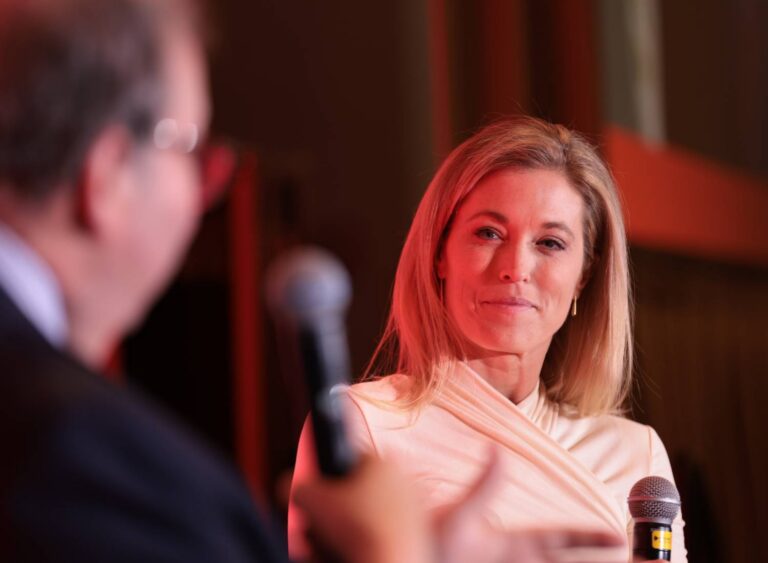







Anne Prisco, President, Holy Family University
 In an interview with Invest:, Anne Prisco, president of Holy Family University, discussed how the university bucked the trend of declining enrollment with a variety of technological tools and program modalities. “We have to be able to offer all of those to the different types of learners,” Prisco said.
What is your current overview of the higher education landscape in Philadelphia?
Philadelphia, like most major cities in the Northeast, is experiencing a demographic cliff. The number of students graduating from high school is steadily decreasing every year. That has put pressure on local universities, especially those that primarily serve students from the local area. There are concerns about the number of school’s and our ability to enroll the number of students we need to remain sustainable. Several smaller schools in Philadelphia have closed or merged as a result of the changes in enrollment patterns.
That said, new technological tools available now are incredibly exciting. We now have the ability to teach online and remotely, and explore all the new modalities for teaching. For the last couple of years, Holy Family University has been getting extra attention for bucking the trend. While many schools have seen declines in enrollment, we have actually increased enrollment for both students living on campus and those who commute. There’s also the exciting possibility of training and retraining adults in new technologies, such as AI. In the U.S., we’re always told that we can go back to school no matter how old we are — I’ve always appreciated that. Whether someone is 40 or older, they can earn another certificate or pivot to a new career. So that’s where we see real potential for the future.
What are the initiatives improving enrollment numbers in recent years?
It definitely is the quality and flexibility of the programs. We’re focused on delivering strong academic programs in the formats that today’s learners need — whether online or in-person, synchronous or asynchronous. Flexibility is key to meeting diverse learner needs. We have added numerous new majors, like cybersecurity, computer science, radiological sciences, and exercise science. We have also looked into more interdisciplinary programs, like philosophy, political science, economics, and sociology, to attract students who are preparing for a lot of different careers. To a certain extent, the athletic programs are also expanding, and the number of sports teams on campus has been increasing. It has attracted more students to live on campus, more than we have ever had before.
How does the university leverage technology in providing better programs for the students?
We have innovative initiatives on both the administrative and academic sides of the house. These include new digital platforms and the integration of AI. By the fall semester, we will have to address AI management within the syllabi and the curricula. It is crucial to consider how AI will be a part of the teaching and learning process — we can’t just treat it as a tool for cheating. AI is a part of everyday life now, so we need to learn how to use it effectively and help our students do the same. Our digital platforms also allow us to offer hybrid courses, which help accommodate students’ commutes and travel schedules. These technologies have made the back-end operations of the university more efficient. For example, we recently adopted an AI-powered chatbot called Lucy, which has saved about 160 staff hours in just a couple of months. Lucy holds all of our schools’ schedules, policy manuals, and course catalogs, so students can check on what they need straight away, instead of calling an office.
We are a smaller institution with 3,600 students, and we pride ourselves on taking care of every student. If a student is struggling in class, we have a platform that allows different offices to share information, enabling us to provide that student with coordinated, wraparound services. Through this network, students have received better support in areas ranging from counseling to tutoring. We have also been able to expand access to mental health services, thanks in large part to our use of technology.
How does the university prepare students beyond academics to become better members of the workforce and society?
One of the courses we will introduce is AI for Ethical Leaders. As a Catholic university, we always think about our mission and values, and distinguish a Holy Family University graduate from someone who hasn’t received a values-based education. We identify five values woven through our curriculum and built into every course. All students are required to take a philosophy class and one religion class. We want them to think about those subjects, in addition to math, science, and other courses. They’re also challenged through interactive group work and presented with ethical dilemmas that often have no clear right answer. By the time they graduate, they’ve wrestled with these kinds of complex situations. And we hold a lot of interfaith conversations, facilitated by religious leaders from other faiths, which helps deepen students’ understanding of other religions beyond Catholicism.
How does the university prepare students for the fast-changing labor markets?
Critical thinking is most important. We have to teach how to learn effectively, because once they know how to learn, they can continue to evolve with the newest technology and the latest job requirements. The Carnegie Foundation recently recognized us as an Opportunity University, which means that we provide significant access and economic mobility to underserved students. Our students, particularly students of color and those from low-income families, tend to earn more money after they graduate, compared to the average student from other schools in the area. We’re very proud of keeping our education affordable, and that students do really well when they graduate. That combination — access, affordability, and strong outcomes — is something we deeply value.
What are the university’s key goals for the next few years?
There’s a lot of construction going on. At our two properties up in Bucks County, we have advanced nursing and psychology programs, and we are building four labs for biotechnology. More facilities are being built and restored to accommodate the new programs, including the cybersecurity program. At the main campus, we are building a fieldhouse for our athletic programs. Lastly, we enhanced the campus center, turning our boardroom into a lounge for students. We now have a game room, and since we have more students living on campus, we are building more accommodating spaces for them. Physically, the school is going to look better with new exciting spaces for our students, faculty, and staff. This is our sacred space, and we spend a lot of time here, so it should be comfortable for all of us.
We will roll out at least four new programs, everything from an associate’s degree to graduate programs. We are heavily invested in the health sciences, especially because this area is known for its “Eds and Meds.” Generally, I’m looking forward to the school having a stronger reputation in business, technology, and health sciences. Right now, we’re really known as a nursing school, and about 40% of our graduates are doing something in the nursing field. I’m hoping that our students and all of our majors are known for their excellence in a few years.