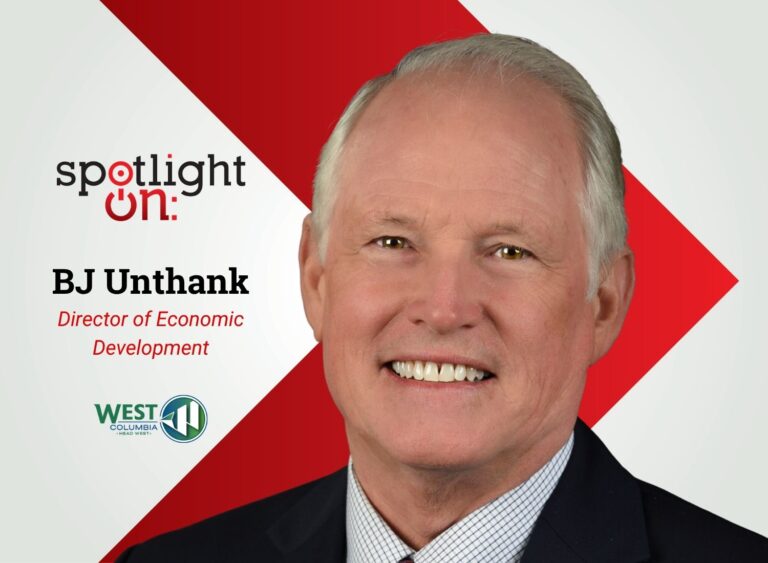
Spotlight On: BJ Unthank, Director of Economic Development, City of West Columbia
Key points:
- • West Columbia’s business-friendly policies are attracting investment and development.
- • River District revitalization and infrastructure upgrades are driving economic growth.
- • Healthcare expansion and workforce partnerships are strengthening the local economy.
 October 2026 — In an interview with Invest:, BJ Unthank, director of economic development for the city of West Columbia, discussed the city’s business-friendly approach, development momentum, and growth priorities. “We look for ways to say yes,” Unthank said, highlighting West Columbia’s approach to helping projects move forward while maintaining high standards.
Join us at caa’s upcoming leadership summits! These premier events bring together hundreds of public and private sector leaders to discuss the challenges and opportunities for businesses and investors. Find the next summit in a city near you!
What changes over the past year have had the greatest impact on West Columbia?
The work we do to make an impact in West Columbia often takes years to come to fruition. We have completed some road improvement projects and have others underway along several major corridors, including Meeting Street in the River District. These projects aim to make downtown more walkable and business friendly.
We also track existing properties that become available for lease or purchase. Our website features a map that helps people see what is actually on the market, including properties that may not be listed on national real estate websites. It offers the kind of on-the-ground information that people looking from afar might not otherwise have access to.
Twice a year, we host Head West events that bring together brokers, bankers, developers, builders, architects, and other professionals involved in development. We share updates on what is happening in West Columbia and stay in touch with people working in construction, building, and real estate.
These efforts have helped us build a reputation as a business-friendly city. We look for ways to say yes. We maintain high standards, and we will continue to do so, but when a project outside the norm comes to us that makes sense and would benefit the city and our residents, we work hard to find solutions.
We also offer what we call a one-stop shop, with the building official, water department, planning and zoning, and permitting functions all located in one area of City Hall. This has helped show that West Columbia is open for business and hungry for growth and development.
What development projects are helping shape the city’s momentum?
We have seen several significant developments over time, including the relocation of a new corporate headquarters to the city of West Columbia. More recently, Langley Pointe Apartments was completed in our fastest-growing corridor along Highway 378, between Interstates 20 and 26. This high-end apartment development is now more than 90% leased. We have worked closely with the developers to advance the 15+ acre parcel adjacent to the development for commercial use. The parcel is near other established mid-to-high-end neighborhoods. The Highway 378 corridor is also home to Lexington Health, a major healthcare provider in the Midlands and surrounding areas, and a key driver of growth in the area.
Which areas and sectors are driving economic momentum?
Different parts of the city have different strengths, and over roughly the past five years, the River District has been the clearest economic driver.
Savage Craft Ale Works opened in the heart of the River District in 2021 and has become a major hub. Several new restaurants have moved into the district and are thriving. Downtown also includes a nine-acre former shopping center ready for redevelopment, one we would love to see developed.
The district has become a real catalyst for West Columbia. We host major events there, including the Meeting Street Music Festival, which draws thousands of people from across the country, along with smaller fall and spring festivals featuring free live music, art, and more.
There is a lot going on, but there is still plenty of work to do, and we are engaged in that work now.
How has the city used public-private collaboration to support redevelopment?
Savage Craft Ale Works is a strong example. The brewery occupies our former city hall and fire station, built in 1925, and includes an event space in the old jailhouse, built in 1908. The property faced several challenges, including water issues on-site.
The city worked with the brewery and the South Carolina Department of Transportation to identify ways to address those issues. The project owner also used the historic building tax credit, the Bailey Bill, the abandoned building tax credit, and other regional programs to make the project possible.
The project required significant collaboration with the city, county, state, and other governing agencies. That collective effort ultimately made it a tremendous success—one we are proud to have been part of.
How does West Columbia help existing businesses and developers succeed?
As a government entity, we have only so many tools in our toolbox. We are a city with a top-rated police department that keeps our community safe and a fire department with the highest possible ISO rating, helping keep insurance rates low. We also have some of South Carolina’s lowest combined water and sewer rates. Among more than 200 providers statewide, we rank fifth-lowest in cost.
These assets help lower the cost of doing business. Every penny counts, especially for businesses that use a lot of water.
Our tax rate is another advantage. Depending on the project, locating in West Columbia can cost significantly less than locating across the river. For example, a project paying $1 million a year in taxes in West Columbia could pay around $1.3 million a year just across the river. For developments worth tens of millions of dollars, that difference becomes a real incentive.
We are also a business-friendly municipal government. We don’t put roadblocks in the way of developers. We look for ways to help businesses and developers succeed while maintaining high standards, and we’ve built a strong reputation for doing just that.
How is healthcare contributing to workforce development and growth?
Lexington Health is a major healthcare provider in the Midlands and surrounding areas. In partnership with the University of South Carolina (USC), it is addressing the nursing shortage in a creative way. In 2024, the hospital opened a state-of-the-art nursing simulation center and teaching facility on its West Columbia campus. The center provides clinical training for USC’s third- and fourth-year bachelor’s nursing students and master’s students.
Its cutting-edge technology and flexible spaces enhance the educational experience for USC’s growing nursing student population and better prepare students to transition into practice. The university awards an average of 900 nursing degrees annually across its system. Within five years, the new Lexington Health facility will help train and graduate 400 nurses each year in West Columbia, an 80% annual increase.
The partners have also built a new graduate medical education (GME) facility on the West Columbia Campus to address the challenge hospitals face in attracting doctors after years of study and residency elsewhere. By then, many have established families and roots and want to stay where they trained. The GME facility is intended to help medical residents establish roots here in Lexington County. When they decide where to practice, they will already be here, giving the hospital a stronger pipeline of new physicians.
Lexington Health continues to expand, bringing significant benefits to our area. We’ve seen growth in restaurants, retail, and other services along the Highway 378 corridor around Lexington Health. I believe the area will see some of its strongest growth in years over the next five years.
What are your priorities for the River District over the next few years?
We have two major projects underway: the Meeting Street Improvement Project and the Mill Village Area Infrastructure Project. The Meeting Street project is a long-term investment in walkability, safety, and the overall sense of place within the city of West Columbia’s River District. It is expected to be completed in Spring 2027. The Mill Village Area project is a comprehensive $15 million infrastructure and revitalization effort focused on upgrading water lines, stormwater systems, roadways, parking, and pedestrian safety in the Mill Village and Alexander Road areas. It is expected to be completed in late Spring 2027.
One of the biggest opportunities is redeveloping the Capitol Square shopping center at the corner of Meeting Street and Highway 378. We would love to see the site redeveloped. Plans have included new luxury apartments, along with retail and mixed-use development. This would help sustain the area’s upward trajectory.
More high-end residential development is also planned, including condominiums and townhomes in the surrounding areas. The River District began as the city center and remains a place where people can enjoy entertainment, restaurants, dining, and events.
What other areas of West Columbia are positioned for growth?
Triangle City, Highway 1, Highway 378, and Charleston Highway are all areas positioned for growth. Council has included these areas in its annual goals and priorities. The Redevelopment and Revitalization plans adopted in 2018 and then updated in 2024 identify targeted projects for each, including improved walkability, park updates, roadway safety improvements, small-area zoning plans, and beautification.
Want more? Read the Invest: South Carolina report.