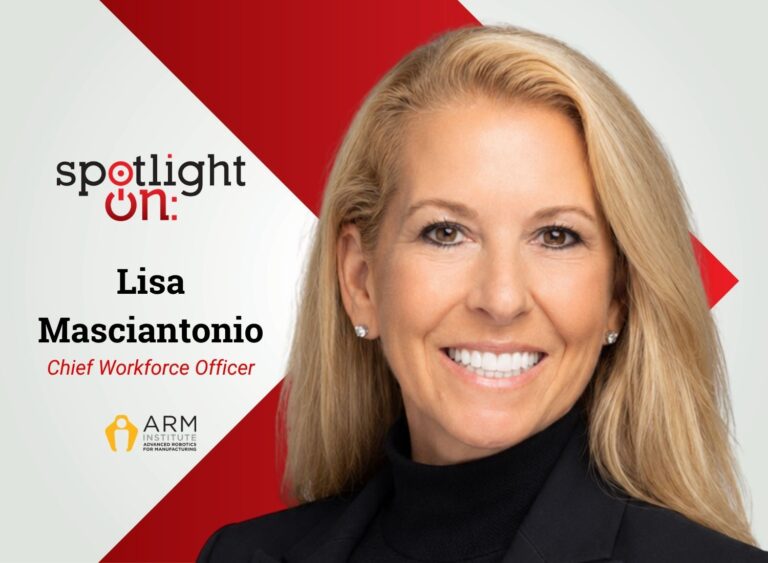

Spotlight On: Lisa Masciantonio, Chief Workforce Officer, Advanced Robotics for Manufacturing (ARM) Institute
Key points:
- • The ARM Institute is helping workers develop skills in robotics, automation, and AI.
- • Manufacturing faces a widening skills gap as retirements outpace workforce entry.
- • Pittsburgh’s robotics ecosystem supports national innovation and workforce development.
 October 2026 — In an interview with Invest:, Lisa Masciantonio, chief workforce officer at the ARM Institute, discussed how the organization is helping prepare the manufacturing workforce for rapid advances in robotics, automation, and artificial intelligence. “We want to be an enabler for everybody else who is focusing on all of these advanced technology changes in the manufacturing world,” Masciantonio said.
Join us at caa’s upcoming leadership summits! These premier events bring together hundreds of public and private sector leaders to discuss the challenges and opportunities for businesses and investors. Find the next summit in a city near you!
How is the ARM Institute helping workers develop the skills needed for robotics, AI, automation, and advanced manufacturing?
We are one of 18 national Manufacturing USA institutes, and our charter is to help revitalize manufacturing in the United States. Each institute focuses on a different component, such as bio, advanced materials, or additive manufacturing. We are responsible for robotics, automation, artificial intelligence, and how those technologies apply across advanced manufacturing.
When you look at robotics and how quickly changes are taking place on manufacturing shop floors, we are responsible for helping the workforce keep pace with those changes. It does not necessarily make sense for us to go out and create new training programs and certifications because many already exist.
Instead, we created a unique free platform called RoboticsCareer.org. It focuses on key competencies and helps make sense of them for the workforce, particularly around robotics and artificial intelligence skills. It defines emerging and current skills, helps people find training that maps to those competencies, connects users with jobs, and allows individuals to create a profile that tells their story, almost like LinkedIn for the manufacturing environment.
The key is helping build the bridge between innovation and workforce readiness. If a manufacturer buys 10 robots and automates significant parts of its lines, but the workforce is not ready, willing, and able to use those solutions, productivity and throughput can lag rather than improve. We want to be an enabler for everybody else who is focusing on all of these advanced technology changes in the manufacturing world.
How significant is the manufacturing skills gap, and what will it take to address it?
This is one of the biggest challenges in manufacturing because solving it has to be a team sport. The skills gap is massive. If you look at data from sources such as Lightcast and studies from the Manufacturing Institute and Deloitte, there is a prediction that over the next seven years, manufacturing will need to hire at least 3.8 million new workers. With the large number of anticipated retirements and fewer millennials and Gen Z workers entering manufacturing, about 1.9 million of those jobs are expected to go unfilled.
It is not only a misalignment of skills. There simply are not enough people to do the work. To put that in perspective, we have about 1,100 community colleges across the country. If every one of those colleges graduated 100 students a year and every student went directly into manufacturing, we still would not make a meaningful dent in that gap for many years.
We cannot rely on one solution. We need to encourage more people to enter the field while also using automated solutions to fill jobs that we know may never be filled. We need to understand where the gaps exist, retain and upskill current workers, and attract more job-ready individuals. We also have to reach students earlier, including in grade school.
Ultimately, policymakers, employers, training providers, and individuals have to work together. We also have a major communication gap. Many people still think of manufacturing as dirty, dull, and dangerous, when some manufacturing floors are cleaner than our homes and are highly digital, technical, and innovation-driven. We need to dispel those myths.
How are you helping define pathways into emerging careers in robotics and automation?
That is exactly where our competency framework within RoboticsCareer.org comes into play. It is designed to create clarity around emerging occupations and the knowledge, skills, and abilities people need to enter them.
On the manufacturing floor, you are increasingly hearing titles such as robotics technician, robotics operator, automation specialist, and AI-enabled manufacturing professional. We help define those job roles so people can understand what they involve and see how they might enter at one level and progress through these new occupations.
These are well-paying jobs with strong benefits, and they are different from older perceptions of manufacturing. We are still putting many of the pieces together, particularly around making sure the skills employers need are reflected in the training that providers deliver.
If an employer says certain skills are required to operate a new automated solution, training providers need to be teaching those competencies in a way that allows people to move directly into those jobs. In many cases, we do not have two to four years to wait for someone to complete a full degree cycle.
We want those career pathways to be visible and actionable, but we also want the core competencies to be gained efficiently so people can enter those jobs more quickly.
How does Pittsburgh’s robotics and advanced manufacturing ecosystem support the ARM Institute’s national mission?
That ecosystem is one of the reasons we were founded out of Carnegie Mellon University. Although the ARM Institute is an independent nonprofit, it remains closely coupled with Carnegie Mellon University and many other Pittsburgh robotics and AI powerhouse companies.
Carnegie Mellon has some of the strongest research capabilities in robotics and artificial intelligence and applies those capabilities not only locally in Pittsburgh but across the country. That expertise is at the heart of what the ARM Institute was established to do.
Another important factor is the large number of robotics and high-tech companies in southwestern Pennsylvania, along with the educational infrastructure around them. That includes certifications, career and technical education, community colleges, and higher education programs that help build the broader ecosystem.
If we are supporting a national manufacturing initiative in robotics and automation, Pittsburgh is central to that work because the region has strong capabilities across those areas. What is happening here can provide lessons for the national stage.
Our local policymakers and government leaders are also supportive, as are the region’s foundations. Their grantmaking helps systematically and effectively build expertise across sectors in the region.
How do you help manufacturers prepare their workforce as they introduce more automation?
In addition to RoboticsCareer.org, we take what I would describe as a talent supply chain approach. In conjunction with our partners at Carnegie Mellon and Valdos Consulting, we look at Bureau of Labor Statistics data, Census data, Lightcast, and other sources to assess whether a region is positioned to succeed with automated solutions and whether the workforce can support those changes. We use a systematic approach that looks first at the external landscape and then at the internal needs of individual employers.
On the technical side, we have established a Robotic Manufacturing Hub to help companies that are considering automation. We help identify where it makes sense to automate, simulate what those changes could mean on the shop floor, and examine the potential impact on productivity, throughput, and the bottom line. From there, we can help develop a timeline and recommendations around the technical changes the employer is considering.
Then we look at workforce readiness. If an employer wants to retain everyone currently working on the shop floor, we examine how those employees can transition into new jobs. Some people may decide to retire, while others may move into another department. From there, we can determine what remaining workforce gap exists.
Using the knowledge we have about the training landscape in that geographic region, we help build the workforce pathway alongside the automation pathway. An employer may find that upskilling the current workforce addresses a large portion of their need, while additional hiring is still required.
We then help identify where those additional workers may come from, what salary levels look like, and what preparation is needed so that when the new automated phase begins, the workforce is as ready as the technical solution.
The goal is to help regions and employers prepare for these changes so they do not over-automate, under-automate, or invest in technology only to discover that their people are not prepared to operate it. It is the practical application of all of these resources to make sure employers, workers, and stakeholders are ready for significant technological change.
Want more? Read the Invest: Pittsburgh report.