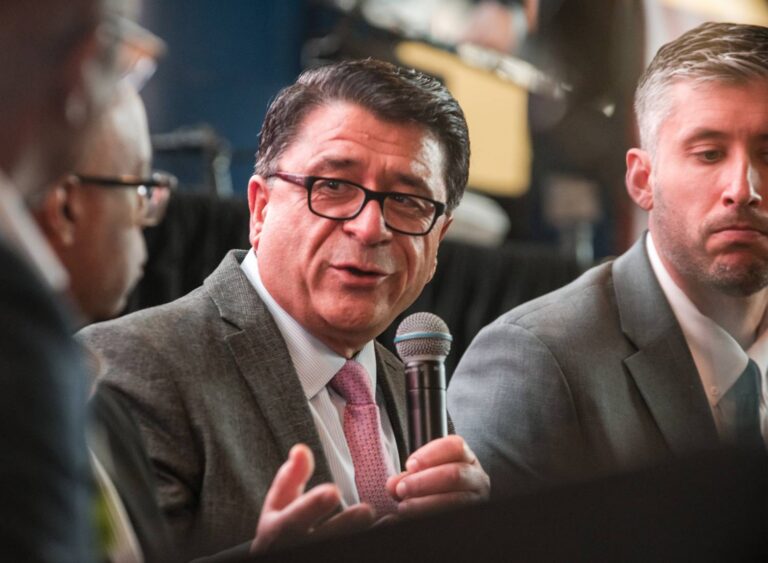







Spotlight On: Rudy Bazan, President, San Antonio Pipeliners Association
 October 2025 — In an interview with Invest:, Rudy Bazan, president of the San Antonio Pipeliners Association, shared how San Antonio’s location makes it a key hub for Texas’ pipeline industry, especially amid rising energy demand from data centers. The association fosters talent through scholarships and YPO programs while championing safety, innovation, and community engagement. “We want to get the word out that our industry is essential, safe, and forward-thinking,” Bazan said.
What makes San Antonio a strategic location for your association and the midstream pipeline industry?
It comes down to location. San Antonio is centrally positioned, equidistant from the Permian Basin to the west, Corpus Christi to the south, and Houston to the east. Each of these areas plays a major role in Texas’ energy infrastructure.
Being able to access any of those markets within two to three hours makes San Antonio an ideal home base for pipeline companies and professionals.
Join us at the San Antonio 4th Edition Leadership Summit! This premier event brings together hundreds of San Antonio’s business and regional leaders to discuss the challenges and opportunities for businesses and investors. This year’s theme centers on how the region is balancing economic growth and authenticity. Buy your ticket now!
What trends or shifts are you seeing in the pipeline and energy sectors?
We’re seeing a significant uptick in interest from data centers, especially in Bexar County. Companies like Microsoft are building several large-scale centers here, but one of the main challenges is supplying them with power. CPS Energy has limitations and is telling some developers they may need to wait years for access to sufficient power.
As a result, many are turning to natural gas as an alternative, which is where we come in. We need to run connector lines from our main pipelines to these sites. That also involves air permitting and environmental compliance, especially when using generators. These changes are bringing new attention and opportunities to our sector.
How is the association partnering with other agencies to support development?
We’re developing relationships with agencies like CPS Energy and ERCOT through speaking engagements at our monthly luncheons to help our members plan for future infrastructure efforts. For example, powering data centers with natural gas, which is relatively new in our area; we’re in the early stages of planning and permitting.
Engineers and environmental specialists are helping us navigate the permitting process. Once the first data center is approved, I expect a domino effect where many more follow.
How is the association supporting workforce development and attracting new talent to the industry?
Talent development is a key priority for the San Antonio Pipeliners Association. We’re a networking organization, but our main focus is raising scholarship funds through events — golf tournaments, clay shoots, fishing trips — to support our purpose. We partner with UTSA, Texas A&M–San Antonio, Texas A&M–Kingsville, and Texas A&M–Corpus Christi to provide scholarships for students pursuing degrees in engineering and related fields. Our members recognize the aging workforce and the need to cultivate the next generation of skilled professionals.
What challenges are you seeing in terms of industry perception and public understanding?
Unfortunately, oil and gas often get a bad reputation in the public eye from advocacy groups and legacy media. What people don’t realize is that 99% of crude oil and gas transported through pipelines reaches its destination safely and without incident. Most people are near pipelines every day and don’t know it because nothing goes wrong. I spent 15 years as an environmental scientist, and I can say that pipelines are some of the safest and most environmentally friendly methods of transporting fuel compared to trucks or rail.
Another misconception is about the people in this industry. These individuals are deeply committed to safety and environmental stewardship. They work in highly regulated environments with strict safety standards and constantly look to improve operations.
How is the association approaching the integration of renewables and other energy sources?
One of our key industry supporters, Howard Energy, says it well: They want to be known not just as an oil and gas company, but as an energy company. That includes renewables.
We’re not opposed to renewable energy. We believe in a balanced approach. As battery and solar technologies improve, they’ll play a bigger role. In the meantime, natural gas is already being used to power AI and data centers. The key is balance — leveraging both traditional and renewable energy sources as they evolve.
That said, there’s a bit of frustration among long-time oil and gas professionals. Many feel underappreciated and misrepresented. They’ve worked hard to advance safety, environmental protection, and energy reliability. That message often gets lost.
What technological advancements are you seeing in pipeline safety and efficiency?
One of the most exciting developments is the use of fiber optics for pipeline monitoring. Operators now sit in command centers, tracking everything in real time. These systems can detect even the smallest gas leaks and pinpoint their location. They can tell when someone or something — even a rabbit or coyote — is on or near a pipeline.
How is the oil and gas industry giving back to the community in ways that are often overlooked?
One thing I wish more people knew is the generosity of the people in this industry. Every year, we hold a holiday toy drive for foster children in our community. We fill two U-Haul trucks with toys based on the generosity of the people in the oil and gas industry.
The oil and gas professionals — and their companies — go above and beyond to give back. These people have big hearts and are deeply committed to their communities. It’s a side of the industry that’s rarely seen but incredibly powerful.
What are your top priorities for the San Antonio Pipeliners Association over the next two to three years?
Our focus is on continued growth and messaging. We want to get the word out that our industry is essential, safe, and forward-thinking.
We’re also prioritizing recruitment, attracting smart, young talent. We’re expanding our young professionals (YPO) effort through mixers, mentorships, and educational outreach. We want to create a pipeline of future leaders and equip them with the knowledge and support they need to thrive.
What is your outlook for the San Antonio energy sector in the coming years?
This year feels like an adjustment period, especially with tariffs, regulatory changes, and broader market shifts. But we’re starting to see improvements.
We anticipate strong growth next year and the year after. Activity in the Eagle Ford Shale is picking up again, and the Permian Basin continues to perform well. We’re also seeing more investments in carbon capture and efficiency-focused technologies.
Overall, the outlook is positive. We have a strong supply and a forward-looking industry that’s constantly evolving.
Want more? Read the Invest: San Antonio report.