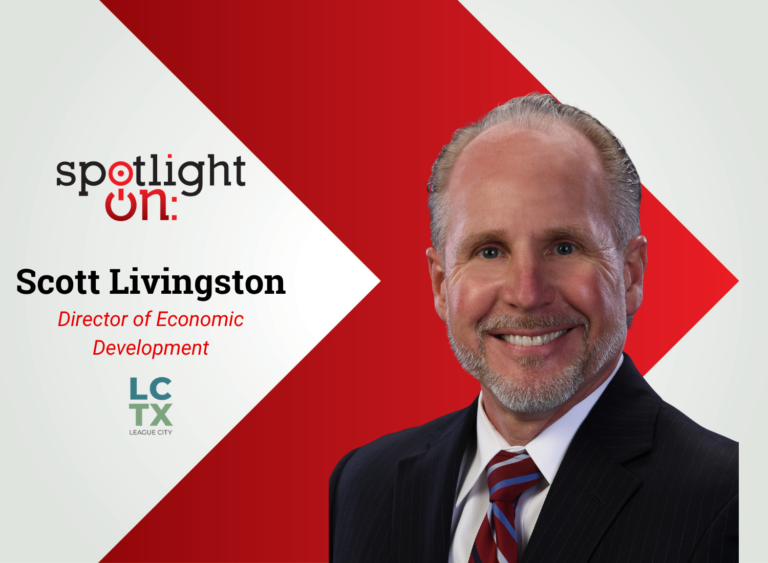

Spotlight On: Scott Livingston, Director of Economic Development, League City
Key points:
- • League City’s location, livability and affordability are drawing new residents.
- • The city is preparing sites for growth along the future Grand Parkway corridor.
- • Impact fees fund new infrastructure, keeping property taxes low for existing residents.
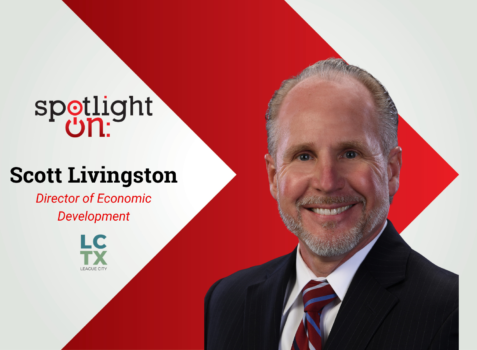 October 2026 — Invest: sat down with Scott Livingston, director of economic development for League City, to discuss the city’s economic momentum, how it is preparing for the Grand Parkway corridor, and the policies guiding sustainable growth. “League City is growing because people want to be here,” Livingston said.
Join us at caa’s upcoming leadership summits! These premier events bring together hundreds of public and private sector leaders to discuss the challenges and opportunities for businesses and investors. Find the next summit in a city near you!
How would you describe League City’s economic momentum, and what has changed the most over the past 12 months?
League City is growing because people want to be here. It is a highly rated community, both in the state and in the nation, and we are consistently ranked highly for our quality of life and overall livability.
At its core, our momentum is driven by a combination of location, amenities, and access. We are halfway between Houston and Galveston, which means we are about 30 minutes from both downtown Houston and Galveston Island. That makes it easy for residents to commute, whether they are driving to jobs outside League City or working in town. A lot of people do work remotely, and the community’s setting supports that lifestyle.
People are drawn here because of proximity to parks and outdoor assets, including Galveston Bay and Clear Lake. We have beautiful parks, a strong tree canopy, and the kind of environment families want. We also benefit from strong education options and a deep healthcare footprint. The University of Texas Medical Branch, which has a 68-acre campus in League City, recently announced a $300 million expansion and owns additional land to potentially expand its campus to 92 acres. Residents also have access to other major healthcare providers, including MD Anderson, Memorial Hermann, Houston Methodist, and Kelsey-Seybold.
Housing also matters. Residents can often get more bang for their buck, and affordability remains a key part of our appeal. In fact, League City was recently ranked as the 9th “Most Affordable, Fastest-Growing City” in the USA and the 8th “Best Place to Live in Texas!”
Another factor that people sometimes overlook is the concentration of high-paying industries connected to our broader region. Healthcare and medical/life sciences are prominent across the Bay Area Houston Region, including the Texas Medical Center, UTMB, and institutions like the Galveston National Laboratory. We are also close to NASA, which supports a major aerospace cluster and a strong STEM workforce, two large petrochemical and specialty chemical clusters, and four major ports.
The Grand Parkway corridor is a major storyline for the region. What has League City done to prepare sites for business investment and make that growth more intentional?
The Grand Parkway is scheduled to start construction this summer in Alvin, and then in League City in the first half of 2027. Construction is expected to finish by 2031.
In preparation, the City of League City completed a Westside Regional Master Plan, which reflects what residents, landowners, business owners, and other stakeholders want to see developed on the west side of League City, particularly along the future Grand Parkway. The Plan outlines future land uses and the supporting infrastructure framework, including drainage, and some diverse districts that will shape development.
That includes districts for housing, commercial development, light industrial uses, and integrated mixed-use development. The intent is to guide growth in a way that strengthens the community and creates predictable and desirable outcomes for investment.
A key theme of the Plan is integrating development with our natural assets. Along the Grand Parkway, we want to capitalize on League City’s natural beauty. We do not want to chase out all the animals and cut down all the trees. We want to integrate our new development with our natural surroundings so that the natural surroundings literally become amenities for the new development. That approach supports quality of life and aligns with what many residents and employers are seeking.
With continued residential growth, how are you balancing housing with commercial development and strengthening the local tax base?
One important initiative is what we call the Development Services Strategic Plan, which focuses on how development moves through the city’s development process, from plan review to inspections and permitting. Developers care deeply about time and predictability, so our goal is to make the process efficient, effective, and transparent.
We work to set clear expectations through tools like our Unified Development Code, zoning ordinances, building codes, and guidance from the Westside Plan. We also hold pre-development meetings on Tuesdays and Thursdays, where developers can sit down with staff and walk through proposed development concepts and pre-construction building plans early in the development process. This process helps to address issues before they become surprises. We do not want an investor to be surprised by something they did not know about.
We also have high standards in League City, and we like those standards because we are trying to build and maintain a quality community. Growth has to be supported by infrastructure. We do not want growth to move so fast that infrastructure lags years behind.
One of the ways we manage this is through development fees, or “impact fees”, including capital recovery fees for water, sanitary sewer, and roads. Therefore, developers pay for their own roads, water lines, and sewer lines, that are a part of their private development. Additionally, when they tie into the city’s water, sanitary sewer, and road systems, we also charge capital recovery fees. This is a deliberate approach. Someone has to pay for growth, and we do not want residents who have been here for decades to shoulder the cost of incremental growth through higher taxes.
Philosophically, we want the users and the projects creating the need to shoulder the responsibility for the new capacity. A byproduct of this philosophy is that it helps to ensure that only serious, high-quality developers choose to develop their projects in League City, and those are the partners we want anyway, partners who can pay their own way and grow with us.
This approach is closely tied to our tax strategy. We have lowered our tax rate each year for the last 12 years, and we are trying to push our property tax rate down as close to zero as possible, or at least as low as we can, while continuing to grow the economic base.
From a tax-base standpoint, we also recognize that League City is still heavily residential. Today, our tax base is comprised of about 80% residential value and 20% commercial value. Through the Westside Regional Master Plan and future growth around the Grand Parkway, we are trying to create more opportunities for commercial development so we can move closer to 70% residential and 30% commercial. In a perfect world, maybe we could reach 60%–40%, but 70%–30% would be an improvement that supports local job creation, minimizes commutes for our citizens, and helps to shift and share a greater opportunity to fund the property taxes in our community that support our community’s superior quality of life among both residential and commercial taxpayers.
Looking ahead two to three years, what are your top priorities and general outlook for League City?
We are fortunate to have a major, international company in League City that reflects one type of business for which we would like to attract more, similar companies. INEOS is the fourth-largest chemical company in the world, and while they have major facilities north and south of us, they have two U.S.-based subsidiaries in League City that create professional, high-paying, white-collar jobs. We would like to attract more projects like that, including headquarters, regional offices, and U.S. subsidiaries.
We are also an ethnically diverse community, and we are open and receptive to people from around the world who want to come here, contribute, and be part of the community. That diversity is part of the broader Houston Region’s strength, and it supports talent attraction and long-term competitiveness.
From an economic development standpoint, we want more clean, high-paying, high-tech jobs, and especially those that are aligned with the key industry sectors of our regional economy: healthcare, aerospace, specialty chemicals, ports and logistics, professional services, and tourism.
At the same time, League City’s superior quality of life is not a side issue for us. As the community grows, we want to expand the types of amenities that make League City a place where families want to stay. We already have strong amateur sports offerings, but we would like to attract more family-oriented entertainment on a commercial scale, things like interactive entertainment, “eatertainment”, cinemas, and destinations where families can spend time together.
Another major priority is the sustainability of infrastructure and finances over the long term. We are a community of about 125,000, and over time, we are planning to grow to about 200,000 – 250,000 in population. As we grow, we want our superior quality of life to be sustainable. That means maintaining, repairing, and eventually replacing city-owned infrastructure, buildings, roads, utilities, sidewalks, and parks, in perpetuity.
This is a challenge for many communities. Cities grow, and then when growth slows, fee income decreases as well. Assets age, costs rise, and without a long-term model, communities can end up in a cycle of decline and tax increases that drive people elsewhere. We are trying to break that cycle so that residents can stay in League City without taxes becoming unsustainably high. Part of our work over the next several years is developing a model that supports long-term maintenance and reinvestment that will sustainably support our superior quality of life in perpetuity.
Want more? Read the Invest: Houston report.