Spotlight On: Tyson Moeller, President, The Port of Texas City & Texas City Terminal Railway Company
Key points:
- • A $3 billion LPG project is expected to drive port growth beginning in 2028.
- • The Port of Texas City anticipates $700 million in infrastructure needs over the next decade.
- • Petrochemical demand and industrial land availability are creating long-term expansion opportunities.
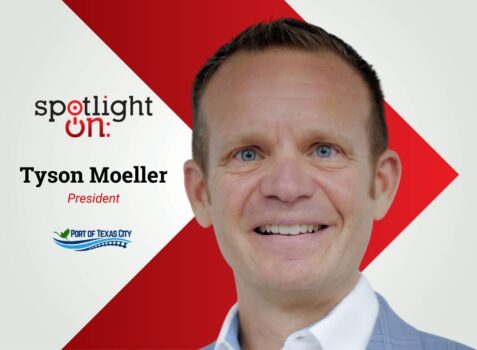 October 2026 — In an interview with Invest:, Tyson Moeller, president of The Port of Texas City and Texas City Terminal Railway Company, discussed growth opportunities tied to petrochemicals, LPGs, rail, and dock infrastructure. “Texas understands what its economy is built on,” Moeller said.
Join us at the Invest: Houston 3rd Edition Leadership Summit! This premier event brings together hundreds of Houston’s business and regional leaders to discuss the challenges and opportunities for businesses and investors. Buy your ticket now!
What changes in logistics and industrial markets have had the biggest impact on your business over the past year?
Our business has been pretty static here at the Port of Texas City, and we expect that to continue through 2027. We do expect additional growth as we get into 2028 and beyond.
MPLX and ONEOK formed a joint venture and turned dirt last year on a $3 billion project. That means new product coming through the Port of Texas City in 2028, specifically LPGs. There will be pipeline product from the Permian Basin to Texas City, a new fractionator, and two new docks at the port. That will represent a significant increase in volume, as well as product diversification from what we do today.
Our base book of business, especially from the water side, comes from Marathon and Valero. Both refineries process about 1 million barrels of crude oil every day and are producing key fuels such as jet fuel and gasoline, which are distributed and exported for domestic and international markets. Other tenants that support the Port volumes are BWC, INEOS and Advario.
Where do you see the most demand for the Port of Texas City, and where do you see the biggest opportunities for growth?
We see growth opportunities from the water/port side, as well as from the rail side. The Port owns over 500 acres that are zoned for heavy industrial use that can be developed. Some of those acres are greenfield, and some are brownfield sites that can be developed for production. There are another 400-plus acres in the surrounding area that are not owned by the Port of Texas City, which includes locations like Shoal Point, where both the Texas General Land Office and the City of Texas City both own property.
There are opportunities for direct rail service and upland areas to be developed for new docks and we have a variety of growth opportunities at the Port of Texas City and in this region.
There are additional products and NGL demand coming that will need to find outlets over the water. We are looking at ways for the Port of Texas City to participate in this growth.
What advantages does the region offer companies looking to invest, expand, or come into Texas City?
The advantages are that Texas, in general, is open for business. The state is welcoming the industry we are in. We are in the petrochemical business, and that business is going to continue to grow in the Gulf region. There are continued investments here versus other states.
Texas understands what its economy is built on, and the advantages we have, especially in the Houston region, including the Port of Houston, Port of Texas City, Port of Galveston, and Port of Freeport. Galveston, Texas City, and Houston all share the same entrance channel.
What we do is represent the region, both at the state and federal levels in Washington, D.C., as one ecosystem when it comes to ports and waterways.
What opportunities do you see from the Houston Ship Channel expansion?
Ours will probably stay focused on petrochemicals. We do some ethanol export, and we expect ethanol exports to continue to grow because of international needs for blending in fuels.
If you think about countries like India or Japan, they are expected to have legislation that would require an E20-type blend. With those legislative actions coming in 2030 or beyond, that will continue to create demand for ethanol exports. Ethanol comes from the Midwest and is railed down to the Texas City or Galveston area.
Where do you see the greatest need for infrastructure investment?
From an infrastructure standpoint, we have over $200 million worth of infrastructure needs in the next two to three years. That includes things like a new port entrance, new rail infrastructure, and docks.
If you go beyond and look at the three- to 10-year range, there are additional rail infrastructure and additional dock infrastructure needed. At a high level, a dock for deepwater vessels could be a $100 million to $150 million investment.
In order to be ready for the markets, you have to start planning now. That includes the proper designs and permitting through the Army Corps of Engineers. Those are things we strategically work through in advance.
What are you seeing in the labor market, and how are you supporting workforce development?
For the Port of Texas City, we are a landlord port. It is really the industries and the companies such as Marathon, Valero, BWC, and INEOS that are focused on the future workforce.
We support regional efforts for workforce training to support the industries that need skilled labor and workforce. It is really the trade crafts, such as welding and I&E, that need to be supported.
Regionally, organizations such as Port of Houston, BAHEP, BayTran, the Greater Houston Port Bureau, and the Economic Alliance are helping pull people together. What is neat is that I talk about the ports having one message, but all of those organizations and agencies are supporting the region, and they come together with a consistent economic message.
Instead of having their own independent messaging and goals, they are coming together to hear what our timeline and goals are and what our messaging is. They are going to the state level and Washington, D.C. level together to talk about the importance of our region. Each of those organizations focuses on something a little different, but there is a common theme of the economic benefit for the region.
How has the environmental performance conversation evolved in your industry?
For us, it is more that you are going to move things by pipeline, rail, and water because it is the most efficient and cleanest way of moving those products.
For our footprint, we do not need a whole lot of trucks on the road. From an emissions standpoint, I would say we have a fairly low carbon footprint when it comes to the transportation modes.
What are your top priorities and general outlook for the next three to five years?
In the next three to five years, we are looking at the development of new docks and additional rail infrastructure within our footprint. We have over 500 acres still to develop, and that consists of uplands for the new docks and new rail infrastructure.
For rail infrastructure alone, I am thinking about $250 million. With the docks, that is probably another $200 million to $300 million. You are easily at about $500 million at a high-level estimate for the new infrastructure. We have communicated to the Texas Department of Transportation’s (TxDOT) Maritime Division that we have about $700 million need for capital improvements over the next 10 years in order to grow with the industries and the region.
Is there anything else you would like to highlight?
The $3 billion project for LPGs is really phase one of the Port of Texas City’s growth story. When I think about the future and the three-to 10-year outlook, phase two will include additional demand for NGLs and LPG products.
We have talked about the 500 or so acres, but 400 of those acres are property in La Marque. That was approved by the City of La Marque last year, and it is now zoned for heavy industrial use. That gives us an opportunity to expand that footprint.
From our standpoint, hydrocarbons are still one of the more efficient ways to provide energy, so we do not see a reduction in demand for those hydrocarbon fuels in the Gulf.
Want more? Read the Invest: Houston report.