Career development in NC: 4 school leaders share their approach
Key points:
- • Families now want evidence that a school delivers growth, and at some schools demand already outpaces capacity.
- • Schools are adding AI and STEM training while insisting that judgment, communication, and character come first.
- • Employers that offer internships, apprenticeships, and scholarships gain early access to the talent these schools produce.
 October 2026 — Career development starts long before the first job. At The Piedmont School & John Yowell Academy in High Point, it can start with a comic book.
Join us at the Invest: Raleigh-Durham 4th Edition Leadership Summit! This premier event brings together hundreds of Raleigh-Durham’s business and regional leaders to discuss the challenges and opportunities for businesses and investors. Buy your ticket now!
A student who struggles with reading might begin with graphic novels. Teachers learn a child’s interests before they apply a curriculum. Across North Carolina, that relationship-first approach is reshaping how schools move students from curiosity to career.
For Kori Mackall, head of school at Piedmont, the order matters. “Our approach is relationship first, curriculum second,” Mackall told Invest:. Graphic novels still count as reading, in her view, and each small success builds the confidence a student needs for harder material.
The idea reaches well beyond one campus. On October 20, Mackall will join Michael Ulku-Steiner, head of school at Durham Academy; Adam Holden, head of school at Saint Mary’s School; and Jami Woods, president of Wilson Community College, at the Invest: Raleigh-Durham 4th Edition Leadership Summit. From a Durham day school to a Raleigh boarding school to a community college in Wilson, all four describe the same shift. Education now has to show that it develops the whole person and connects that person to meaningful work.
Families want proof
Mackall is in her 15th year at Piedmont and her fourth as head of school. She has watched parents grow more exacting as more of them explore schools of choice. “Parents today want more than reassurance that their child will receive support. They want evidence,” said Mackall.
The school serves 90 to 100 students from kindergarten through 12th grade. Each has an attention deficit diagnosis, a specific learning disability, or both. Literacy and math classes never exceed six students, and several grade levels now have waitlists.
The CDC reports that 12% of U.S. children aged 3 to 17 had ever been diagnosed with ADHD as of 2024. Mackall sees timing as the deciding factor. “Early intervention is key. Early identification is key,” she said.
Holden faces the same pressure at Saint Mary’s, where families weigh several strong independent schools against outstanding public options. The all-girls boarding school’s day does not end at 4 p.m., so parents expect it to deliver more than academics. “We are also helping young women develop values-based character, confidence, and the ability to advocate for themselves,” Holden told Invest:.
At Durham Academy, Ulku-Steiner doesn’t measure success by test scores and college admissions alone. The school starts with what he calls the bottom of the pyramid: sleep, movement, friendships, and handling conflict. In his view, everything else depends on it. “If students don’t feel physically, emotionally, and socially safe, they simply cannot reach their highest levels of academic development,” Ulku-Steiner shared with Invest:.
Technology, used with care
Once those foundations are in place, the question becomes what students should learn, and technology now dominates that conversation. Durham Academy integrates AI into teaching, but strong results are no reason to stand still, in Ulku-Steiner’s view. “Complacency is what concerns me most,” he said, adding that they want students to treat technology as a tool, never as a replacement for conversation, collaboration, or the ability to grapple with ambiguity.
Wilson Community College turned the same caution into classroom policy. Faculty label each assignment red, yellow, or green to signal how much AI students may use. Woods wants graduates who can do both. “Students should understand AI, use it ethically, recognize its risks and opportunities, and combine those skills with strong communication, teamwork, and critical thinking,” she said. Through a partnership with Wayne Community College, Wilson students can complete an Associate of Applied Science degree in AI.
Saint Mary’s has added computer science, cybersecurity, and AI to its curriculum and has begun the first phase of a STEM building. It has not traded away mathematics, science, English, or world languages to do so. Holden sees no conflict between the two. “New and innovative programs don’t threaten identity, because we know exactly who we are.”
Thinking beyond the campus
So far, each of these schools has adapted within its own walls. The larger shift is happening across the region. Colleges, employers, and schools are pooling resources to build talent that no single campus could produce alone.
Wilson Community College operates the Biomanufacturing Education & Skills Training (BEST) Center, but Woods describes its scope as regional. It brings together community colleges, universities, and industry partners. The center is set to open in April 2027, backed by $30 million from the North Carolina General Assembly and $13 million from the Golden LEAF Foundation. Once fully operational, it could train up to 500 people a year for life sciences employers.
Woods wants those relationships to run year-round, not just through annual advisory meetings. “Employers should know they can call us whenever they need talent or training,” she said. The college is also building registered apprenticeships, which can reduce tuition costs for students while employers develop future hires. Growth, for Woods, means nothing if quality slips. “As we grow, we need to keep two things tightly coupled: access and success.”
Piedmont plays its own regional role. It hosts workshops where public, charter, and private school teachers learn strategies to take back to their classrooms. It also collaborates with a statewide network of schools serving students with learning differences. Through the High Point Chamber and Leadership High Point, Mackall introduces local business leaders to the school’s work. A new internship elective will place those students with companies. She sees an advantage employers often miss. “Students with neurodiverse minds bring creativity, problem-solving skills, and fresh perspectives.”
The Research Triangle gives Durham Academy a similar reach. Its partners include universities, research labs, medical institutions, and cultural organizations. Upper School students take on research projects that resemble undergraduate theses. Saint Mary’s draws on regional assets too, from an equestrian program at a local barn to its role as academic partner to the North Carolina Courage.
Much of this growth depends on private capital. At Piedmont, business and foundation partners have funded scholarships, a computer lab, and part of an expansion that adds a high school wing and, later, a gymnasium. “Without those partnerships, many of our scholarships, facility improvements, and program expansions simply would not have happened,” Mackall shared.
Ulku-Steiner has watched three decades of graduates pivot and reinvent themselves. For him, that is the real measure of preparation.
“If we can help students leave Durham Academy with a strong sense of who they are, with good habits, and with a healthy orientation toward the world, then we’ve prepared them not just for college, but for life,” he said.
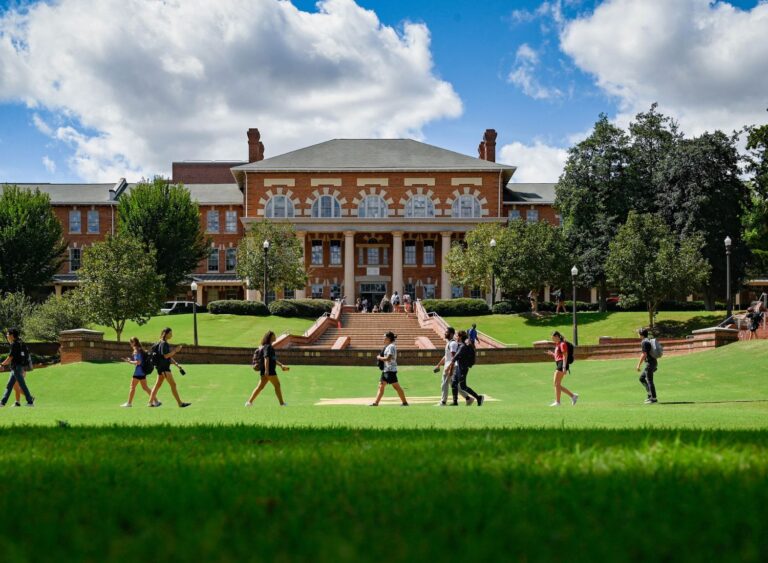
Top image by Becky Kirkland, courtesy of North Carolina State University
Want more? Register today for the upcoming Invest: Raleigh-Durham 4th Edition Leadership Summit!