Spotlight On: Clyde Higgs, President & CEO, Atlanta Beltline
Key points:
- • The Atlanta Beltline has become a major driver of jobs, investment, and economic growth.
- • Companies are increasingly using the Beltline to attract talent and support workforce needs.
- • Leaders remain focused on completing the 22-mile loop by 2030 while expanding housing and connectivity.
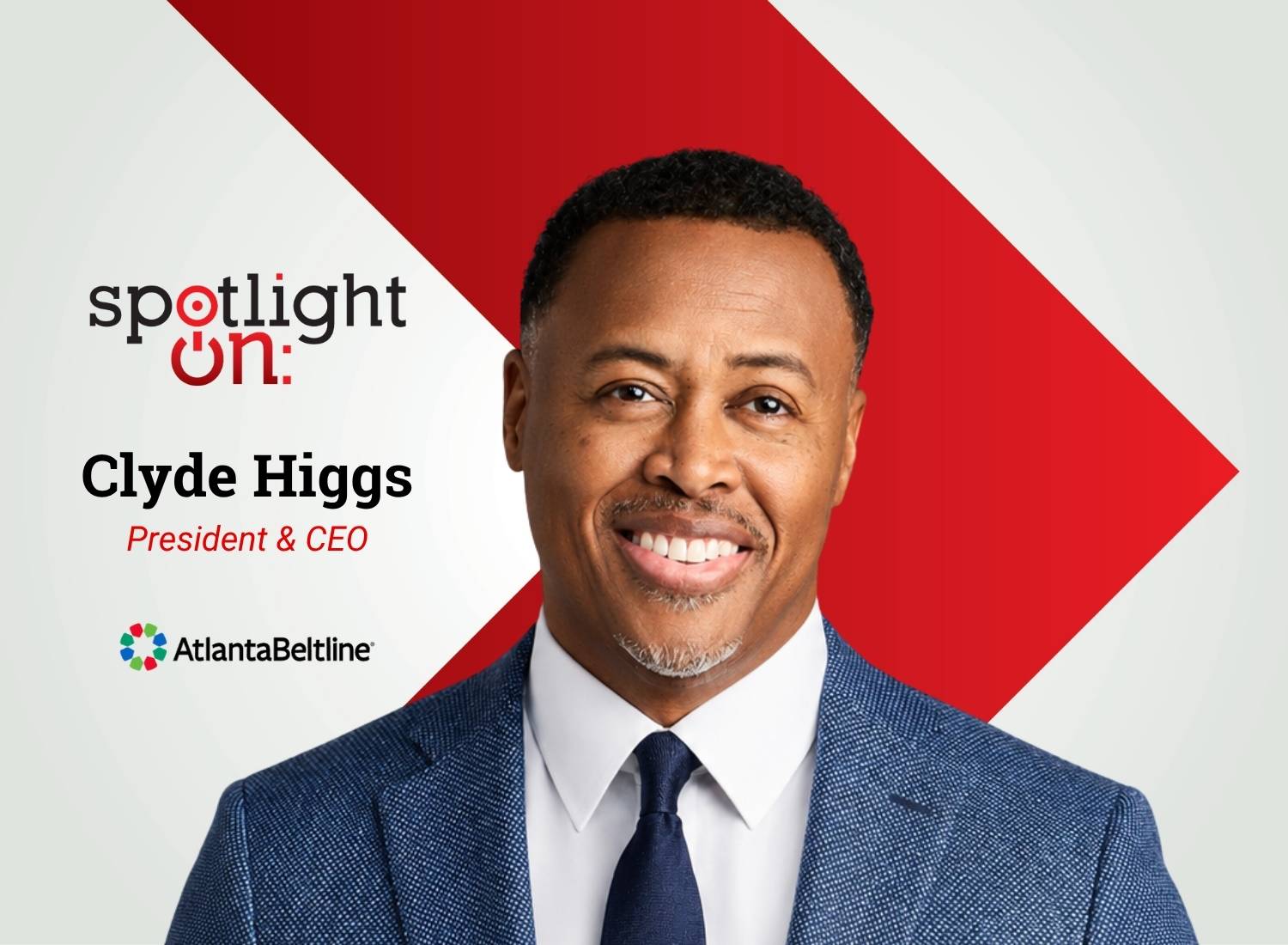 June 2026 — Focus: spoke with Clyde Higgs, president and CEO of Atlanta Beltline, about the project’s economic impact, community-driven development, and the path toward completing the 22-mile loop by 2030. “Many people locally think about the Beltline as a place to walk, spend time with family, and experience joy. That is exactly how we want them to think about it. But corporations and employers view it as a workforce development strategy,” Higgs said.
Join us at caa’s upcoming leadership summits! These premier events bring together hundreds of public and private sector leaders to discuss the challenges and opportunities for businesses and investors. Find the next summit in a city near you!
How has the Beltline’s role in Atlanta’s economy changed over the past year?
The last year feels like one of those seminal moments for the Beltline and our progress in reaching our goals. We have invested about $900 million into the Beltline to date, but what is most remarkable is that we have seen over $14 billion in private investment follow the Beltline. That is about a 15-to-1 return on investment on public dollars.
I have been in economic development for over 20 years, and I have not seen a return like that on public investment. A 3-to-1 return is impactful, but a 15-to-1 return at this scale is unheard of, at least to my knowledge.
We have also supported 91,000 jobs. When this project started, the goal was 25,000 jobs by the end of 2030, so we have outperformed on the job creation side. Historically, infrastructure has been thought of as a place to get you from A to B. When it’s people-powered, people-focused, community-focused, this is the result of that.
How are companies and investors approaching the Beltline differently today?
Many people locally think about the Beltline as a place to walk, spend time with family, and experience joy. That is exactly how we want them to think about it. But corporations and employers view it as a workforce development strategy.
In the days of remote work and trying to get people back into offices, companies can locate along the Beltline and use that as a way to attract employees. We have large companies such as BlackRock, McKinsey, OneTrust, and Intuit, but we also have smaller businesses, restaurants, lounges, and retail shops. Companies are starting to look at the Beltline as a way to attract employees to their place of business, and it has proven out.
Where are you seeing the most growth and investment right now, especially beyond the Eastside Trail?
The Eastside Trail is still the biggest driver because it is the most mature section of the Beltline, but we are encouraged by what we see on the Westside. The Westside is emerging in a significant way, and it has a lot of diversity in the business mix. You have retail, eateries, restaurants, light manufacturing, and commercial space.
There is a nanotechnology company called Carbice thriving on the Westside Trail. It was created by a Georgia Tech professor, spun out of the university, funded by the federal government and venture capital, and intentionally located on the Beltline. They hire directly from the Westside community. That is something I get excited about.
The entire Southside Trail has been completed, a 3-mile stretch from I-20 and Glenwood to Metropolitan and University. We are already seeing investors and developers gravitate toward those areas. The Beltline also owns 356 University Avenue, a 13.7-acre site that will be redeveloped into a mixed-use development with affordable housing, affordable commercial opportunities, and job creation.
Do you think Atlanta is moving quickly enough on density, transit, and walkability?
We are finally starting to see a return to the city of Atlanta proper, and the Beltline continues to outperform in that space. We have added about 26,000 additional residents to the Beltline, and densification is something we want to encourage.
Our thesis is that if you move to Atlanta and live near the Beltline, you should be able to access the things you care about without having to get in a personal vehicle. You should be able to walk your child to school, walk to a grocery store, walk to work, walk home, or walk to a restaurant.
People are using the Beltline not only as a recreational amenity but also as part of their daily life. Mailchimp is located on the Beltline, and about a third of its workforce uses the Beltline to get back and forth to work. That represents more than 900 cars that are not on the road because of the Beltline. We want other companies to adopt that mindset.
What can other fast-growing cities learn from Atlanta’s Beltline experience?
We host another city almost every month, and they always ask what the superpower of the Beltline is. We have the benefit of being something that is authentically Atlanta. The whole concept of the Atlanta Beltline was driven by the community. It was not a top-down initiative. The community told elected officials this was something they wanted to make happen.
When we talk to other cities, we ask them to find something that authentically represents their city. We were blessed with four abandoned railroad corridors in Atlanta. They already existed, so it was not something we had to recreate. It was something we needed to redevelop.
Another important piece is creating a special-purpose entity focused on delivering that vision. Atlanta Beltline Inc. focuses every day on delivering trails, parks, future transit, housing affordability, commercial spaces, and public art.
How important is it to establish a long-term funding strategy as the tax allocation district approaches its potential sunset in 2030?
That is one of the things we continue to debate in Atlanta. The Beltline tax allocation district (TAD) could potentially sunset at the end of 2030. Having that unique funding source has been another genius move by the city because it created dedicated funding.
When I first joined the Atlanta Beltline, our annual budget was about $33 million. This coming fiscal year, our annual budget will be over $365 million. The more success you drive, the more funds you have available to do things that impact the community.
During the 2008 to 2012 recession, our TAD was not performing as planned because we were in one of the most challenging economic environments in history. Once we came out of the recession, the TAD continued to grow.
What role do you expect the Beltline to play in showcasing Atlanta to a global audience?
The Beltline was recently a finalist for the WRI Ross Center Prize for Cities, which recognizes cities and countries doing something at scale in the built environment related to sustainability and health impacts. That recognition shows there is global awareness of what we do.
I think we are primed and ready because the global community is ready to converge on Atlanta. When visitors ask what they should do in the city, they are going to be told to go to the Atlanta Beltline. This is where you really see Atlanta’s diversity across age, gender, race, and other demographics. If visitors want an authentic Atlanta experience, they should visit the Beltline.
As you look toward the next decade, what gives you the most confidence, and what concerns remain?
There is a strong chance that we will finish the entire 22-mile loop by 2030, as we originally promised the community. We are nearing completion of the 17th mile of the Atlanta Beltline.
I have been CEO for almost eight years, and in the early days, there was a lot of doubt that we could actually pull this off. To have the support, will, and know-how to do it is humbling.
On the affordable housing side, we are at 80% of our goal, when many people said it could not be done. We think we are going to beat our affordable housing goal by 30% by the end of 2030.
The next big conversation is how we implement transit along the Beltline. As the implementation organization, Atlanta Beltline Inc. is prepared for whatever form that ultimately takes. We are very excited about the future.
Is there anything else you would like to add?
We are very reflective right now. We are past the 20th anniversary of the Atlanta Beltline, and I am past my 10th anniversary working with the Beltline. It is humbling to see that we are very close to bringing this project to completion. There is still a lot more work to be done on commercial affordability, transit, and parks, but with regard to the Beltline loop, we are getting there.
Want more? Read the Focus: Atlanta report.