

Wall Street South Draws More Palm Beach Investment
Key points:
- • Gatsby Florida refinanced DiVosta Towers in Palm Beach Gardens for $100.4 million.
- • The 217,208-square-foot office complex is fully leased to financial-services tenants.
- • Broker Berkadia says the submarket’s rents rose more than 90% in a decade.
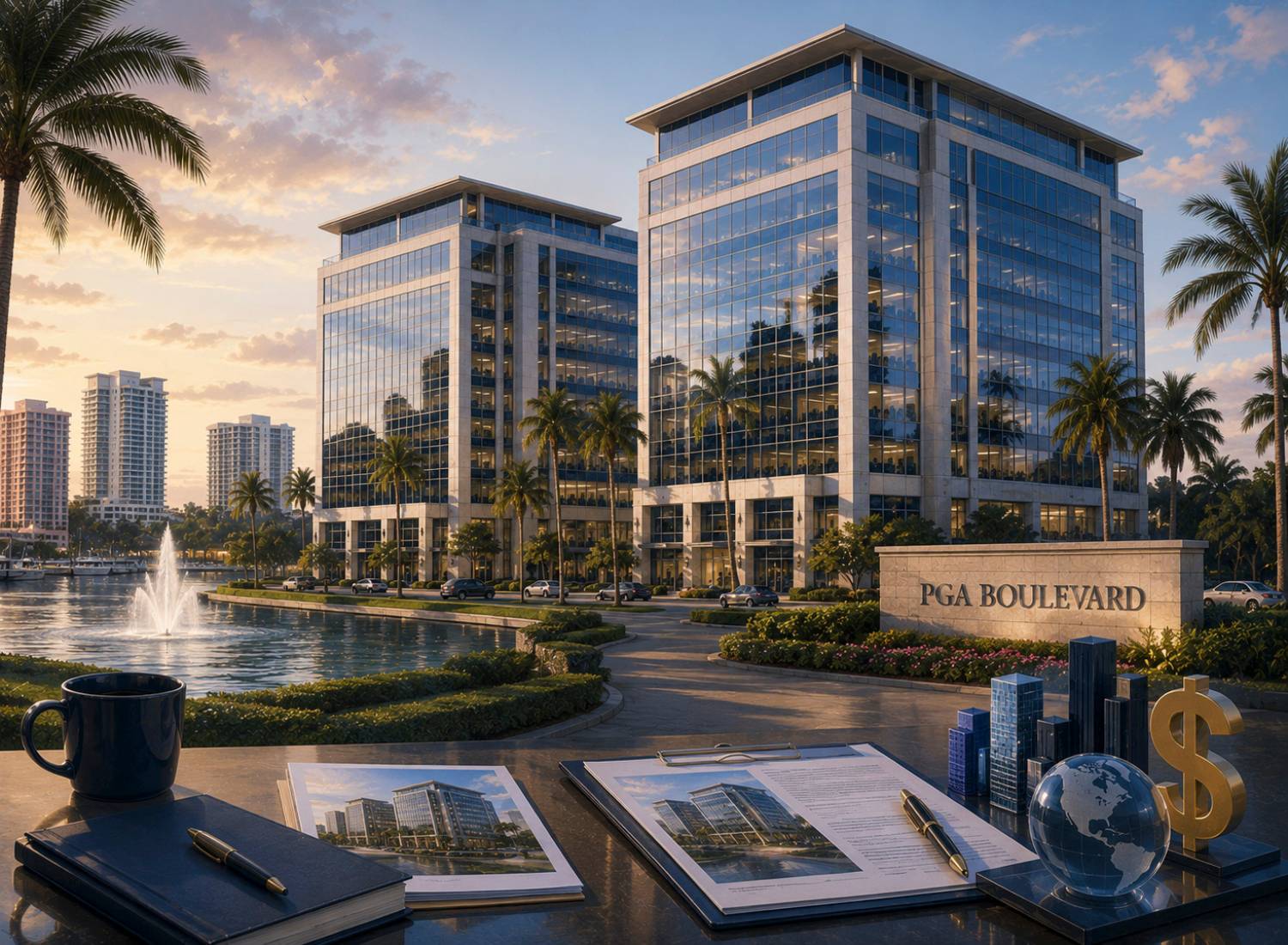 August 2026 — A $100.4 million refinancing of a fully leased office complex in Palm Beach Gardens is the latest sign that Palm Beach investment in finance-anchored real estate shows no sign of slowing. Gatsby Florida secured the loan to refinance DiVosta Towers, a two-building, 217,208-square-foot complex whose tenant roster reads like a directory of the firms driving Florida’s “Wall Street South” migration.
Join us at caa’s upcoming leadership summits! These premier events bring together hundreds of public and private sector leaders to discuss the challenges and opportunities for businesses and investors. Find the next summit in a city near you!
According to Commercial Observer’s reporting on the deal, the two buildings at 3825 and 3835 PGA Boulevard are anchored by J.P. Morgan Chase, Wealthspire Advisors and Virtu Financial — a mix of a bulge-bracket bank, a wealth-management firm and a high-frequency trading company that together illustrate just how broad the financial-services migration to Palm Beach County has become.
Berkadia’s Charles Foschini, Scott Wadler, and Shannon Wilson brokered the debt on behalf of Gatsby Florida, with Cirrus Real Estate Partners on the other side of the transaction. That a fully leased, finance-tenant-anchored suburban office asset could command a nine-figure refinancing in mid-2026 cuts directly against the national narrative of struggling office markets, in which vacant towers in gateway cities have become a byword for post-pandemic distress.
A standout submarket
Berkadia’s Wadler described Palm Beach Gardens as having “emerged as one of the strongest office submarkets in the country,” according to the same Commercial Observer report, with rents up more than 90% over the past decade. That kind of sustained rent growth is unusual for a suburban office submarket anywhere in the country, let alone one competing with downtown West Palm Beach just a few miles south.
The explanation is largely the same one that has powered Florida’s broader financial-services boom: firms relocating from New York, Connecticut and other high-tax Northeast markets have concentrated in a relatively small number of buildings, and demand from that concentrated pool of tenants has outpaced the region’s supply of comparable class-A space. DiVosta Towers’ full occupancy, at a moment when many U.S. office landlords are still fighting to fill space, is itself evidence of how tight that submarket has become.
Why lenders keep saying yes
The DiVosta Towers deal also says something about how lenders are underwriting Florida financial-services office assets right now. A $100.4 million loan on a property of this size implies lenders are comfortable with valuations well above what a comparable building might command in a market with softer fundamentals — a sign that debt capital views the finance-tenant concentration in Palm Beach Gardens as durable rather than cyclical.
That confidence matters beyond this single transaction. It signals to other property owners in the submarket that refinancing or recapitalizing similar assets remains viable, which in turn supports the broader case for new office construction or renovation aimed at the same tenant base. Every well-priced refinancing of an occupied building effectively resets the comparable-sale benchmark other owners and lenders will use for the next deal.
None of this happens in isolation from the broader “Wall Street South” story that has reshaped Palm Beach County’s economy over the past several years. Hedge funds, private equity firms, wealth managers, and now trading firms have moved staff and, in some cases, full headquarters functions south, drawn by no state income tax and, increasingly, by the presence of peer firms already established in the market.
DiVosta Towers’ tenant list — a major bank, a wealth adviser, a trading firm — is a microcosm of that migration playing out in a single suburban office park. As more of those firms plant roots, the buildings that already house them become more valuable simply by association, which helps explain why a fully leased asset can refinance at such a strong valuation even in a national office market that remains, on average, considerably softer.
For landlords and lenders elsewhere in Florida, the DiVosta Towers refinancing is a useful data point on how much premium a concentrated financial-services tenant base can still command, and on how much appetite still exists for Palm Beach investment even after several years of sustained rent growth.
Executives should watch whether comparable West Palm Beach and Palm Beach Gardens assets follow with their own refinancings or sales in the coming months, and whether new construction breaks ground to capture demand from firms that have not yet found space in the submarket’s existing towers. If either happens at scale, it will confirm that this deal was not an isolated data point but the leading edge of the next phase of Palm Beach County’s financial-services real estate boom.
Want more? Read the Invest: Palm Beach report.