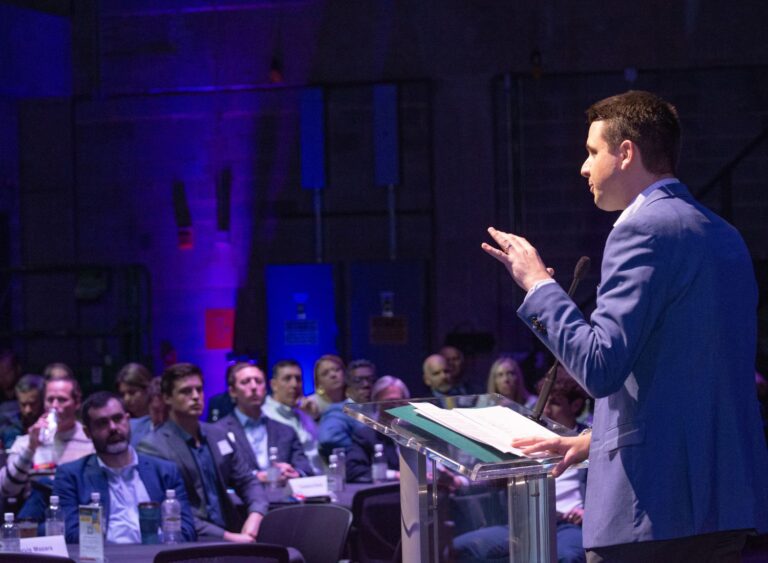







Stephen George, MD, Medical Director – Surgical Services & Pediatric Spinal Surgery, Nicklaus Children’s Hospital
 Invest: spoke with Dr. Stephen George, medical director of surgical services and pediatric spinal surgery at Nicklaus Children’s Hospital, about how collaborative research, advanced imaging, and multidisciplinary care are shaping pediatric spine treatment. “It’s important to realize that we do not treat conditions, we treat patients,” Dr. George said.
How has specialized pediatric spine care advanced in the diagnosis and treatment of spinal deformities?
When we talk about pediatric spine care, we are addressing a broad scope of highly complex conditions. One of the major advances has been leveraging collaborative research, including international collaboration, to better understand these conditions.
In the past, the field often operated in silos, which limited the ability to build on collective knowledge. At Nicklaus Children’s Hospital’s Orthopedics, Sports Medicine, and Spine Institute, our spine group participates in the Harms Study Group, a global collaboration of pediatric deformity surgeons who pool experience and data. This has created the largest prospective database in this field.
With that, we are able to move beyond grouping conditions together as if they are the same. By analyzing larger datasets, we see meaningful differences between conditions that once appeared similar. This allows us to tailor treatments based on more precise diagnoses and shared global experience.
How are advanced imaging technologies improving diagnostic accuracy while minimizing radiation exposure in children?
We now have imaging modalities that provide minimal radiation exposure, which is critical for both diagnosis and long-term monitoring in pediatric patients.
Also, three-dimensional imaging allows us to better understand complex deformities. When combined with collaborative research, this improved visualization helps us identify subtle but important differences in conditions.
That leads to more tailored treatments and more predictable outcomes. The combination of safer imaging and better anatomical understanding has significantly improved both safety and precision.
Why is a patient- and family-centered approach essential in pediatric orthopedic care?
These conditions are complex and require a team approach. While we often think of the medical team, one of the most critical components is the patient and their family.
We cannot provide effective treatment without their participation and compliance. It is essential to understand their perspective and provide thorough education about the condition and treatment options.
If patients and families are truly part of the care team, they must be informed and involved in decision-making. That leads to better engagement, stronger compliance, and ultimately better outcomes.
What role do innovation and research play in improving surgical techniques, recovery protocols, and long-term outcomes?
Innovation requires both a commitment to improvement and the humility to recognize that things can be better. From a surgical standpoint, this means analyzing objective outcomes to identify where improvements are needed.
We look at both internal and collaborative data, as well as long-term outcomes, to refine techniques. For example, intraoperative imaging and navigation allow for a more precise understanding of anatomy, particularly in complex cases. This leads to greater surgical precision and more predictable results.
However, innovation extends beyond the operating room. One key area has been pain management. Historically, expectations around pain were standardized, but we now recognize the risks associated with certain medications, particularly opioids.
Through research, we have reduced opioid use and implemented alternative pain management strategies. We have also changed expectations around recovery. Patients are now mobilized earlier, often on the first day after surgery.
As a result, recovery has improved significantly. Length of stay has decreased from over a week to, in many cases, discharge by the second day after surgery. This represents a major improvement in both outcomes and patient satisfaction.
We also prioritize long-term follow-up. Patients are often monitored for up to a decade to ensure sustained outcomes and to continue learning from their progress.
How is the expansion of state-of-the-art facilities enhancing care and patient experience?
We have been fortunate to have strong institutional support for continuous improvement and future-ready care. Investment in advanced facilities allows us to support both technological innovation and the patient experience.
Facilities must account for the full patient journey, including hospital stay and access to ancillary services. They must also support a multidisciplinary approach, ensuring that all necessary specialists can work together seamlessly.
From a surgical perspective, facilities must accommodate advancing technologies such as imaging, navigation systems, and robotics. Having these capabilities readily available allows us to offer the most advanced care possible.
When all of these elements are integrated, it enhances both clinical outcomes and the overall patient and family experience.
How do you approach spine care in young athletes, particularly in terms of injury prevention?
A significant portion of my patients are athletes, and we do see spine injuries related to sports. While treating these conditions is important, prevention is equally critical.
This involves helping athletes develop routines that support long-term spinal health. Athletes often push their bodies to perform at a high level, but it is important to understand physical limits and how the body responds to stress.
We work closely with physical therapy teams to develop prevention strategies. These programs focus on safe training practices and reducing the risk of chronic injury.
Through education and proactive strategies, we have seen a reduction in sports-related spine injuries and a decreased need for treatment or cessation of activity.
How does collaboration across subspecialties support holistic treatment plans?
It’s important to realize that we do not treat conditions, we treat patients. Once you understand that, you begin to see the complexity behind even straightforward cases.
Effective treatment requires a multidisciplinary approach. This includes not only physicians but also physical therapists, mental health specialists, and social services professionals.
These elements are sometimes overlooked, but they can be the most significant factors in a patient’s care. In some cases, challenges in treatment are not medical but rooted in other aspects of the patient’s life.
By taking a holistic approach, we can better understand those factors and tailor treatment accordingly. This allows us to provide care that is both effective and compassionate, meeting the needs of patients and their families more completely.