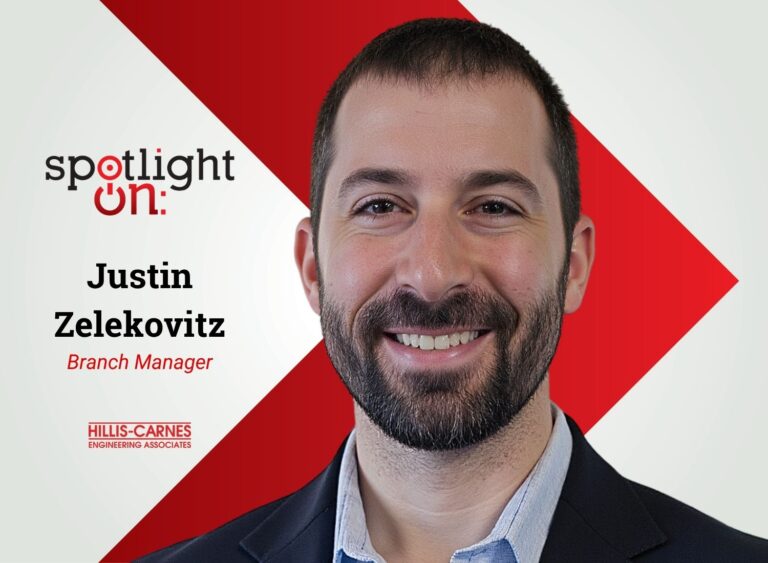

Spotlight On: Justin Zelekovitz, Branch Manager, Hillis-Carnes
Key points:
- • Hillis-Carnes’ Pittsburgh office has grown steadily since opening in 2021.
- • Healthcare, education, and infrastructure are driving regional development.
- • Training and certifications anchor the firm’s workforce strategy.
 October 2026 — In an interview with Invest:, Justin Zelekovitz, branch manager at Hillis-Carnes, discussed the firm’s growth in Western Pennsylvania, the importance of materials testing and special inspections, and how Pittsburgh’s economy continues to evolve. Zelekovitz also highlighted Hillis-Carnes’ approach to service, workforce development and risk management. “The work we inspect remains long after the construction teams leave, which is why materials testing and special inspections are fundamentally about health, life, and safety,” said Zelekovitz.
Join us at caa’s upcoming leadership summits! These premier events bring together hundreds of public and private sector leaders to discuss the challenges and opportunities for businesses and investors. Find the next summit in a city near you!
What opportunities did Hillis-Carnes see in Western Pennsylvania, and how has the Pittsburgh office evolved since its launch?
Western Pennsylvania represented an opportunity because Hillis-Carnes did not have an established presence in the Pittsburgh market, despite having previously supported major projects here, including materials testing and special inspections for Heinz Field, now Acrisure Stadium. Pittsburgh is a major metropolitan area with a strong relationship-driven business culture, and the region had significant long-term development potential.
When Hillis-Carnes established a permanent Pittsburgh presence in 2021, the initial challenge was building recognition and earning trust. Developers, contractors, public entities, and ownership groups often rely on firms and professionals they already know. My familiarity with the market, combined with the support of Hillis-Carnes’ ownership and corporate leadership, gave us a strong foundation.
Since then, the office has evolved from a market-entry operation into an established regional resource. Clients experienced the consistency of our service, technical expertise, responsiveness, and personal approach. That experience led to repeat business, stronger relationships, and continued growth. Our service model has remained consistent, while our reputation and capabilities have continued to expand.
Why are construction materials testing and special inspections so critical to safer, higher-quality infrastructure?
Construction materials testing and special inspections are sometimes viewed as a commodity, a project requirement, or simply another box that must be checked. In reality, these services are fundamentally about health, life, safety, and long-term performance.
Our role is to verify that critical construction materials and structural components conform to the approved design documents, project specifications, applicable codes, and industry standards. That includes the soils supporting the structure, concrete, masonry, reinforcing steel, structural steel connections, welds, bolts, and other elements that contribute to the integrity of a building or infrastructure system.
We are not on-site simply to identify deficiencies. We are there to help the project team address issues before they become embedded in the finished work. Once construction is complete, the contractors and inspectors leave, but the work remains for decades. That is why testing and inspections are so important: they help protect the people who will occupy and use the structure throughout its service life.
How has demand for engineering and testing services changed across sectors as the region grows and modernizes?
Demand has become more diversified, but it also remains closely tied to broader economic conditions. Higher education and healthcare, what Pittsburgh often refers to as “eds and meds,” continue to account for a significant share of major regional development. At the same time, we are seeing opportunities associated with transportation infrastructure, public-sector improvements, mixed-use redevelopment, industrial investment, and the modernization of existing facilities.
The nature of the demand is also changing. Projects are becoming more technically complex, schedules are tighter, and owners expect faster access to information. Clients increasingly want testing and inspection partners who can provide not only field coverage, but also timely communication, digital reporting, trend identification, and practical recommendations when conditions differ from what was anticipated.
The overall market remains affected by interest rates, construction costs, institutional budgets, public funding, and private investment. As a result, demand may shift between sectors, but the need for quality assurance, risk management, and reliable engineering support remains constant.
What do major projects in higher education, healthcare and mixed-use development say about the direction of Western Pennsylvania?
Major projects in higher education, healthcare, and mixed-use development demonstrate that Western Pennsylvania is continuing to diversify beyond its historic industrial base. Steel remains an important part of the region’s identity, but Pittsburgh has also developed nationally recognized strengths in healthcare, higher education, robotics, artificial intelligence, advanced research, and technology.
Institutions such as Carnegie Mellon University, the University of Pittsburgh, and the region’s major healthcare systems continue to attract talent, research investment, and related development. Mixed-use and adaptive-reuse projects also reflect a growing emphasis on creating communities where people can live, work, learn, and access services within the same area.
We have proven that we can evolve. Western Pennsylvania has repeatedly adapted as industries and economic conditions have changed, while retaining the technical knowledge, work ethic, and infrastructure established through its industrial history. The region’s next phase of growth will come from combining those traditional strengths with innovation, institutional investment, and thoughtful redevelopment.
How does Hillis-Carnes help owners, contractors, and developers reduce risk while keeping projects on schedule and within budget?
Risk management has become an increasing priority for owners, developers, contractors, and engineering firms. Our role is to identify construction-related risks early, communicate them clearly, and provide practical recommendations before an issue creates a larger schedule, cost, or performance impact.
Hillis-Carnes supports that process through responsive field service, timely reporting, experienced technical review, and ongoing communication with the project team. When unexpected conditions or nonconforming work are encountered, we explain what we observed, why it matters, the available paths forward, and the potential risks and budget implications associated with each option.
While we do not control the contractor’s means, methods, or overall construction schedule, our responsiveness can help prevent avoidable delays. Early notification, clear documentation, and prompt technical recommendations allow the responsible parties to make informed decisions and keep the project moving.
We also remain mindful of our contractual role and responsibilities. The appropriate solution is always project-specific, but our objective is consistent: protect the client’s interests, support the design intent, and help the project team resolve issues efficiently.
How are innovation and data changing how Hillis-Carnes delivers value to clients?
Innovation and data are allowing us to provide clients with faster, more consistent, and more transparent service. Hillis-Carnes uses a proprietary project-management and reporting platform developed specifically around our engineering, testing, and inspection operations.
Because the system reflects our actual workflows, information can move efficiently from the field to project managers and clients. It improves report consistency, supports timely communication, creates a searchable project record, and allows us to track testing results, inspection activity, deficiencies, scheduling needs, and project trends more effectively.
The value is not simply the technology itself. The value is giving clients accurate information sooner so they can make decisions, address issues, and manage their projects more effectively. We use technology to support, not replace, the technical judgment and personal service our clients expect.
How is Hillis-Carnes investing in workforce development, internships and mentoring?
You are only as strong as the people you are developing to lead after you. Workforce development is therefore not separate from our business strategy, it is essential to the long-term quality and continuity of the firm.
For engineering students and recent graduates, we invest in relationships with local universities, attend career fairs, and provide internships that combine meaningful field experience with appropriate mentoring and supervision. I often say that some of the best engineers are made in the field. Hands-on experience teaches young professionals to connect design concepts with actual construction conditions and to think practically and critically.
For field technicians, we emphasize structured training and industry-recognized certifications through organizations and programs such as ACI, ICC, and NECEPT. Those credentials build competency across concrete, soils, masonry, reinforcing steel, structural steel, bolts, welds, wood framing, and other inspection disciplines.
We also support the professional pathway for engineering graduates, from internships and full-time employment through the Fundamentals of Engineering examination, engineer-in-training status, increasing project responsibility, and eventually professional licensure.
One of the most important things we can give employees is knowledge they truly own. Certifications, field experience, and professional development strengthen Hillis-Carnes, but they also remain with the individual throughout their career.
Where do you see the greatest opportunities for Western Pennsylvania over the next several years, and what role can engineering firms play in that growth?
Western Pennsylvania’s greatest opportunities will come from reinvesting in its existing assets while continuing to diversify its economy. Transportation infrastructure will remain a major need, particularly through PennDOT, the Pennsylvania Turnpike, municipalities, and other public agencies. There are also significant opportunities involving bridges, roadways, utilities, water systems, institutional facilities, adaptive reuse, industrial redevelopment, and the modernization of aging infrastructure.
The region also has the ability to connect its traditional strengths in construction, manufacturing, and engineering with emerging sectors such as advanced technology, robotics, healthcare, energy, and research.
Engineering firms play an important role by helping public and private owners understand existing conditions, evaluate feasibility, manage technical and construction risks, and verify that projects are built in accordance with the design. Through sound engineering, responsive field support, reliable testing, and clear project documentation, firms like Hillis-Carnes help turn investment into infrastructure and facilities that will serve the region for generations.
Western Pennsylvania has repeatedly demonstrated its ability to adapt. Our opportunity now is to ensure that the next generation of growth is not only ambitious, but durable, safe, and well executed.
Want more? Read the Invest: Pittsburgh report.