





Miami business news: Home-care agencies shut down
Key points:
- • TPS ended for Haitian nationals in late July, affecting about 93,000 Florida workers.
- • Two South Florida home-care agencies closed after each lost 80+ authorized workers.
- • Hotels and nursing homes are operating short-staffed as employers compete for workers.
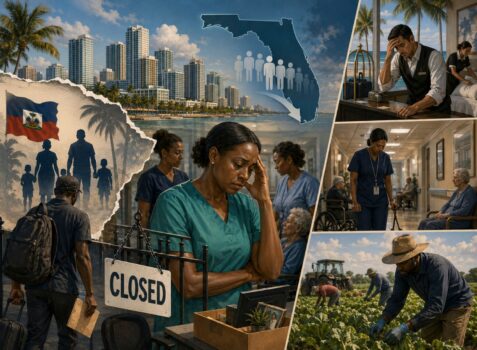 September 2026 — Two home-care agencies in Miami-Dade and Broward counties have shut down entirely this summer, and the reason has nothing to do with demand for their services. Miami business news this month highlights the fallout from the end of Temporary Protected Status (TPS) for Haitian nationals, a federal policy shift that has pulled tens of thousands of authorized workers out of South Florida’s labor force in industries that were already struggling to staff up.
Join us at the Invest: Miami 11th Edition Leadership Summit! This premier event brings together hundreds of Miami’s business and regional leaders to discuss the challenges and opportunities for businesses and investors. Buy your ticket now!
TPS had protected Haitian nationals and given them work authorization since 2010, and it lapsed in late July, ending legal work eligibility for a workforce that had become deeply embedded in specific corners of the South Florida economy, according to the Wall Street Journal.
As of January, Axios Miami reported that roughly 93,000 Haitian TPS holders were working across Florida, concentrated in hospitality and tourism, healthcare support roles such as nursing homes and home care, food service, and agriculture. Within those categories, an estimated 16,000 worked as cooks and servers, 12,000 in agriculture, and 4,000 as nursing assistants, a distribution that put the impact of TPS’s expiration squarely on industries that already run on thin staffing margins even in a normal year.
Home-care agency closures
The two home-care agency closures illustrate how quickly that impact showed up on the ground. Each agency lost more than 80 TPS-authorized employees once their work authorization expired, a loss severe enough that neither could continue operating and both shut down rather than attempt to rebuild their workforce from scratch. Jewish Community Services of South Florida, a nonprofit serving elderly and vulnerable residents, terminated 18 Haitian TPS workers for the same reason. Hotels and nursing homes across the region are now operating short-staffed, absorbing the loss by cutting hours of service, leaning harder on remaining staff, or turning away new clients rather than risk overextending existing caregivers.
The scale of the disruption reflects how concentrated South Florida’s reliance on this specific workforce had become. Home care and nursing homes serve an aging population that is not shrinking, hospitality and tourism remain central to the regional economy well beyond any single event, and agriculture operates on tight seasonal labor timelines that do not easily absorb a sudden authorized-worker shortfall. When a large, legally documented segment of that labor pool loses work authorization all at once, employers cannot simply post job openings and expect them filled at the same pace; replacing specialized experience, particularly in caregiving roles that require trust and continuity with clients, takes considerably longer than replacing a retail or warehouse position.
The disruption also lands at a moment when South Florida’s broader labor market has looked comparatively stable. Regional unemployment has held steady even as national hiring has cooled, giving the appearance of a resilient local economy. But that headline stability can mask a real shortage of workers in specific, hard-to-automate roles, especially caregiving and hospitality jobs that depend on in-person labor rather than the white-collar positions that dominate broader jobs data. For businesses in those categories, the TPS expiration is not a statistic; it is a direct staffing crisis that shows up as unfilled shifts and, in the most severe cases, agencies that can no longer keep their doors open.
Ripple effects
The ripple effects are likely to extend beyond the businesses that employed TPS workers directly. Families relying on home-care agencies that have closed now need to find replacement care quickly, often on short notice and without the option of a smooth transition.
Hotels operating short-staffed may need to limit room availability or slow service during a period the region’s other economic indicators otherwise show as steady, potentially denting the tourism revenue that fuels much of South Florida’s tax base. And employers across hospitality, healthcare and agriculture are now competing for the same shrunken pool of authorized workers, a dynamic that tends to push wages up in the short term even as it raises operating costs for businesses already managing thin margins.
What happens next depends largely on how quickly affected employers can rebuild their workforces and whether any legal or legislative relief materializes for former TPS holders. For a region where hospitality and caregiving are central to daily economic life, the coming months will show whether South Florida’s employers can adapt to the new labor reality or whether the disruption deepens further.
Want more? Read the Invest: Miami report.