
Philadelphia business news: A market split in two
Key points:
- • The Philadelphia luxury threshold rose 7.5% to $1.15 million in Q2 2026.
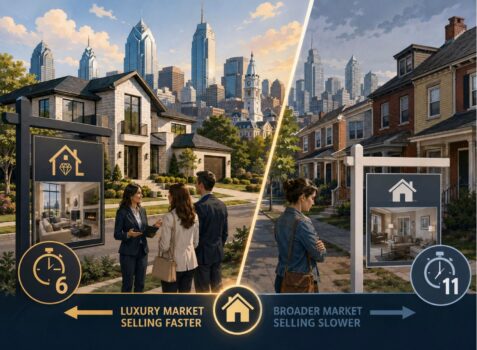
- • Luxury homes sold in a median of 6 days versus 11 days for the market overall.
- • Luxury buyers paid all-cash in 42% of deals, versus 24% market-wide.
 September 2026 — A house now has to sell for more than $1.15 million to count as “luxury” in Greater Philadelphia, and the region’s overall housing market is cooling even as that top tier keeps selling faster than everything beneath it. Philadelphia business news this month centers on a widening split between the high end of the housing market and everyone else, according to Axios Philadelphia ‘s analysis of Bright MLS data covering the second quarter of 2026.
Join us at caa’s upcoming leadership summits! These premier events bring together hundreds of public and private sector leaders to discuss the challenges and opportunities for businesses and investors. Find the next summit in a city near you!
The luxury threshold for the Philadelphia region rose 7.5% to $1.15 million in the second quarter, a marker Bright MLS sets each quarter based on the top 10% of home sales by price. Luxury sales themselves grew a modest 0.5% compared with the same period in 2025, even as new luxury listings fell 4.6% year over year, a combination that has kept competition tight for the limited inventory available at the top of the market.
The result shows up clearly in how quickly those homes move: Luxury properties sold in a median of six days in the second quarter, versus 11 days for the market overall, meaning the region’s most expensive homes are changing hands nearly twice as fast as a typical listing.
Broader market cooling
That speed gap is notable because the broader Philadelphia housing market is showing real signs of cooling. Home tours across the region were down nearly 4% and overall sales fell 1% through July compared with the same stretch of 2026’s prior year, a slowdown that Bright MLS economist Lisa Sturtevant and Drexel University’s Kevin Gillen attribute largely to affordability constraints biting into the middle of the market.
Buyers earning a typical regional income increasingly cannot qualify for the mortgage payments that current prices and interest rates require, a dynamic playing out in most major U.S. metros this year as the combination of elevated rates and years of price appreciation prices out a growing share of would-be buyers. Philadelphia is not unique in that respect, but the regional numbers put a specific face on a trend economists have been describing nationally for months, and they give local lenders, builders and brokers a concrete benchmark for how much of the slowdown is a Philadelphia story versus a national one.
The luxury segment is largely insulated from that affordability squeeze, and the financing data shows why. Luxury buyers paid all-cash in 42% of transactions in the second quarter, compared with 24% across the market as a whole. That gap reflects a straightforward reality: buyers at the top of the market are far less dependent on mortgage rates than buyers financing a typical purchase, which means the same rate environment that is slowing sales in the middle of the market barely registers for the wealthiest purchasers.
It also means the luxury segment can keep absorbing limited inventory at a brisk pace even while the rest of the market slows, widening the gap between how fast expensive homes sell and how fast everything else does.
The record-setting headline number tells a related but distinct story. The median regional home sale price hit $430,000 in the recent data, up 4.3% and a new high for the market, even as the number of transactions cools. Within Philadelphia proper, the median sale price reached $292,000, also a record for the city itself. Rising medians alongside falling transaction volume is a familiar pattern in a market where affordability is squeezing out lower-priced sales disproportionately: when cheaper homes are harder to finance and sell more slowly, the mix of homes that do sell skews upward, pushing the median higher even without genuine across-the-board price appreciation.
Split conditions
For the region’s real estate industry, the split market creates two very different businesses operating under one roof. Agents and brokerages focused on luxury listings are seeing homes move quickly and command strong prices, supported by an increasingly cash-heavy buyer pool insulated from financing costs.
Those working the broader market are contending with slower tours, longer time on market and buyers who are more sensitive to every basis point of mortgage rate movement. Executives in real estate, mortgage lending and home-related retail should watch whether the luxury segment’s momentum holds into the fall selling season, whether new luxury inventory picks up enough to ease the current scarcity, and whether affordability pressure in the broader market deepens further if rates stay elevated.
The Philadelphia region’s housing market next reports figures in the fourth quarter, and that data will show whether the divide between its fastest- and slowest-moving segments keeps widening or whether rate relief later this year narrows the gap by pulling more financed buyers back into the market at the same time luxury sellers finally list the inventory they have been holding back.
Want more? Read the Invest: Philadelphia report.