
Michael Smith, President & CEO, Charlotte Center City Partners (CCCP)
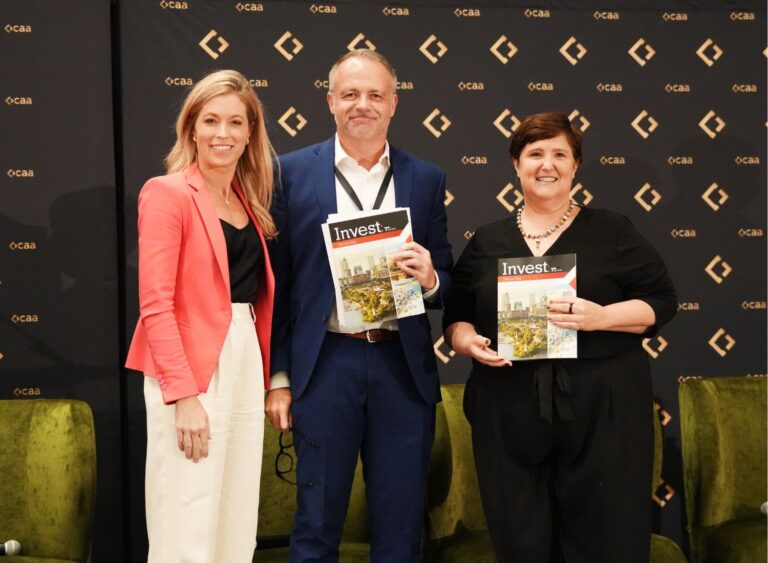
 In an interview with Invest:, Michael Smith, president and CEO of Charlotte Center City Partners (CCCP), highlighted Charlotte’s economic momentum, focus on vibrant mixed-use districts, and innovative public-private partnerships that are driving its evolution into a leading southeastern hub. Smith said, “We are bullish on Charlotte; it is an incredibly aspirational community with great fundamentals.”
What differentiates Charlotte’s urban core from other Sunbelt markets?
We think Charlotte is the strongest downtown in the Southeast. It is defined by the concentration of assets in a complete environment. It is a park-once environment, and it is the singular central business district for our metropolitan statistical area. Many cities do not enjoy that, so it is a real differentiator. Companies that want to be co-located with our greatest hotels, our sports assets, our cultural assets, close proximity to the airport, and the center of our road and transit network will find that here. That has been a superpower for our region. All the way back to 1966 with the Odell Plan, we have prioritized Center City and brought intentional urban design and economic development strategy to support that.
Are there any specific sectors or types of companies showing the most interest in establishing their presence in the city center, and what is driving this growth?
Regarding sectors, a number of things are helping our center city stand out. Number one is the blend of talent growth and job growth. Our metropolitan statistical area added 61,000 new residents over the last year, and that is expected to grow by 50% by 2050. We are the 14th largest city, yet we are the sixth fastest growing metropolitan statistical area according to CoStar and the U.S. Census. We are the third fastest growing metropolitan statistical area for gross domestic product growth, according to CoStar and the Bureau of Economic Analysis. We are fifth in the United States for recent college graduates. This is because Charlotte is a business-friendly city that grows jobs organically in great sectors and also recruits new jobs and new sectors to our community. For instance, we are particularly excited about vintage office conversions and reinvestments. The Beckworth, which is a 100-year-old office building, is being converted into 220 hotel rooms. The old Duke Energy headquarters is being converted by Asana Partners into roughly 450 apartments and 60,000 square feet of retail. A number of buildings in that vintage class have sold at deep discounts. To the untrained eye, that could be concerning. However, it offers an opportunity for the recapitalization of buildings that need to be repurposed. Being sold at a discount brings new developers and new investors into our community. We aspire to be a preferred destination for capital and developers who want to help communities reposition vintage assets. This is important for our tax base, and it will have interesting implications. We have a line of sight to at least 1,700 to 2,000 additional residential units from these conversions. That will grow our uptown population by 2,700 to 3,000 additional residents in areas with a smaller residential population now. The goal is to have every block complete with hospitality, retail, residential, and office uses.
What design and amenity trends are you seeing in new developments?
The design competition and projects like Brooklyn Village at the Church, the Beckworth Hotel, and others on the horizon show a strong interest in urban living. There is a strong trend for residential units that are either market rate or luxury. The other strong trend, as we transition from a central business district to a central activity district, is the hospitality sector. There is demand and growth for hotel rooms to support the activation of Bank of America Stadium, the Spectrum Center, and our cultural arts institutions along Tryon Street. The market has picked up on that. Another important piece is the attention to retail, bringing a sense of authenticity to the asset, keeping that experience local, and keeping the ground floor active to make the space above, whether a hotel room, a residential unit, or an office, more interesting. So, for us, ground‑floor activation is a top priority to drive street‑level vibrancy.
How are education and academic institutions influencing investment and innovation?
Charlotte is nationally recognized for its public-private partnerships, and we believe the next generation of great cities will be defined by public-private academic partnerships. We are thrilled with the education partners in our region. We are particularly proud of UNC Charlotte’s achievement of R1 research status and its role as a key partner in the North Tryon Tech Hub. This collaboration is creating a powerful intersection of corporate innovation, entrepreneurship, and academics. A critical component of this is UNC Charlotte’s Co-Lab: Center for Entrepreneurship, which acts as a micro-engine for job creation and innovation, fostering a new generation of startups and talent, further enhancing the city’s ability to absorb and engage this growing population.
This academic integration is complemented by other significant education investments in our community, including The Pearl, a partnership with Atrium Health and Wake Forest University, which is a new Second Ward high school currently under construction. Furthermore, Johnson and Wales University is launching a new three-year, 90-credit-hour degree in hospitality, and the merger between Elon University and Queens University is another exciting development. We believe great downtowns are built by layering residential, employment, hospitality, and academics together. This blend of educational institutions and employers allows us to reskill, upskill, and, most importantly, retain the talent that differentiates our market.
Which assets or buildings are being repurposed, and what does that mean for Downtown offerings?
Vintage office recapitalizations are actively reshaping the offerings in downtown Charlotte. Key buildings, including 525 North Tryon, 201 South Tryon, and 550 South Tryon, are being strategically repositioned as modernized, competitive options for new economic development prospects. This means that these historic structures, rather than being obsolete, are being transformed into prime, Class-A office space that can attract a new generation of tenants. For Downtown, this revitalization translates into a more diverse and vibrant commercial landscape, enhanced property values, and a strengthened tax base. It also provides modern, character-rich alternatives to new construction, offering unique environments that are highly appealing to innovative companies seeking to establish a presence in a dynamic urban core. This strategic repositioning ensures the central business district remains competitive, sustainable, and attractive for future investment.
Given the diversity of the talent pool, how are you aiming to fill gaps in workforce preparedness and skills alignment?
We have what we call the HIIVE Initiative, which was born out of how small businesses were affected by the COVID-19 pandemic. During that time, we did a grant process to help small businesses make capital expenditure investments for the changing landscape. Initially, this meant plexiglass, patios, online digital commerce solutions, takeout, and product diversification. From that, we learned that small businesses and entrepreneurs needed additional resources besides capital. They needed to understand the fundamentals of business, they needed a network, and they needed marketing skills. We put together a nine-week program with partners including the City of Charlotte, Bank of America, and local family foundations. This educational program talks about business fundamentals but is tailored to how to successfully operate in a dynamic environment like Uptown, South End, or Midtown. That is one small piece in a larger ecosystem of how Charlotte pays attention to talent and workforce.
What are your top priorities for the next two to three years, and what is your general outlook?
We are bullish on Charlotte and bullish on Center City. This is an incredibly aspirational community with great fundamentals, from Fortune 500 companies to a great network of small businesses. We are a forward-looking city that believes its best days are ahead. That is the kind of community that invests in its infrastructure. We continue to make bold investments in our airport in partnership with American Airlines, and we are currently negotiating another 10-year partnership with them. We are excited about the journey with our rapid transit system, which will bring the Silver Line from the airport through Uptown out to the Bojangles Coliseum area, the Red Line from the Gateway Station north to the Lowe’s campus in Mooresville, and the extension of the streetcar east and west another two miles in each direction. We are excited about the investments new ownership is making in our stadium and arena, especially as they are bullish on Charlotte and are looking at doubling the use of these public facilities. These are incredible engines for our hospitality community and great differentiators for quality of life. We are particularly excited about the North Tryon Tech Hub, The Pearl, and the Iron District, which will help stitch together Uptown and South End and create a new node along the Silver Line. The Gateway District around the Gateway Station and South End broadly have seen incredible land assemblage by great development partners in preparation for the next cycle. Great cities create the context for tomorrow’s vibrancy, and that is what Charlotte is doing in intentional ways as we fulfill the elements of our 2040 Center City Vision Plan.
How is the city extending its urban core and implementing its long-term vision planning?
The city is strategically extending its urban core through the focused activation of the Gateway District and South End, both of which are gaining significant momentum. This expansion is not occurring organically but is being intentionally guided by the comprehensive framework of the 2040 Center City Vision Plan. Key sites and substantial land assemblages within these districts have been prepared and are now ready for development. This advanced preparation by development partners, who assembled these properties during the prior cycle, has created the necessary context for tomorrow’s vibrancy. The plan ensures this growth is cohesive, sustainable, and aligns with the broader goal of creating a more complete and extended central activity district. This deliberate approach to urban expansion facilitates a seamless connection between established and emerging areas, enhancing the overall connectivity, density, and economic potential of Charlotte’s urban landscape.