

Nashville business news today: A robotaxi first
Key points:
- • Nashville is the first city where Lyft riders can request a Waymo robotaxi directly.
- • Flexdrive’s new 80,000-square-foot depot near the airport opens this fall.
- • Waymo is exiting Uber partnerships in Phoenix, Austin and Atlanta as it expands with Lyft.
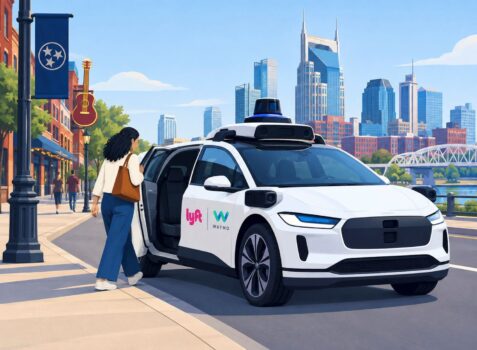 September 2026 — Nashville riders opening the Lyft app this month are seeing something no other city offers yet: the option to book a Waymo driverless car. Nashville business news today centers on Lyft’s decision to let riders request Waymo robotaxis directly through its own app, making Nashville the first market where the two companies’ technology is fully integrated for passengers.
Join us at caa’s upcoming leadership summits! These premier events bring together hundreds of public and private sector leaders to discuss the challenges and opportunities for businesses and investors. Find the next summit in a city near you!
The service is now live in neighborhoods near the city’s urban core. Riders who would rather have a human behind the wheel can still decline a Waymo match and request a traditional driver instead. The robotaxis are not yet available in Bellevue, Antioch, or Madison, though both companies have said expansion into those areas is planned, Axios reported.
Behind the app integration is a physical buildout that signals how seriously both companies are treating Nashville as a proving ground. Flexdrive, the fleet management subsidiary Lyft acquired in 2020, is opening an 80,000-square-foot depot near Nashville International Airport this fall to handle charging, cleaning, and maintenance for hundreds of Waymo vehicles. That scale of infrastructure investment goes well beyond a pilot footprint and suggests both companies expect the Nashville fleet to grow substantially once the depot is running.
Jeremy Bird, Lyft’s executive vice president of global growth, described Nashville as a template rather than a one-off market. “We want to prove this model in Nashville and then take it to scale,” Bird said, according to the Axios report. That language matters because it frames Nashville not as a novelty launch but as the market Lyft and Waymo are using to work out the operational kinks of shared dispatch, fleet servicing and rider experience before extending the arrangement elsewhere.
The Nashville deal also marks a pivot in Waymo’s broader partnership strategy. The company ended its three-year partnership pilot with Uber in Phoenix earlier this year, and it has said it plans to exit similar Uber partnerships in Austin and Atlanta as well. In their place, Waymo is leaning on fleet-management partners including Avis, Avomo, and Moove, with Lyft’s Flexdrive now added to that list. The shift suggests Waymo is consolidating around operators built specifically for fleet logistics rather than ride-hailing apps that also happen to offer fleet support.
That consolidation carries real stakes for Lyft, which has spent years positioning itself as the smaller, scrappier alternative to Uber in the ride-hailing market. Landing the exclusive Waymo integration in a launch city gives Lyft a claim Uber cannot currently match in Nashville, even as Uber continues to operate its own robotaxi partnerships in other metros.
For a company that has often played catch-up on autonomous-vehicle partnerships, being first in any market — let alone one where a national brand-name partner is actively exiting a competitor’s deal — is a meaningful marketing and investor-relations win regardless of how large the Nashville fleet ultimately grows. Investors have watched Lyft’s autonomous-vehicle strategy closely for signs it can translate into rider growth rather than just headlines, and a functioning depot-and-dispatch system in a midsized metro gives the company a concrete operational story to point to the next time it reports quarterly results, particularly if Nashville ridership data holds up once the service expands beyond the urban core.
For Nashville, the arrangement adds another data point to the city’s case as a magnet for mobility and logistics investment beyond its traditional healthcare and music-industry base. Robotaxi rollouts have so far concentrated in Sun Belt metros with wide roads, favorable weather and permissive state regulatory environments, and Tennessee’s approach to autonomous-vehicle rules has made Nashville a natural fit for operators looking to expand past the West Coast markets where the technology first launched.
City and regional economic-development officials have increasingly cited these kinds of technology partnerships as evidence that Nashville’s growth story extends beyond entertainment and healthcare into logistics, mobility, and the infrastructure investment that comes with it, adding a technology-sector credential to a metro whose national profile has long centered on music, tourism, and hospital systems.
Want more? Read the Invest: Nashville report.