


Tampa Bay business news today: Waymo goes live
Key points:
- • Waymo’s public robotaxi service now covers roughly 50 square miles of Tampa.
- • The all-electric Jaguar I-PACE fleet operates from a warehouse purchased in Town ‘n’ Country.
- • Waymo is considering expanding into Pinellas County after meeting with St. Petersburg officials.
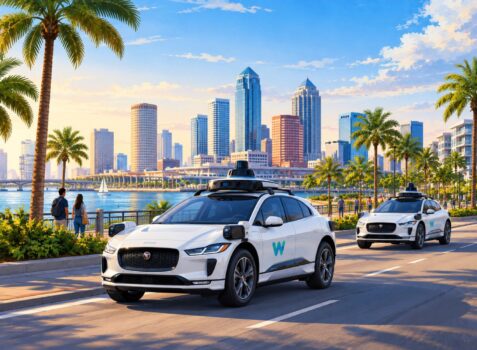 September 2026 — Driverless rides just went from pilot project to public utility in Tampa. Tampa Bay business news today centers on Waymo’s decision to open its robotaxi service to the general public. The service will run across roughly 50 square miles of the city, Axios Tampa Bay reported, including areas stretching from Hyde Park through Northwest Park, Temple Crest, and the Westshore area to Highland Pines in East Tampa.
Join us at the Invest: Tampa Bay 7th Edition Leadership Summit! This premier event brings together hundreds of Tampa Bay’s business and regional leaders to discuss the challenges and opportunities for businesses and investors. Buy your ticket now!
The footprint is large enough to cover much of the metro’s core commercial and residential density in one launch rather than a slow neighborhood-by-neighborhood rollout. A service area that size means the company is betting on broad demand across the metro from day one rather than testing appetite in a single dense core before expanding outward.
The fleet running those routes is built around all-electric Jaguar I-PACE vehicles fitted with Waymo’s roof-mounted sensor and camera arrays, dispatched from a warehouse in Town ‘n’ Country that the company purchased in June specifically to house the operation.
Waymo is rolling out access gradually even within its now-public service area, inviting new riders through its app on a rolling basis rather than opening the waitlist to everyone simultaneously, a pattern the company has used in other launch cities to manage demand against fleet size.
Demand is already there
That demand appears to already be there: Thousands of Tampa residents signed up for the service ahead of the public launch, a pre-launch interest level that followed months of testing and mapping runs conducted with Waymo employees riding along before any fare-paying passenger climbed in.
Those internal test rides serve a specific purpose beyond training the company’s mapping systems — they let Waymo identify local quirks in road design, signage and traffic patterns before turning the vehicles loose on paying customers, a step the company treats as mandatory before any public launch. The company is not stopping at Tampa’s city limits, either — it has already met with officials in St. Petersburg and is weighing an expansion into Pinellas County, according to the Tampa Bay Times. It is a sign that Tampa is being treated as a beachhead for coverage across the broader bay area rather than a standalone market.
Tampa’s launch lands the metro in the middle of a national race among autonomous-vehicle operators to claim ride-hailing markets before their rivals do, and it arrives with a direct local rival already on the road: Tesla launched its own robotaxi service in Tampa in July, making the metro one of a small number of U.S. cities where two competing driverless services now operate simultaneously.
That head-to-head competition is unusual even by the standards of an industry that has mostly expanded city by city with a single operator at a time, and it gives Tampa riders — and local businesses weighing partnerships or advertising with either company — a rare choice between competing driverless platforms in the same metro.
Competition on the road
For Tampa specifically, having both operators on the road simultaneously turns the metro into a real-world comparison point that riders, regulators, and rival cities elsewhere will be watching as each company pushes to demonstrate its technology can handle a midsize Sun Belt metro rather than only the smaller test markets where robotaxi service first proved viable.
The safety case for autonomous ride-hailing has been part of Waymo’s pitch nationally, and an independent study cited alongside the Tampa launch found that Waymo’s robotaxis have been involved in fewer crashes than human drivers, data the company and its backers point to as justification for expanding into new metros despite lingering public skepticism about self-driving technology.
Whether that safety record holds up as Waymo scales in the large and traffic-dense region of Tampa Bay is the kind of question regulators and rival operators will be watching closely as ride volume climbs.
What happens next will test how quickly Tampa’s driverless capacity can scale to meet the demand already signaled by thousands of pre-launch signups, and whether Waymo’s interest in Pinellas County translates into an actual expansion or stalls at the meeting stage.
Want more? Read the Invest: Tampa Bay report.






