


Pittsburgh small business news: Tech’s new hub
Key points:
- • Pittsburgh is now home to 11 unicorn startups, up from 7 a year ago.
- • The region has raised $3.3 billion in venture capital since 2025.
- • More than 700 startups now operate across the Pittsburgh region.
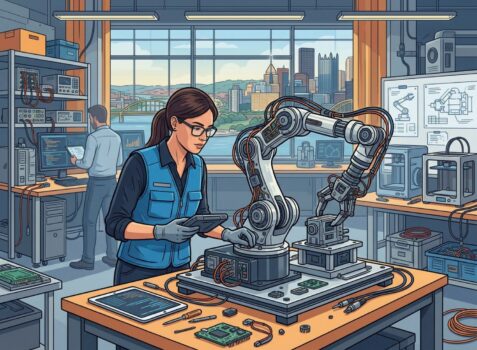 October 2026 — Pittsburgh‘s startup scene just crossed a threshold that puts it in rare company among U.S. tech hubs. Pittsburgh small business news centers on the region’s count of unicorn startups — private companies valued above $1 billion — climbing to 11, up from seven a year ago, including two decacorns ($10-$100 billion valuation), according to dealroom.
Join us at caa’s upcoming leadership summits! These premier events bring together hundreds of public and private sector leaders to discuss the challenges and opportunities for businesses and investors. Find the next summit in a city near you!
Local investors and university researchers argue the city has found a lane that Silicon Valley isn’t chasing: physical-world robotics and AI rather than consumer software, Axios Pittsburgh reported.
The broader numbers back up the momentum. More than 700 startups now operate across the Pittsburgh region, including more than 500 that have raised venture funding, and the region has pulled in $3.3 billion in venture capital since 2025 alone. Gecko Robotics, one of the city’s newest unicorns, has built a business inspecting industrial infrastructure with robots and sensors, while Agility Robotics — co-founded by Damion Shelton, who also serves as a Carnegie Mellon University associate vice president and executive director of the school’s Swartz Center — builds humanoid robots designed for warehouse and logistics work.
Heavy lifting behind the boom
Carnegie Mellon’s research base is doing much of the heavy lifting behind the boom. Deva Ramanan, a professor at the university’s Robotics Institute, co-founded Octant Systems, an AI startup that builds world-simulation software and operates out of both Pittsburgh and New York. Howie Choset, a CMU computer science professor, and Theresa Mayer, the university’s vice president for research, have both pointed to the school’s decades of federally funded robotics research as the underlying reason companies keep spinning out of campus labs rather than relocating to the coasts once they raise real money.
Local venture capital has organized around that specialty rather than fighting it.
Magarac Venture Partners, a firm based in the Bakery Square neighborhood alongside several of the startups it backs, has built its investment thesis specifically around hardware and physical-space technology — robotics, industrial AI and advanced manufacturing — arguing that Pittsburgh’s cheaper lab and warehouse space, plus its university pipeline, gives hardware startups an advantage the Bay Area’s software-first ecosystem can’t easily replicate.
The timing lines up with StartUP PGH Week, the annual push by the region’s economic development groups to market Pittsburgh’s startup credentials to outside investors and founders considering a relocation.
Eleven unicorns is still a small number next to the hundreds clustered in the Bay Area or Boston, but the growth rate — four new unicorns in roughly a year — is the kind of trajectory regional boosters can point to when recruiting the next wave of hardware-focused founders who might otherwise default to a coastal address.
Emphasis on cost advantages
The region’s pitch increasingly emphasizes cost advantages that are harder to find in established tech hubs. Lab and warehouse space suited to robotics testing costs a fraction of comparable space in the Bay Area or Boston, and Pittsburgh’s cost of living lets startups extend runway further per venture dollar raised. That is a meaningful advantage in a funding environment where investors have grown more disciplined about burn rates since the excesses of the early 2020s.
Retention remains the bigger long-term challenge than formation. Carnegie Mellon has produced robotics and AI talent for decades, but the region has historically struggled to keep graduates from decamping to the coasts once they finish their degrees. The current wave of unicorns, several of them founded by CMU faculty and alumni who chose to build locally, is the clearest evidence yet that Pittsburgh’s ecosystem has matured enough to compete for talent that once left almost automatically.
The open question for Pittsburgh’s tech ecosystem is whether it can keep producing unicorns at this pace once the current crop of CMU spinouts matures, or whether the region needs a second generation of homegrown talent and capital to sustain the momentum.
Investors and founders elsewhere should watch how many of Pittsburgh’s 500-plus venture-backed startups reach meaningful scale over the next two years, since that conversion rate — not the unicorn count alone — will determine whether the region has built a durable hardware and robotics cluster or simply caught a favorable funding cycle.
Want more? Read the Invest: Pittsburgh report.






