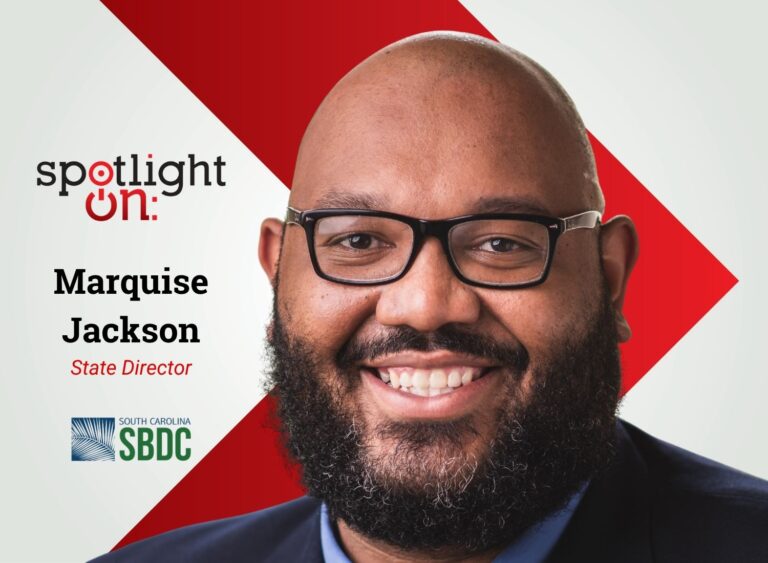

Spotlight On: Marquise Jackson, State Director, South Carolina Small Business Centers
Key points:
- • Tight capital markets are increasing financing challenges for small businesses.
- • Corporate investment is creating new opportunities for local suppliers.
- • Innovation and alternative financing are key to South Carolina’s growth.
 September 2026 — In an interview with Invest:, Marquise Jackson, state director of the South Carolina Small Business Development Centers, discussed the network’s statewide strategy, financing gaps, supplier opportunities, and the innovation economy. Jackson said, “Our job is to help people navigate around those external factors.”
Join us at caa’s upcoming leadership summits! These premier events bring together hundreds of public and private sector leaders to discuss the challenges and opportunities for businesses and investors. Find the next summit in a city near you!
What has changed for the SBDC over the past year?
Most of the changes have been internal. I became state director after the previous director had served for 16 years, and I brought a different viewpoint. My focus has been bringing us together as a statewide network. We have about 55 people across 20 locations serving all 46 counties, so creating a cohesive network of expertise is important.
Externally, we are affected by whatever affects small businesses because they are the people we serve. Capital markets are tight, making it harder for lenders to take risks and for us to help businesses obtain financing. Changes in government regulation, including tariffs, have increased the cost of materials that businesses need to produce their products. That can make businesses less resilient and create uncertainty about whether they can continue. The politics do not change our responsibility. There will always be outside pressures. Our job is to help people navigate around those external factors. We help them build the resilience to respond.
We also see fear among owners when conditions change. They ask whether they will succeed or be able to keep going. Our response is to help them prepare rather than promise that external conditions will disappear. Resilience means understanding the business, knowing the available options, and being able to adjust when costs, regulations, or capital conditions shift.
How has South Carolina’s growth changed the support businesses need?
The South Carolina I returned to is different from the one I left. The state is growing rapidly, and that has had a positive impact on our work. Larger businesses are arriving, and existing businesses need more support to keep pace with industry growth.
Automotive is a clear example. We want to help suppliers that serve major automotive companies operate better and meet the demands of those corporations. As more automotive investment arrives, more suppliers come to us for assistance. The pace of innovation is also increasing, creating opportunities for scalable companies that can grow faster. We have to respond with the right programs, services, and people to support small businesses in that innovation ecosystem.
Where are the most important financing gaps?
For a lending institution, the basic cost of processing a $100,000 deal can be similar to the cost of processing a $5 million deal. Both require due diligence, even if a larger loan receives additional rigor. That can make larger, less risky deals for established businesses more attractive to lenders.
Younger businesses may have revenue and acceptable credit but still struggle to convince underwriters that they can repay a loan and remain a going concern. A business operating for three years can look riskier than one operating for nine years, leaving otherwise qualified owners outside the traditional capital market.
Financial literacy is another issue. Business owners have to meet payroll and continue operating, and that pressure can lead them to accept unfavorable financing. Some use merchant cash advances with high costs and daily withdrawals from their accounts. Once a business carries that kind of obligation, a traditional lender may be unwilling to work with it, making the situation difficult to escape.
The gap is not always a lack of revenue or an unacceptable credit score. It is often the lender’s concern about the age of the company, its ability to demonstrate repayment, or the debt it already carries. That distinction matters because it shows why education and preparation have to accompany any introduction to capital.
How could South Carolina improve access to capital?
The state could use more alternative lenders. Banks sometimes have to decline a business because it does not fit within their requirements. Other sources may be able to take more risk on a company with credit challenges or provide more flexibility when a business already carries debt.
Community Development Financial Institutions are doing some of that work in South Carolina, but we need more of them across the state. A stronger network of alternative capital providers would give businesses more options when they do not fit traditional lending criteria.
The SBDC also helps owners prepare before they approach a lender. We do not simply select a bank and make an introduction. We examine the opportunity as a lender would, including financial projections, the business plan, available income, existing debt, and the owner’s personal financial position. The goal is to educate owners about where they stand, identify the lenders that may fit, and determine the best path forward. They can enter the process prepared to earn a yes, or understand why the answer may be no before applying.
How can local suppliers benefit from major corporate investment?
The Department of Commerce deserves credit for promoting South Carolina as a place to do business. As part of that attraction strategy, large corporations should understand that the state has a network of small businesses ready to work with them. Tax incentives are one consideration, but the availability of local suppliers is another.
Corporations can strengthen their supply chains by doing business locally. Their relocating employees also need restaurants, childcare, entertainment, and other services, many of which are provided by small businesses. Those local companies help fill out the community around a major employer.
The best approach is to make corporations aware of the network that already exists and connect them with partners who understand each market. The SBDC and Commerce already work closely, so this is happening, but there is room to do more. Including local supplier capacity consistently in business-attraction conversations can broaden the benefits of corporate investment.
What are your priorities for strengthening the SBDC network?
Our first priority is building capacity and becoming more efficient. We need to keep professional development in front of our people so they can sharpen their skills. We also need tools that make us more efficient and impactful and help us remain responsible stewards of the funding we receive.
We also need to tell our story more effectively. We touch about 5,000 businesses each year, including multimillion-dollar companies that create jobs and contribute to the economy. We do not always do a strong enough job of explaining that impact. We want to put a spotlight on what is happening through small businesses across South Carolina.
The third priority is remaining responsive. Small-business needs change, so we continually look for partnerships that can lead to new initiatives and funding opportunities. Working with other organizations helps us reach more businesses and deliver a greater impact than we could achieve alone.
What should the state prioritize in the years ahead?
This is a strong moment for South Carolina. I would like to see more investment in the innovation ecosystem and the innovation economy. Organizations such as the South Carolina Research Authority are already doing substantial work, and continued investment can help the state support more scalable and fast-growing businesses.
South Carolina also has many companies that are growing and performing well. Retaining those businesses is essential. They need to continue seeing the state as a strong place to operate and expand. Supporting innovation, developing local suppliers, and ensuring that established South Carolina businesses can keep growing should remain statewide priorities.
Want more? Read the Invest: South Carolina report.