Key points:
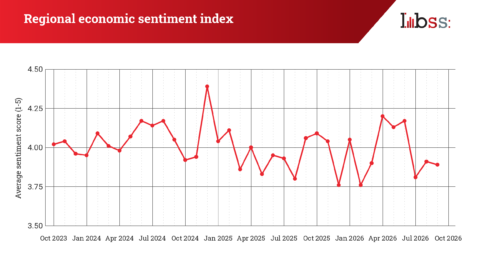
- • The Regional Economic Sentiment Index fell to 3.90 in 3Q26, giving back the 2Q26 rebound and landing near year-ago levels.
- • Quarter over quarter, executives reported little change in company health, hiring plans, and market conditions, although company health and hiring intentions remained below year-ago levels.
- • Local-government support rose for a second straight quarter, to 64%, the highest reading in the past five quarters.
 October 2026 — Business leaders across major U.S. metro areas reported a cooler outlook for their regional economies in the third quarter, according to the latest Invest: Business Sentiment Survey (I:BSS). The Regional Economic Sentiment Index fell to 3.90 out of 5, down 0.23 from the 2Q26 reading of 4.13 and 0.05 below 3Q25. Executives reported little change in their own organizations, hiring plans, and industries.
Join us at caa’s upcoming leadership summits! These premier events bring together hundreds of public and private sector leaders to discuss the challenges and opportunities for businesses and investors. Find the next summit in a city near you!
Regional economy: 2Q26 rebound fades
Across surveyed markets, 72% of respondents rated their regional economy as strong (a 4 or 5 on the five-point scale), down 13 percentage points from 85% in 2Q26 and unchanged from 3Q25. Monthly averages were 3.81 in July, 3.91 in August, and 3.89 in September, below the 4.13–4.20 range of the second quarter and toward the lower end of readings since the survey launched in October 2023.
Executives described a mix of caution and continued investment. “I would describe the tone across Houston as cautious optimism,” a Houston banking executive told caa. “… Despite continued uncertainty around interest rates, tariffs, and geopolitical events, businesses have adapted and are moving forward.”
The third-quarter move reverses last quarter’s pattern, when regional executives were upbeat as large-firm CEOs pulled back. The Conference Board Measure of CEO Confidence rose to 52 in 3Q26 from 47 in the second quarter, though it remained below the 59 recorded in the first quarter. Small-business sentiment moved in the other direction. The NFIB Small Business Optimism Index slipped to 98.7 in August from 99.8 in July, as expectations for better business conditions weakened even as owners remained largely positive about the health of their own companies.
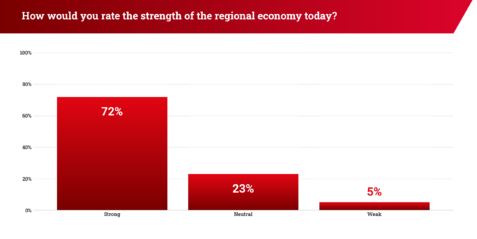
Among surveyed markets, 77% of respondents in the South rated their regional economy as strong, compared with 65% in the North. The gap narrowed to 12 percentage points from 18 points a year earlier. “Charleston has a diverse economy, but perhaps more importantly, it has a resilient one,” a South Carolina bank leader told caa. In the North, a Pittsburgh professional services executive pointed to momentum: “There continues to be significant interest in artificial intelligence, data centers, and energy-related investments across the region.”
Company performance holds
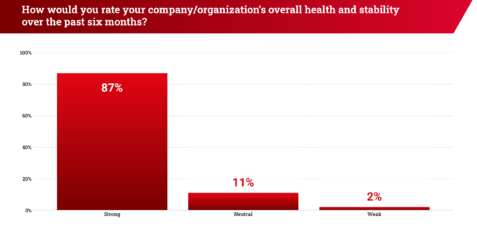
Confidence in organizational health remained high, with 87% of respondents rating their company’s health and stability as strong, down 1 percentage point from 88% in 2Q26 and 6 percentage points from 93% in 3Q25. The Business Roundtable’s CEO Economic Outlook Index rose three points to 94 in 3Q26, its strongest reading in more than four years, driven primarily by improved hiring plans as sales expectations and capital investment plans remained at multiyear highs.
“There are many strong balance sheets across the market, and consolidation continues to increase,” a Raleigh banking executive said. “Investors and companies still have significant capital available to fund investments and acquisitions.”
Hiring recovery levels off
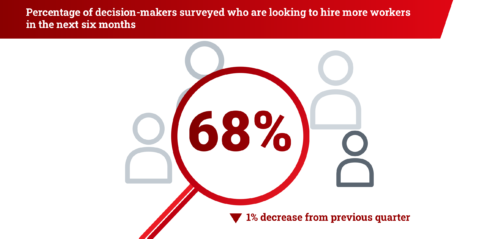
Some 68% of respondents plan to expand their teams over the next six months, down 1 percentage point from 69% in 2Q26 and 8 percentage points below the 76% recorded in 3Q25. The national labor picture was mixed. Employers added 29,000 jobs in September, below the 45,000 monthly average of the prior 12 months, and the unemployment rate was 4.2%, according to the Bureau of Labor Statistics. August payroll growth was revised down to 133,000 from 162,000. By contrast, the Business Roundtable’s hiring subindex rose seven points to 58.
For some leaders, the concern is what technology means for the next generation of workers. “One trend we are seeing with generative AI is that people will become more productive, which may mean that companies require fewer entry-level hires,” a Jacksonville business school dean said. “… If there are fewer entry-level hires, where will the next generation of managers come from?”
Market conditions stay steady
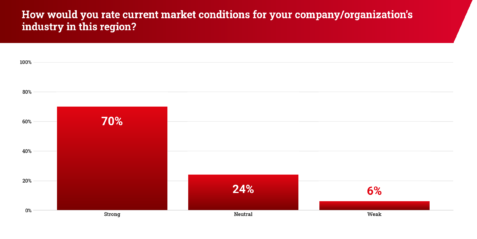
Across surveyed markets, 70% of respondents rated market conditions as strong, 24% as neutral, and 6% as weak. Strong ratings were essentially flat from 71% in 2Q26 and up 2 percentage points from 68% in 3Q25, while the share of weak ratings ticked up from 4%.
Executives described a market that rewards quality. “The broader real estate story is increasingly one of selectivity,” an Atlanta commercial real estate executive said. “Since 2020, we have seen a widening gap between high-quality assets and less differentiated properties.”
That selectivity extends to capital spending. “Houston businesses remain growth-oriented, but they are taking a disciplined approach,” a Houston-based executive in the finance sector told caa. “They are being selective about how they invest capital and demanding stronger returns and clearer economic justification.” The Duke University–Federal Reserve CFO Survey found fewer firms planning investments in equipment and structures than in the first quarter. Among firms not planning investments, more than a quarter cited preserving cash.
Local government gains continue
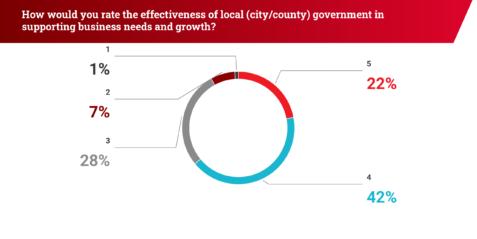
Local-government support was the survey’s bright spot for a second consecutive quarter. Across surveyed markets, 64% of business leaders rated their local governments as supportive (a 4 or 5 on the five-point scale), up 3 percentage points from 2Q26 and 11 percentage points from 53% in 3Q25.
For one city official in Texas, visible infrastructure investment was tied to business confidence. “As a business owner or developer, you can feel more confident making an investment because you can see that the infrastructure in front of your property is going to change,” the official told caa.
What to watch in 4Q26
Regional sentiment moved from 4.13 back to 3.90 in a single quarter, while company health, hiring, and market conditions barely changed. The Federal Reserve’s latest Beige Book described national economic activity as growing modestly, with 10 of 12 Federal Reserve Districts reporting slight to moderate growth. Employment increased very slightly overall, while contacts reported heightened uncertainty around energy prices, policy, and international conflict.
For business leaders, the fourth quarter will test whether that divergence persists. Interest rates and capital costs remain important to investment and real estate decisions. Executives are also watching how AI changes workforce requirements even as employers continue to report demand for skilled workers. Local-government support, meanwhile, has risen for two consecutive quarters. The next I:BSS will show whether broader economic confidence begins to catch up with executives’ comparatively stronger assessments of their own companies and industries.
For more I:BSS reports, click here.
Share your business and economic outlook for Q4 here.