Ray Staats, President, Craven Community College
 Ray Staats, president of Craven Community College, spoke with Invest: about the college’s expanding workforce role, employer partnerships, and approach to artificial intelligence. “We’ve moved from an information age to an age of discernment,” Staats said.
How are changing workforce needs shaping Craven Community College’s priorities?
Change is continuous for us. We are engaged in major construction projects across three campuses, plus a fourth campus that will open soon. We are seeing a shift among our industrial partners from simply accepting whatever programs happen to be available toward having an active role in designing what we offer. We are customizing courses and materials around their needs.
Craven County is diverse. In the northwest part of the county, we have a major industrial park with companies such as Bosch, Moen, and Chatsworth. In the southeast, we have Marine Corps Air Station Cherry Point and Fleet Readiness Center East, which is ramping up depot operations in support of the new F-35.
The latter has unique workforce needs. Our mixed-trades skilled artisan training combines curriculum programs with short-term workforce development courses into a customized mix that changes as employees’ skill needs change.
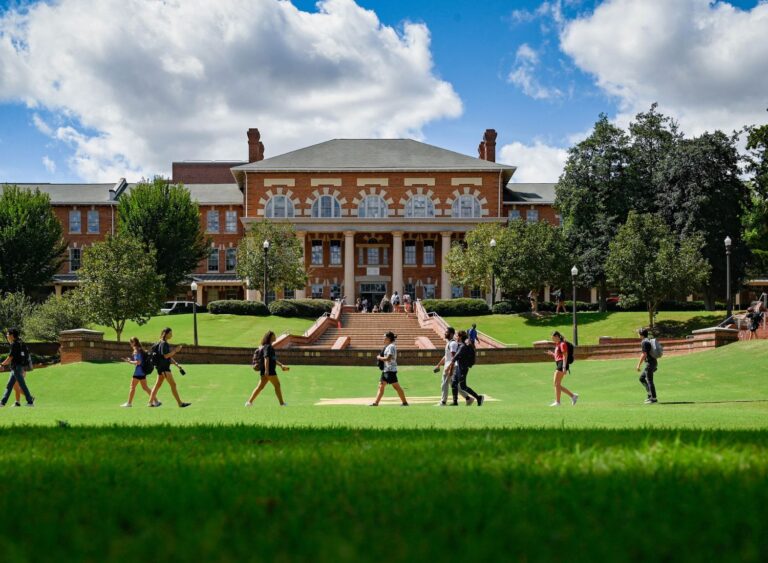
We also partner with NC State on a resident, ABET-accredited four-year engineering degree. Students can work through that degree without leaving Craven County, and then there are jobs waiting for them on the base.
Our role as a community college is constantly evolving.
How has the college evolved to serve a broader range of students?
When I joined Craven Community College in 2015, it probably would have been considered a typical junior college that was focused on degree programs. Today, I describe us as a comprehensive community college.
We serve people through reentry programs for those who have been incarcerated, workforce development, career and college readiness programs, arts and sciences, health sciences, career programs, and programs extending all the way through an engineering degree.
We see high school valedictorians and students who did not complete high school. We serve veterans, second-career students, and students with disabilities. You name it, and they are probably coming through the college today.
How are campus investments helping the college respond to workforce demand?
On our main campus, we are completing a roughly $7 million Corporate Training Center. Previously, our largest flexible room held about 90 people. The new facility can host about 450 people in theater-style seating or approximately 250 at roundtables.
At our Havelock campus, we completed the STEM Building in 2020 to increase capacity for the NC State engineering program. We are now building the Fleet Workforce Education Center to expand workforce and entry-level training for Fleet Readiness Center East.
In downtown New Bern, the Volt Center is a seven-building operation dedicated exclusively to workforce development. About 1,000 students move through that campus annually in short-term, job-focused programs. We are working to add another building for health sciences workforce programs because our main campus has no more room to expand those programs.
Our fourth campus will be the Public Safety Training Center, a 30-acre site in the industrial park dedicated to training fire, police, emergency services, and other first responders. All of these
projects are in direct response to needs that the community and we have identified.
How does being locally focused allow the college to respond quickly?
North Carolina has 58 community colleges with specific service areas. Ours is Craven County. Within this well-defined and compact area, I have the ability to engage with employers on an ongoing basis. Sometimes, I’m speaking with them several times in a single week.
We spoke with hospital leaders about the challenge of admitting patients when there is a long-term shortage of staff needed to prepare rooms. Within two months of the initial conversation, we’d designed an environmental services program. We not only train these employees now, but are also helping with the onboarding process to get them started faster.
Every project we pursue starts with identifying some type of need, and then we get creative.
For me, the biggest challenge has consistently been having enough floor space for emerging programs. Other colleges may struggle with having enough instructors, equipment, or scholarships. We have done well in those areas, but limited space remains our most pressing issue.
How do relationships with employers translate into opportunities for students?
One of the most important things we do is to maintain a continuous presence throughout the community. We want to be everywhere. In my case, I serve with nine nonprofits and organizations around the county, including both chambers and multiple economic development groups. The idea is that wherever local leaders are meeting and having discussions, the college has a seat at the table and is an active participant. My vice presidents do the same within their specialties. We start with presence and then build trust.
The reason the hospital looked to us to assist with its environmental services challenge was the long-term successful relationship we’ve had as a responsive partner. For example, we are, by far, their largest supplier of new nurses. The Public Safety Training Center is another example. A local firefighters association had tried for about 20 years to create a comprehensive training facility. Once the college joined the effort, we were able to bring together police, fire, and emergency services and combine our efforts and resources.
Over two or three years, with support from local government and the state legislature, we’re building a new campus and resolving a 20-year community need. It is all about being present, listening well, and then acting.
How does Craven County’s economic diversity influence the college?
Craven County is semirural, with about 100,000 residents, but it is extremely diversified for its size. In the west, we have a major industrial park with Fortune 500 companies. In the east, we are anchored by a large military base. In the center, New Bern has tourism tied to its history and location along the Neuse and Trent rivers.
Tourism, heavy industry, and the military operate on different economic cycles. One may be up while another is down or holding steady, so our economic fluctuations tend to be muted and seem to be a couple of years behind statewide trends.
That helps the college because we can project what may happen over the next year or two by scanning conditions around the state.
How is artificial intelligence changing teaching and operations at Craven Community College?
Last January, we started an initiative called GAIM, or Generative Artificial Intelligence Momentum. Our purpose is to reimagine how we conduct our teaching and learning mission in light of the rapid advances in AI technology.
It’s no longer if students will use AI — these tools are already in widespread use to get the “right” answers to a wide variety of questions. Complex information is available right at their fingertips. Given this, how does an instructor verify that the student understands the answer they’ve obtained via AI? Another way to look at this — how does a student, or instructor, discern the information AI tools provide?
Our faculty are redesigning curriculum to focus on imparting the necessary core knowledge and utilizing new tools, some of them being AI, to evaluate whether students are successful in obtaining the desired learning outcomes.
We are also learning how AI can help us operate better as an institution. For example, AI tools can be used to identify patterns such as when a student begins submitting assignments late or stops attending class and use this information to intervene earlier than would have otherwise been possible. AI tools are also being used for earlier detection of financial irregularities, reducing the risks of mistakes or fraud.
What risks and opportunities do you see as AI becomes more widely used?
Those who do not possess sufficient core knowledge are vulnerable to AI being used for deception and misinformation. Conversely, AI tools can greatly enhance speed and accuracy and eliminate time-consuming routine tasks.
Since AI aggregates massive amounts of data, its outputs “tend to the mean” rather than provide truly unique outputs that, for now at least, remain the province of human creativity.
AI is causing, and will continue to cause, a transformation in the workplace. Some jobs will be devalued or eliminated while others will become increasingly indispensable.
It is important to distinguish between using AI to enhance someone’s work and using it to replace that work. We are working through questions about attribution in our college policies. How do you inform a reader or listener that something is entirely your work versus AI-generated? Is there a difference between AI drafting something that you polished versus you drafting something that AI polished? Some tough questions!
Why is the local community college model important?
One of the things I am most proud of is that we operate locally. That’s the essence of a community college and why we’re distinct from other higher education institutions.
Programmatically, I’d point to the Volt Center. It’s what our community needed. Other communities may need something different. For example, we do not offer an agriculture degree program while neighboring colleges have large, successful agriculture programs.
We are also part of a military community, which gives us a different focus from most colleges in the state. Our course offerings reflect the needs of this population.