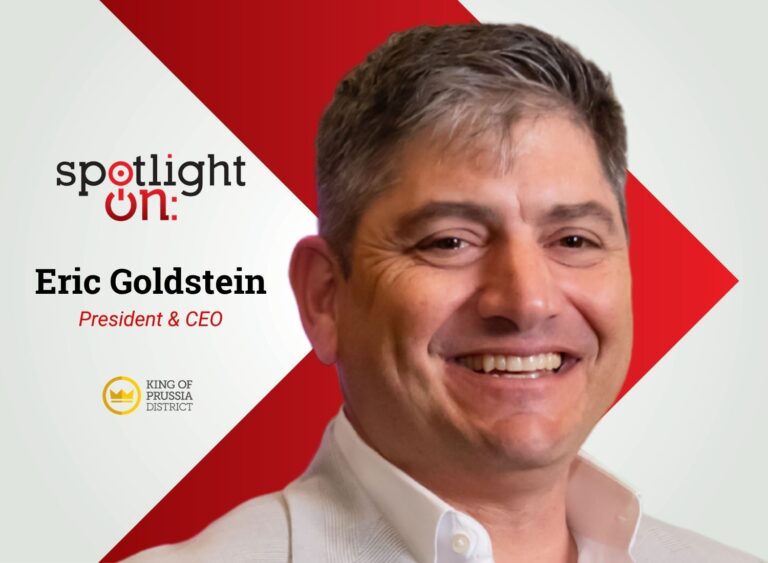
Spotlight On: Eric Goldstein, President & CEO, King of Prussia District
Key points:
- • Experiential retail and entertainment developments are driving visitor growth.
- • Access and amenities are increasingly influencing corporate location decisions.
- • Strong office occupancy and residential demand support King of Prussia’s growth.
 October 2026 — In an interview with Invest:, Eric Goldstein, president & CEO of King of Prussia District, discussed the area’s appeal to companies, residents, and visitors, along with experiential development and the changing office market. “Companies are looking for locations with excellent access and amenities for their employees,” Goldstein said.
Join us at caa’s upcoming leadership summits! These premier events bring together hundreds of public and private sector leaders to discuss the challenges and opportunities for businesses and investors. Find the next summit in a city near you!
How has the past year been for King of Prussia District, and what does it show about the regional economy?
The past year in this community has been excellent. We are seeing substantial growth due to the desirability of King of Prussia among companies, residents, and visitors. According to our most recent Community Survey, access and amenities are the key drivers of visitation, new resident demand, and new business demand.
Which developments or investments have been most significant over the past year?
The most significant investments have been destination retail and experiential development projects. At King of Prussia Mall, a former Lord & Taylor department store was converted into the first Netflix House in the country. It is an immersive, themed experience dedicated to Netflix content, where visitors can become part of the shows and movies they love.
We also saw a former Saks OFF 5TH converted into a Dave & Buster’s, an arcade-style entertainment venue for children, families, and young adults. A former JCPenney is being converted into DICK’S House of Sport and Level99, both immersive retail and entertainment venues. Together, these types of uses have occupied hundreds of thousands of square feet in King of Prussia, alongside newer destinations such as Topgolf.
Eataly also opened at King of Prussia Mall in space formerly occupied by two retailers. It is another experiential, food- and market-oriented destination designed to attract visitors. These uses attract a broad mix of people, and they are driving significant year-over-year visitor growth in King of Prussia.
What are companies looking for when choosing where to locate or expand?
We find that companies are looking for locations with excellent access and amenities for their employees. Before the pandemic, companies often located close to where the CEO lived. Real estate considerations such as rent and taxes also mattered.
Since 2020, many more HR and talent leaders participate in site-selection meetings because the employee experience has become much more important. Today, companies want a location that gives employees a reason to come to the office, including things to do before, during, and after work. Employees want doctors, retailers, restaurants, and entertainment nearby.
The employee experience now weighs much more heavily in a location decision. That creates a different competitive landscape across the Philadelphia region because a company is evaluating not only the office itself but also what surrounds it and what employees can access throughout the day.
That change is appearing in the numbers. Our Class A commercial vacancy rate is about 11%, which is excellent compared to our suburban and city neighbors. King of Prussia is a great post-pandemic location, driven primarily by access and amenities.
How must commercial districts such as King of Prussia evolve as office needs and consumer behavior change?
We have also evolved our programs to provide better access and amenities. On the access side, our organization has spent years raising money to expand multimodal trails for pedestrians and cyclists. The goal is to make connections between retail, commercial, and residential communities easier and safer to navigate.
King of Prussia has not historically been a walkable community. It is very auto-centric, but we are changing that quickly. We and our partners, including the Township and County, have invested considerable time and money in expanding sidewalks and multiuse trails.
Those connections matter because they link retail areas with commercial and residential communities. Improving them is part of how our organization is responding to the market’s evolution.
The other part of our evolution is expansion of our events. We create experiences for employees, residents, and visitors, including networking events, tournaments, and other activities during the workday. These events give people more reasons to come to King of Prussia, spend time in the office, connect with the community, and feel that they are doing more than entering an office building from 9 to 5.
What economic opportunities in King of Prussia could affect the wider Philadelphia region?
One opportunity is the continued expansion of destination and experiential retail. We are also seeing continued multifamily residential development. King of Prussia’s population grew from 28,000 to about 37,000 in the last 10 to 12 years, and housing demand remains strong. The same access and amenities that appeal to companies and visitors also appeal to residents. More multifamily projects are in the pipeline.
Residential projects continue to move through the pipeline because people want to live in a place with this level of access and amenities. Their presence, in turn, supports the retail and dining offerings already here.
We like having people live here because they support local businesses and help sustain dining and retail. We are also seeing solid performance in life sciences. By square footage, the King of Prussia/Valley Forge area is the largest life sciences submarket in the Philadelphia region. What happens here in that sector has a significant regional impact on employment and investment.
What are the greatest challenges that could constrain growth?
Our challenges are probably similar to those facing communities nationally. Higher interest rates have a significant effect on economic development. There has also been a national downturn in demand for life sciences property. I hope we do not see that here, but we are competing in a national market that has not performed well recently.
General public sentiment is another potential challenge. When a community expands as rapidly as King of Prussia has over the past 10 to 15 years, there is a risk of backlash as residents deal with real issues such as congestion. We must navigate those concerns while continuing to attract investment and development.
What are you watching most closely over the next two or three years?
I watch office occupancy and what companies are doing with regard to their current leases. We are now in the period when many companies that signed seven-year leases before the pandemic are reaching the end of those leases, so this is the window when many companies have to make decisions.
In urban environments, companies appear to be renewing leases for much smaller footprints. Fortunately, we are not seeing that as much in King of Prussia. Leases here are being renewed for generally the same size. Of the few downsizings, we have seen immediate backfills by other companies. Our occupancy rate has remained consistent and strong of late, but I still follow this issue closely.
Want more? Read the Invest: Philadelphia report.