
Face Off: Global business connections drive Philadelphia growth

Key points:
- • Philadelphia leaders are pairing trade support, investment attraction and international relationships to help companies enter new markets.
- • Global events and cultural programming matter most when regional partners turn introductions into customers, partnerships and investment opportunities.
- • Exporters need targeted market selection and practical help with finance, logistics, compliance and buyer connections.
 October 2026 — Foreign direct investment and global business connections are playing an increasingly central role in driving U.S. regional economic growth. Across the Philadelphia region, business development organizations and international trade associations are sharpening their strategies to help domestic companies expand abroad while attracting foreign enterprise and capital to the region.
Join us at caa’s upcoming leadership summits! These premier events bring together hundreds of public and private sector leaders to discuss the challenges and opportunities for businesses and investors. Find the next summit in a city near you!
Cross-border investment into the United States rose in 2025 amid ongoing shifts in global trade policy. According to the U.S. Bureau of Economic Analysis, the foreign direct investment position in the U.S. increased by $266 billion, bringing the total to $5.86 trillion at historical cost. Manufacturing accounted for 42.8% of the position, with finance and insurance and wholesale trade also representing large shares of foreign investment.
READ MORE: Why access to capital matters more than ever
At the same time, regional business hubs are using international events, cultural programming and specialized trade networks to build commercial relationships and connect companies with international markets. Through August 2026, U.S. exports of goods and services increased by $267.7 billion, or 11.8%, from the same period in 2025, according to the U.S. Census Bureau and BEA.
In Philadelphia, those connections move through the region’s port and airport. PhilaPort handled a record 889,268 20-foot equivalent units in 2025, a 6% increase from the prior year, with refrigerated cargo accounting for 64% of its containerized imports.
Philadelphia International Airport served 4.1 million international passengers in 2025, offered 39 nonstop international destinations as of December and handled more than 482,000 tons of freight and airmail, up 7.4% from 2024. Alongside those logistics assets, the Department of Commerce connects businesses with export-support programs, partner organizations and international business-development opportunities.
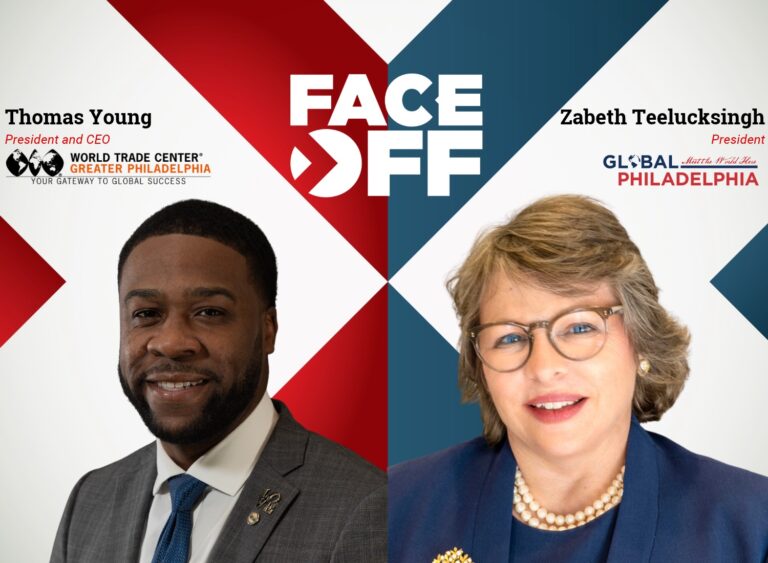
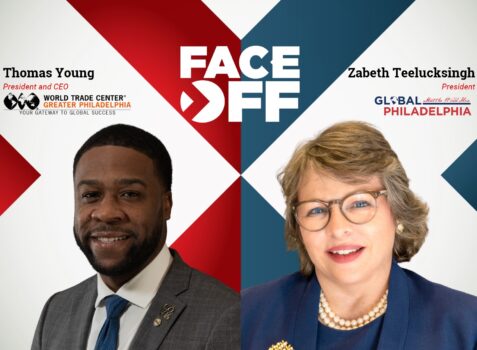
Invest: Philadelphia spoke with Thomas Young, President and CEO of the World Trade Center Greater Philadelphia, and Zabeth Teelucksingh, President of the Global Philadelphia Association, about how international organizations are building global business connections and positioning U.S. regions to capture cross-border investment.
What did the past year demonstrate about the appetite for international companies to invest in and connect with U.S. regional markets?
 Thomas Young: The past 12 months were extraordinary for the World Trade Center of Greater Philadelphia and the region. One of our biggest highlights was hosting the World Trade Centers Association Global Business Forum. It brought together more than 500 participants from over 50 countries and territories and placed the Greater Philadelphia business community in front of an international audience.
Participants held more than 500 business-to-business matchmaking meetings, and our focus was turning those relationships into customers, partnerships, and investment opportunities for the region. The forum reinforced why our work matters. Businesses need trusted relationships and practical guidance when making international decisions.
 Zabeth Teelucksingh: It has been a very busy year, largely because of Philadelphia’s 2026 positioning. We expanded our usual World Heritage Week into World Heritage Month in May, with more than 200 events and 80 civic partners. It served as a lead-up to the World Cup and other summer activities, and many people told us it positioned the city well for what followed. It was an early, coordinated effort to focus attention on Philadelphia’s international identity before the summer’s largest events.
Understanding the region’s different population groups became more important. Those communities and their connections are assets that people may previously have missed.
How do global events, cultural designations, and international brand positioning translate into tangible commercial and real estate opportunities?
Young: If international participants did not know Philadelphia before, they now know what the region has to offer. One of my priorities was also ensuring that local businesses looking outward understood that international growth is accessible. We focused on helping more companies export, using a network of more than 300 World Trade Centers in over 90 countries to support business attraction, and strengthening coordination among regional partners.
Success is measured by what companies achieve: new sales, stronger partnerships, and opportunities to expand at home.
Teelucksingh: There is broad momentum in the city, and real estate is particularly active. Large developers are building rental apartments, while the housing market remains robust for individuals. The range of housing creates opportunity at different levels.
We’re also seeing communities relocate from the New York metropolitan area… People recognize that they can build a comfortable life here without giving up those cultural ties.
I’ve also met representatives from Colombia who recognize that Philadelphians are traveling to Medellín and building business interests there. Colombian government representatives are paying attention to the city in response. Those are two vibrant examples of international communities generating connections in both directions.
What specific tools and strategies are most effective for helping businesses navigate international expansion and trade uncertainty?
Young: Many companies are asking for diversification. Operating in multiple markets can create new revenue opportunities and reduce dependence on a single source of demand, but they must be the right markets. We start by examining where demand exists for a particular product or service, whether the economics work, and whether a market can benefit the specific company.
Diversification is not simply entering more places; it is identifying the locations that fit the business.
For fiscal year 2026, companies working with us reported $137.4 million in increased export sales, compared with $121 million for fiscal year 2025. That growth shows the value of helping companies expand internationally.
Teelucksingh: Major milestones created terrific collaboration among Philadelphia organizations. Collaboration generates momentum, new ideas, and opportunities for future positioning. Civic leaders saw the value of the city’s international profile, and there is considerable thought going into how to establish it as a lasting asset. The relationships built while preparing for major events can continue producing ideas after the events themselves are over.
The effort has two sides. Major civic leaders and institutions can and should drive the conversation, while individuals, communities, and other organizations also advance it organically.
What is the biggest barrier preventing mid-sized businesses from pursuing global business connections, and how can regional partners address it?
Young: For a small business, the biggest barrier is often knowing where to begin. An owner may have a competitive product but limited time or staff to research another country, identify a distributor, or understand market requirements. We make the process more manageable through individual trade consultations, market research, international business education, and connections to buyers and partners.
We also connect companies with specialized resources for international finance, logistics, and compliance. We are a regional partner of the Export-Import Bank of the United States. My goal is for more companies, including those that have never considered exporting, to see international growth as something they can prepare for and pursue.
Teelucksingh: The city’s reputation has evolved. It’s increasingly seen as welcoming and attractive, but connectivity remains a gap. Philadelphia International Airport has strong service to Europe and many excellent destinations there.
There is momentum to add service farther afield, particularly to Asia and Africa. Those connections would better serve the region’s Asian and African communities. Adding them is part of the work still needed to make Philadelphia a confirmed international hub.
Looking ahead, we want to extend our work through a stronger statewide position rather than limiting the message to Philadelphia alone.
Want more? Read the Invest: Philadelphia report.