


Boston small business news: Downtown’s new owners
Key points:
- • Downtown Boston’s office vacancy rate sits just above 25%, pushing owners toward discounted sales.
- • BreakTime, Bridge Over Troubled Waters and Embrace Boston bought buildings for $4.4M to $9.5M.
- • Downtown asking rents have fallen 19% since the pandemic began.
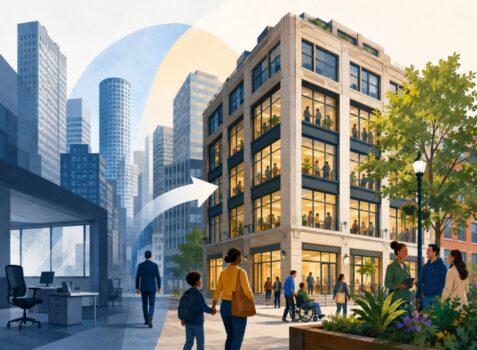 September 2026 — Downtown Boston‘s office towers spent the past several years as a symbol of everything wrong with the post-pandemic commercial real estate market. Now they are becoming something else entirely: an unlikely landing spot for the city’s nonprofit sector. Boston small business news this month centers on a wave of nonprofit organizations buying up downtown office buildings at prices that would have been unthinkable before 2020, Axios Boston reported, as vacancy in the downtown core sits just above 25% and landlords increasingly need any buyer willing to close a deal.
Join us at caa’s upcoming leadership summits! These premier events bring together hundreds of public and private sector leaders to discuss the challenges and opportunities for businesses and investors. Find the next summit in a city near you!
The transactions read like a tour of the sector’s growth. BreakTime, a nonprofit serving young parents experiencing homelessness, bought a six-floor building from Eastern Bank in late 2024 for $6.3 million. Bridge Over Troubled Waters, which serves runaway and homeless youth, purchased 25 West St. in October for $4.4 million.
And Embrace Boston, the racial-equity organization behind the Embrace memorial on Boston Common, bought 33-41 West St. this summer for $9.5 million. Add in the Boston Society for Architecture and Lawyers for Civil Rights, both now renting space in the same downtown corridor around Downtown Crossing and Winter Street, and a clear pattern emerges: organizations that could never have competed for downtown real estate against banks and law firms are now the ones signing the deeds.
Iván Espinoza-Madrigal, executive director of Lawyers for Civil Rights, put the shift plainly: “I strongly believe that this intervention is possible because of more affordability and availability of space in the downtown core that would have been difficult to achieve before the pandemic.” That affordability is stark by the numbers — downtown asking rents have fallen 19% since the pandemic began, a decline steep enough to turn what was once premium office space into something nonprofits with modest real estate budgets can actually afford to own outright rather than rent indefinitely.
A boon for nonprofits
The shift says as much about the state of Boston’s office market as it does about the nonprofits taking advantage of it. A quarter of downtown office space sitting empty is a vacancy rate that would have seemed impossible before 2020, when Boston’s Financial District and Downtown Crossing submarkets commanded some of the highest rents in the country. The pandemic-driven shift to hybrid work hit older, amenity-poor buildings hardest, since companies renewing leases have gravitated toward newer towers with better transit access and amenities, leaving early- and mid-20th-century office stock to lose tenants faster than the broader market.
That has forced owners of those buildings into a choice: sit on empty floors indefinitely or sell at a discount to buyers who would not have been in the market a decade ago. The bifurcation is notable because it is not uniform across Greater Boston: lab and life-sciences space in Cambridge’s Kendall Square has stayed comparatively resilient even as older downtown office towers struggled, underscoring that this is a story about building quality and location as much as it is about office demand broadly.
Boston’s experience mirrors a dynamic playing out in downtowns across the country, where nonprofits, government agencies and even residential developers have increasingly stepped into gaps left by commercial tenants that shrank their footprints or left the urban core altogether. What sets Boston apart is the speed and visibility of the shift — multiple nonprofit purchases within roughly two years, concentrated in a few blocks, is enough to start reshaping who occupies downtown storefronts and how transit ridership patterns look during business hours. For a city whose downtown was built around finance, law and consulting firms, watching mission-driven organizations become anchor tenants is one of the more unusual real estate stories nationally this year.
Bargain-hunting moment or something else?
What happens next will determine whether this is a temporary bargain-hunting moment or a lasting reshaping of downtown Boston’s tenant base. If commercial vacancy stays elevated, more nonprofits and civic organizations are likely to find similar opportunities, further diversifying who occupies the city’s core beyond the traditional finance-and-law tenant base. But if hybrid-work patterns stabilize and companies begin expanding their office footprints again, landlords who sold at a discount this year may find themselves having given up buildings just before the market turned.
Executives and city planners watching Boston’s commercial real estate market should track whether asking rents stabilize following these transactions, whether more nonprofits pursue ownership over leasing, and whether the added foot traffic from these organizations’ staff and clients helps revive the retail and restaurant businesses that have struggled alongside the office vacancies driving this unusual buying spree.
Want more? Read the Invest: Boston report.






